StudentAid
Unit 12: Nuclear and Particle Physics — Long Questions
11th Class Physics · Unit 12: Nuclear and Particle Physics
Structure of Nucleus
• The atomic nucleus comprises two types of particles: protons and neutrons. A proton is the nucleus of the simplest atom, hydrogen, called a protium. The proton has a positive charge of the same magnitude as that of the electron (1.6 × 10⁻¹⁹ C) and its mass is 1.67 × 10⁻²⁷ kg. The neutron, whose existence was pointed out in 1932 by James Chadwick, is electrically neutral as its name suggested and its mass is nearly the same as that of proton. Now we can say that the nucleus has two types of particles (neutrons and protons) called nucleons.
• A hydrogen nucleus consists of a single proton. However, the nuclei of all other elements consist of both neutrons and protons. The different nuclei are called nuclides.
• The number of protons in a nucleus is called the atomic number represented by the symbol Z. The total number of nucleons, the sum of neutrons and protons, is represented by the symbol A and is called the atomic mass number, or simply mass number. It is written as: N = A - Z ----------- (1) where N represents the neutron number.
• In order to specify the given nuclei, the symbol X is commonly used as Z X, where X is the chemical symbol for the element.
• To indicate the mass of atomic particles, instead of kilogram, unified mass scale (u) is generally used. By definition 1u is exactly one twelfth the mass of carbon 12 atom (1u = 1.6606 x 10⁻²⁷ kg = 931 MeV).
• In this chapter (unit), the mass of a proton is 1.007276 u and that of a neutron is 1.008665 u while that of an electron is 0.00055 u.
• For a particular atom (e.g., carbon), nuclei are found to contain different numbers of neutrons, although they all have the same number of protons. Example: For example, carbon nuclei always have 6 protons, but they may have 6, 7 and 8 neutrons. Nuclei that contain the same number of protons but different numbers of neutrons are called isotopes.
• Isotopes of carbon are C, C, and C, amongst them C and C are stable but C is unstable and decays into nitrogen along with the emission of β and neutrino particles.
Fundamental forces
• To understand the structure of the nucleus, it is important to know the nature of the forces that bind the nucleon together. But before that, we should know the basic forces in nature.
• Despite the apparent complexity within the universe, all interactions in the universe are governed by the four basic forces, known as fundamental forces.
• These forces control how objects move, interact and behave at different scales from tiny atoms to massive galaxies.
• The four fundamental forces are gravity, electromagnetism, weak nuclear force, and strong nuclear force.
(i) Gravitational force:
• Gravitational force or gravity is one of the four fundamental forces of nature. It is the weakest of the four but it is a long-range force. It is an attractive force and arises due to the gravitational interaction between the bodies.
• The gravitational force between two bodies is proportional to the product of their masses and inversely proportional to the square of the distance between them. When considered for massive objects, such as the Sun, or giant planets, gravitational force is considered to be significant as the masses of these objects are large. However, on an atomic level, this force is considered to be negligibly weak.
(ii) Electromagnetic Force:
• The electromagnetic force is responsible for electric field and magnetic field interactions.
• Like the gravitational force, the electromagnetic force follows an inverse square law but is much stronger than gravity.
• It governs a vast range of phenomena, from atomic structure and chemical bonding to electricity, magnetism, and light propagation.
• James Clark Maxwell (1861) formulated a set of four fundamental equations that unified electricity and magnetism into electromagnetism. These equations describe how electric and magnetic fields interact and how electromagnetic waves propagate.
• These equations showed that electric and magnetic fields are not separate forces but are two aspects of a single electromagnetic force.
(iii) Nuclear Forces:
• Out of the four fundamental forces, nuclear forces are the strongest attractive forces. Electromagnetism holds the matter together, but there was no explanation on how the nucleus is held together in the atom.
• If we only consider the forces of electromagnetism and gravity, the nucleus should fly off in different directions.
• The stability of the nucleus implies that another force should exist within the nucleus which is stronger than the gravitational force and electromagnetic force. This is where nuclear forces come into play.
(iv) Strong Nuclear Force:
• Strong nuclear forces are responsible for holding the nuclei of atoms together. They only exist inside the nucleus.
• So, we call them as short-range forces. The strong nuclear force acts as an attractive force between all nucleons, protons and neutrons alike.
• Thus, protons attract each other via the strong nuclear force at the same time they repel each other via the electric force.
• A neutron, being electrically neutral, can attract other neutrons or protons via the strong nuclear force.
(v) Weak nuclear forces:
• Weak nuclear forces are responsible for the radioactive decay, particularly the beta decay and interactions involving neutrino.
• Unlike the other fundamental forces, the weak force can change the identity of particles, making it essential for processes like nuclear fusion in stars and the decay of unstable atomic nuclei. The relative strength and range of the above four forces are given in Table 12.1.
Metter and anti-matter
• It was predicted by Paul Dirac in 1928 that the fundamental particles have their anti-particles.
• The rest masses of the anti-particles are the same as that of their corresponding particles but with opposite charges.
Example: For example, positron is the anti-particle of an electron. It is represented by e+. The rest mass of the positron is the same as that of an electron but it carries positive charge with magnitude the same as that of an electron.
• It is noted that the positron was the first discovered anti-particle by Anderson in 1932 in a cloud chamber experiment.
• This was first experimental discovery of an anti-particle. After that a lot of antiparticles were discovered.
• Usually, the anti-particles are represented by a letter with a bar over it, e.g., antiproton is represented by p anti-neutrino by ν and so on.
• The quarks and leptons have been recognized as the fundamental particles also known as elementary particles among the too many discovered particles. These elementary particles have also anti-particles.
• Do you know? The cosmic rays are high-energy particles coming from the outer-space with unknown sources. Their source may be the Sun or the other stars. These particles consist mostly of protons, neutrons and heavier nuclei, which are continually bombarding the Earth. When these particles interact with the atoms of the gases of the Earth's atmosphere, they produce showers of secondary particles which rain down on us all the time.
• When nuclei of unstable radioactive element say U-235 undergo fission reactions in the nuclear reactors, they emit a variety of particles, such as, neutrons, neutrinos, a-particles, photons, electrons and positrons.
• When the charged particles, such as electrons and protons are accelerated by an accelerator and then bombard on the target material, which is hydrogen, when accelerated charged particles may also collide head-on with each other. As a result, the debris from these reactions contain particles like pions, kaons, muons and even anti-protons.
Pair production
• Pair production occurs when a gamma ray photon (high energy photon) passes nearby an atomic nucleus. As a result, an electron-positron pair is emitted as shown in Fig.
• The presence of a third particle, such as a nucleus, is necessary to conserve linear momentum.
• According to the law of mass-energy equivalence, the minimum energy of a photon for pair production must be equal to the sum of the rest mass energies of the created particles.
• The rest mass energy of the electron-positron pair is 2m c2 = 1.02 MeV which has been verified experimentally.
• A gamma ray photon with energy less than 1.02 MeV cannot produce an electron-positron pair whereas a photon with energy greater than 1.02 MeV creates an electron-positron pair and the excess energy goes into the kinetic energies of the particles.
• The process of pair production satisfies the laws of conservation of charge, momentum and energy.
Annihilation of Matter
• It is the opposite process of pair production. For example, when an electron and a positron interact to each other, they annihilate into two gamma ray photons as shown in Fig. The reaction can be written as: e + e+ → γ + γ
• The energy of each gamma ray photon is 0.51 MeV which is equal to the rest mass energy of an electron or a positron, i.e. E=m c2 In an annihilation reaction, energy and momentum are conserved.
• Besides the electron and positron annihilation, the annihilation reactions of other particles and their anti-particles can also be carried out. Example: e.g., proton and anti-proton, lepton and anti-lepton, quark and anti-quark, etc.
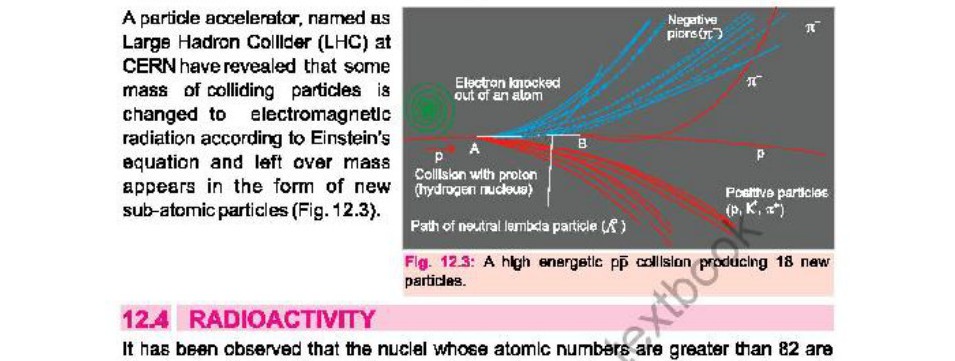
• High energy collisions between the particles at CERN have revealed that some mass of colliding particles is changed to electromagnetic radiation.
• According to Einstein's equation and left over mass appears in the form of new sub-atomic particles.
Radioactivity
• It has been observed that the nuclei whose atomic numbers are greater than 82 are found naturally unstable, and these nuclei spontaneously emit radiations. Such nuclei are called radioactive and the emission of radiation is known as natural radioactivity.
• These radiations are of three types, α-particles, β-particles and γ-radiations. Unstable isotopes can also be produced artificially in the laboratory by nuclear reactions.
• This process occurs when a stable element is bombarded with high-energy particles, such as neutrons, protons, alpha particles, or gamma rays, causing it to become unstable and emit radiation.
• This is called artificial radioactivity and radioactive isotopes are named radioisotopes or radionuclides.
• The α-particles, β-particles and γ-radiations are traversed differently when passed through the electric field as shown in Fig.
α-particles:
• It is seen that α-particles deflect towards the negative terminal of the electric field, showing that they have a positive charge.
• The α-particles are emitted at high speeds, typically a few percent of the speed of light. However, α-particles can travel only several centimetres in the air due to their large mass.
β-particles:
• The β-particles deflect towards the positive terminal of the electric field, showing they have a negative charge. The deflection of β-particles is more than the α-particles, proving that they are lighter particles than α-particles. The β-particles are fast-moving electrons and move with speeds up to 0.9995 of the speed of light. The γ-radiations passed through the electric field without deflection, showing that they have no charge.
γ-particles:
• The γ-radiations are electromagnetic radiations which consist of photons. They move with the speed of light with the highest penetrating power but the lowest ionization power.
Decay process • The process of emitting α-particles, β-particles and γ-radiations from the nucleus is called α-decay, β-decay and γ-decay, respectively, and are discussed below.
Alpha (α) Decay
• If the nucleus has more protons than the number of neutrons, the electrostatic force of repulsion becomes greater than the strong nuclear force of attraction. In this case, the nucleus becomes unstable and emits alpha particles in radioactive decay.
• An α-particle is equivalent to a helium (He) nucleus which consists of two protons and two neutrons. This means the nucleus loses two protons and neutrons in the α-decay.
• Hence, the atomic number Z decreases by two while its mass number A decreases by four. Alpha decay can be written in general as: Z X → Z-2 X + 2 He
Here Z X is the parent nucleus which decays into the daughter nucleus Z-2 X and 2 He is the alpha particle.
• In the α-decay, it is experimentally observed that the number of nucleons (A) and electric charge are conserved. An example of α-decay is given below:
• A radium-226 isotope (226 Ra) emits an alpha particle and decays into a daughter nucleus radon-222 ( 222 Rn). 226 Ra → 222 Rn + 4 He 88 86 2
In the above nuclear reaction, the daughter nucleus ( 222 Rn) is different from the parent nucleus ( 226 Ra). This transition of one element into another is called the transmutation of the elements.
• It is experimentally found that the mas of the parent nucleus is greater than the total mass of the daughter nucleus and the mass of the α-particle. Thus, the total mass-energy (E=m c2) of the decay products is less than the mass-energy of the original nucleus. This difference in mass-energy is called the disintegration energy Q, or the Q-value of the decay.
Beta Decay
There are two types of β-decay, beta-minus (β−decay)decay and beta-plus (β+−decay)decay.
(i) β− Decay
• Some nuclides have neutron-to-proton ratio (N/P) too large and are the source of P'-decay. The P-particles are not the orbital electrons but they are created within the nucleus at the moment of emission.
• In this process, a neutron in the nucleus decays into a proton and an electron, plus another particle called anti-neutrino which is the antiparticle of neutrino.
• The neutrino is denoted by a Greek symbol ν (nu) and anti-neutrino is denoted by a bar over the ν. The decay process is given by the following relation: 0 n → 1 p + 0 e + ν
• One of the neutrons changes to a proton and in order to conserve charge it emits an electron. These electrons are called beta particles. However, they are indistinguishable from orbital electrons.
• Both the neutrino and the anti-neutrino have zero charge and very small mass, which is why they are very difficult to observe when passing through the matter.
• No nucleons are lost when a β-particle is emitted, and the total number of nucleons A remains the same but the mass number Z changes. Beta decay process can be written as: Z X → Z+1 X + 0 e + ν
• From the above equation, it is clear that the parent element of atomic number Z is transmuted to another element of atomic number (Z+1).
Example: An example is the isotope of thorium, which is unstable and decays into protactinium by beta emission. The reaction is represented as: 234 Th → 234 Pa + 0 e + ν 90 91 -1
(ii) β+-Decay
• There are also nuclides that have neutron-to-proton ratio (N/P) too small for stability and decay by emitting a positron instead of an electron.
• The positron (e+) has the same mass as the electron but it has a positive charge.
• The positron is the anti-particle of the electron. In this process, a proton in the nucleus decays into a neutron and a positron, plus a neutrino. The generalized decay is given below: Z X → Z-1 X + 0 e + ν
An example of a decay of Neon into Flourine by emitting positron and neutrino is: 19 Ne → 19 F + 0 e + ν 10 9 +1
(iii) Gamma Radiation
The emission of γ-radiation from a nucleus is generally represented by this equation: Z X* → Z X + γ −radiation
Where Z X* represents an excited nucleus while Z X shows ground state of the nucleus.
Table 12.2: The summary of nature of alpha, beta and gamma radiations
Energy of Alpha and Beta Particles in Radioactive Decay
• In both α-decay and β-decay, for a particular radionuclide, the same amount of energy is released.
• In α-decay of a particular radionuclide, every emitted α-decay has the same sharply defined kinetic energy.
• When the number of α-particles is plotted against kinetic energy, there are distinct spikes that appear on the graph as shown in Fig. This demonstrates that α-particles have discrete energies.
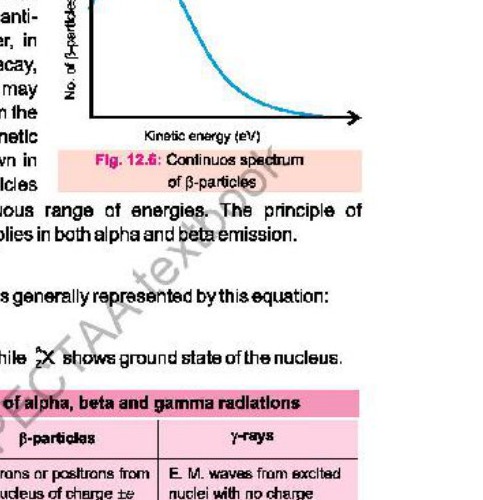
• However, in the case β-particle emission, energy is shared between β-particle and antineutrino in varying proportions.
• The sum of electron (or neutrino's) energy, however, in every case remains the same.
• Thus, in β-decay, the energy of an electron or a positron may range from zero to a maximum value. When the number of β-particles is plotted against kinetic energy, the graph shows a curve as shown in Fig. 12.6.
• This demonstrates that beta particles (electrons or positrons) have a continuous range of energies. The principle of conservation of momentum and energy applies in both alpha and beta emission.
Elementary particles
By the term fundamental particle, we mean a particle that has no internal structure, which means that it is indivisible. Presently, the fundamental constituents of matter are considered to be quarks (protons, neutrons and mesons are made up of quarks) and leptons (including electrons, positrons, and neutrinos). They are considered the basic building blocks of matters.
When a nucleus is smashed in an ultra high energy particle accelerator, or two high energy particles are collided, entirely new types of particles are created which apparently do not exist within the atoms of the ordinary matter.
They are the outcome of the violent collisions needed to probe the basic structure of matter. More than a hundred new particles have been identified to be classified into families with similar properties.
Many of these were accounted well with the scheme of theoretical physicist while the rest were named "strange particle".
They are always created in pairs, e.g., when a pion (π) collides with a proton, two strange particles k° and Λ° are created. The nuclear reaction is: π + p → k° + Λ°
All particles spin on their axes and the spin of charged particles makes them tiny magnets. The characteristic spin of electron, protons, neutrons is 1/2 and the spin of photon is 1 and of pions is taken as zero. Half spin particles obey the Pauli's exclusion principle which says that only one particle of a kind occupies a given quantum state. These particles are called "fermions".
The particles with zero or whole number spin do not obey this principle. They are called "bosons" as they obey Bose-Einstein statistics. Further major classifications are:
1. The nucleons and the heavier particles such as Λ° and k° which decay to nucleons are called "baryons" (heavy).
2. The particles that do not interact strongly with nucleons, and are called leptons (small) along with the electrons, tau and neutrino.
Both of the β-decay (beta-minus and beta-plus) processes provide evidence that the protons and neutrons are not the fundamental particles.
By the 1960s many new types of particles similar to the neutron and proton were discovered, as well as many "midsized" particles called mesons whose masses were mostly less than nucleon masses but more than the electron mass (other mesons, found later, have masses greater than nucleons).
The strongly attractive particles are called π meson or pions while the weakly interacting particles were named μ mesons or muons.
This discovery led to the conclusion that these particles could not be fundamental particles, and must be made up of even smaller constituents, which were given the name quarks.
Hadrons and Leptons
Particles can also be classified based on the four fundamental forces that act on them. While the gravitational force affects all particles. Its impact at the subatomic level is so minimal that it is generally disregarded at the sub-atomic level.
The electromagnetic force, which acts on all electrically charged particles, is well understood and can be considered when necessary; however, in this chapter, we largely ignore its effects.
Particles can be broadly classified based on whether they interact via the strong force.
Those that experience the strong force are known as hadrons, while those that do not, are called leptons.
Examples
Examples of hadrons include protons, neutrons, and pions, whereas electrons and neutrinos are classified as leptons.
Hadrons are composite subatomic particles that can be further divided into two broad categories: some are bosons, referred to as mesons such as pion, while others are ferminos, known as baryons, with protons and neutrons being the key examples. Baryons are made an odd number of quarks (usually three quarks), and mesons are made up of an even number of quarks (usually three quarks), and mesons are made up of an even number of quarks (usually two quarks: one quark and one anti-quark).
The leptons interact only through weak or electromagnetic interactions. No experiments have yet been able to reveal any internal structure for the leptons, they appear to be truly fundamental particles that cannot be split into smaller particles. All known leptons have spin 1/2, so they all fermions.
The six known leptons are grouped as three pairs of particles as shown in Table 12.3. Each pair includes a charged particle (e, u, t), its associated neutrino and corresponding anti-particles.
Charged leptons can combine with other particles to form various composite particles such as atoms and positronium, while neutrinos rarely interact with anything, and are consequently rarely observed. The best-known of all leptons is the electron.
Quarks
In 1964, M. Gell-Mann and George Zweig proposed that none of the hadrons, not even the proton and neutron, are truly fundamental, but instead are made up of combinations of three more fundamental entities called quarks or quark flavours.
Quark are considered to be truly fundamental particles, like leptons.
Types
Three quarks originally proposed were named up, down, and strange, with abbreviations u, d and s, respectively.
Presently, we are aware of six quarks, just as there are six leptons-based on a presumed symmetry in nature. The other three quarks are called charm, bottom and top (c, b, t). These new quarks can be distinguished from the 3 original quarks (Table 12.4).
(i) All quarks have a spin and an electric charge (a fraction of the previously thought smallest charge e on an electron).
Quarks are invisible. They never appear on their own.
All hadrons are considered to be made up of combinations of quarks (plus the gluons that hold them together), and their properties are described by looking at their quark content. Mesons consist of a quark-antiquark pair. For example, a π meson is a ud combination. A π° can be made of uu
Each baryon, on the other hand, consists of three quarks, such as:
The proton has a quark composition of ud and so its charge quantum number is:
q (uud) = 2/3 + 2/3 + (-1/3) = +1
Neutron has a quark composition of udd and its charge quantum numbers is:
q(udd) = 2/3 + (-1/3) + (-1/3) = 0
Mesons are quark-antiquark pairs.
Consider the meson π, which consists of an up-quarks u and an antidown quark d. We see that the charge quantum number of the up quark is +2/3 and that of the antidown quark is +1/3. This adds nicely to a charge quantum number of +1 for the π+ meson; that is, q(u) = 2/3+1/3 = +1
Not long after the quark theory was proposed, it was suggested that quarks have another property (or quality) called colour, or "colour charge" (analogous to electric charge).
According to this theory, each flavour of quark can have one of three colours, usually designated red, green, and blue. Note that the names "colour" and "flavour" have nothing to do with our senses, but are purely whimsical-as are other names, such as charm, in this new field.
The anti-quarks are coloured antired antigreen, and antiblue. Baryons are made up of three quarks, one of each colour. Mesons consist of a quark-anti quark pair of particular colour and its anti-colour.
Both baryons and mesons are thus colourless or white. Each quark is assumed to carry a colour charge, analogous to an electric charge, and the strong force between quarks is referred to as the colour force.
Higgs Boson
Fundamental particles are considered to be the six quarks, the six leptons and the gauge bosons (Higgs bosons), which are the carriers of the fundamental forces.
Leptons and quarks interact with each other by sending and receiving bosons.
Example
For example, electromagnetic interactions occur when two positively charged particles send and receive (exchange) photons.
The photons are said to "carry" the force between charged particles. Likewise, attraction between two quarks in an atomic nucleus occur when two quarks send and receive gluons.
Similarly, the W+, W- and Z are the bosons that are the carriers of weak nuclear force and gravitons are the carriers of gravitational force.
The Higg's boson is a special particle discovered in 2012 at large hadron collider at CERN. It is associated with the Higg's field that permeates all of the space. Its crucial role is that it provides explanation for how the other particles get mass by interacting with it.
The particles that interact strongly with Higg's field get more mass such as carriers of electroweak interaction i.e., W+,W- and Z bosons whereas the particles like photons do not interact with Higg's field and hence, their rest mass is considered zero.
Key Facts
(i) The Higgs boson gets its mass from its interactions with its associated Higg's field.
(ii) It can be a unique portal to find the conditions of universe shortly after the Big Bang and signs dark matter due to its distinctive characteristics and properties.
Conservative laws
All nuclear processes such as nuclear reactions and nuclear decays obey conservation laws such as:
(i) Conservation of energy, momentum and charge. It includes the nucleon number N and charge number Z.
(ii) Baryon number
(iii) Lepton number
A symmetry of matter and anti-matter
Many observations show that there is the asymmetry between matter and anti-matter. This is the most remarkable features of our universe.
A number of hypothesis are existed which show that the universe consists almost entirely of matter rather than anti-matter
Example
e.g., he universe is assumed to be composed up 5% of ordinary matter (electrons, protons and neutrons), 71% of hydrogen atoms and 24% of helium atoms, there are no any contribution of anti-hydrogen or anti-helium atoms in the composition of the universe.
The experimental results explain that the matter and anti-matter asymmetry is indeed due to the violation of conservation of baryon number. i.e., there is imbalance number of baryons and its anti-baryons.
Now if the particle-antiparticle symmetry is also violated, then there will be a mechanism for making more quarks than anti-quarks, more leptons than anti-leptons and eventually more matter than anti-matter. Hence, it is concluded that the problem asymmetry of matter and anti-matter is still mystery.
Most of the matter in the observable universe is plasma
Our universe is more vast than our thinking, because we still long know about its 5% part but we still do not know about its remaining 95% part. For example, our universe consists of about 27% of unknown matter called dark matter and about 68% a mysterious antigravity material known as dark energy. By adding 27% and 68% we have 95%. It means 95% universe is out of our thinking, i.e., we know nothing about 95% of the universe.
On other hand, the 5% of the universe that we know about it, consists of 68% hydrogen, 27% of helium and 5% of ordinary matter. Where hydrogen and helium are almost in the plasma state.
Therefore, these figures indicate that 95% of the 5% of the observable universe is the plasma state, while the remaining 5% is in the form of matter. Hence, it is concluded that most of the matter in the observable universe is plasma.
To explain the interactions between the masses of the particles through different mediators, we have the following two theories, the quantum field and the string
1. The Quantum Field Theory
According to the theory, each particle is represented by a field called quantum field and it is responsible to transmit a force from one particle to another by a mediator.
Example
For example, let a positively charged particles produces an electric field in the space around it. This charged particle exerts an attractive force on a nearby negatively charged particle through its field.
Moreover, the field can also carry energy and momentum from one particle to another. Where he energy and momentum of all fields are quantized.
The quanta that exchange momentum and energy from one type of particle to another in their field are called field particles.
Thus, we can say that the interactions between particles are described in terms of the exchange of field particle or quanta which are all bosons.
Example
For example, the electromagnetic force is mediated by photons called quanta of the electromagnetic field. Similarly, the strong nuclear force is mediated by field particles called gluons, the electro-weak force is mediated by the field articles called Bosons (W+ and Z) and the gravitational forces is mediated by field particles called gravitons.
2. String Theory
String theory is an advanced concept in theoretical physics proposing that the fundamental particles of the universe, instead of being point-like, are actually tiny, vibrating string.
These strings can be open or closed loops, and their vibrations determine the properties of particles, including mass and force.
String theory framework, offering a potential theory of everything, still remains unproved experimentally.
Standard model of elementary portion
The standard model is the collection of theories that describe the smallest experimentally observed particles of matter and interaction between energy and matter
Three categories of particles form the standard model are shown in Fig.
Matter, which makes up only 5 of the universe is composed of quarks and leptons.
The fundamental bosons provide three forces: electromagnetism, the strong nuclear force and the weak nuclear force.
The Higg's boson discovered in 2012 provides an explanation for how the other particles get mass.
This model is still considered incomplete. Currently, it is unable to explain many important features of the known universe such as: (i) gravity (ii) dark matter (27% of the universe (iii) dark energy (68% of the universe).
More figures from this unit