StudentAid
Unit 12: Waves — Long Questions
10th Class Physics · Unit 12: Waves
Definition "The mechanism by virtue of which energy is transferred from one place to another without transferring matter is called wave or wave motion."
1. Explanation
- As waves travel through a medium, they cause the particles within it to vibrate.
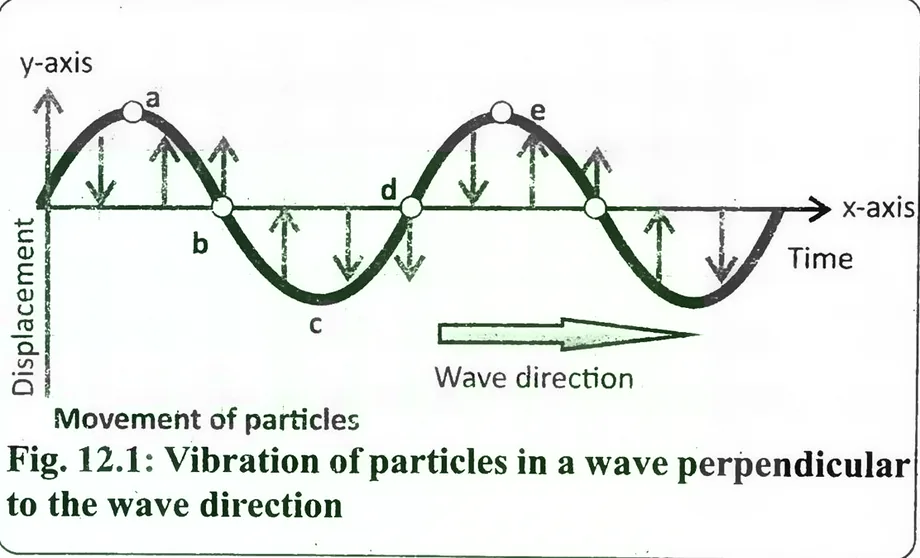
- These vibrations allow energy to be transferred from one particle to the next, as shown in Fig.(12.1). However, the particles themselves do not move along with the wave. They simply oscillate around their original positions.
2. Examples
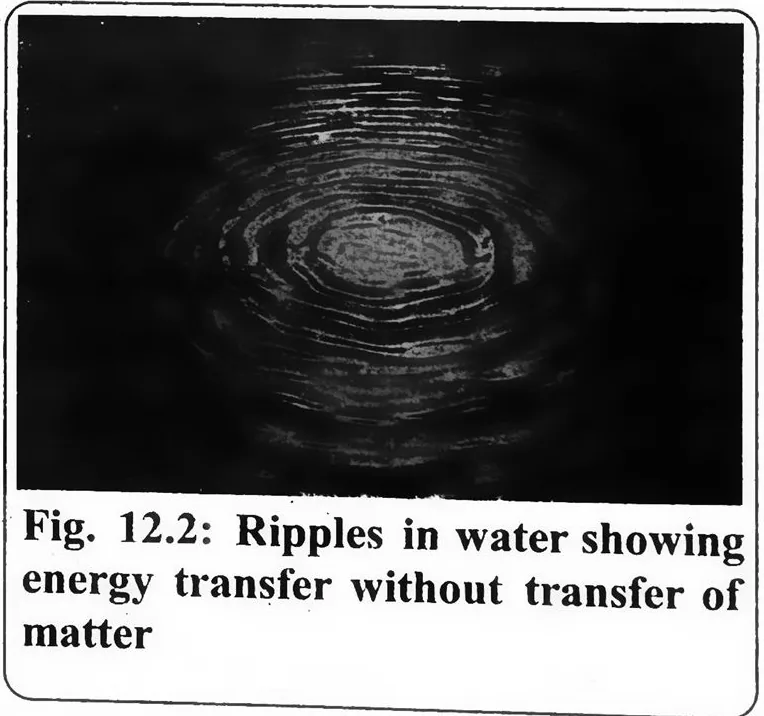
- For example, when a twig is dropped into still water, ripples spread across the surface, as shown in Fig. 12.2. These ripples carry energy outward, yet the water and the twig remain mostly in place.
- A similar effect occurs with sound waves. When a guitar string is plucked, it creates vibrations that travel through the air as sound waves (Fig.12.3). The air particles do not move toward our ears; instead, they vibrate in place to pass the energy forward.
- The same principle is illustrated by vibrant in a spring. When one end of a stretched spring is pushed and released, longitudinal waves move through the spring. As shown in (Fig.12.4), the spring develops regions of compression (where the coils are close together) and rarefaction (where the coils are spread out). These compressions and rarefactions travel along the spring, showing how energy is transmitted without the entire spring moving forward. This experiment visually demonstrates wave motion and how longitudinal waves (such as sound) travel through matter.
Types of Waves
There are two main types of waves:
1. Mechanical Waves
Definition: "Mechanical waves are waves that require a material medium such as air, water, or a solid material to travel."
a. Explanation
- These waves cannot pass through vacuum because they rely on the vibration of particles in the medium to transfer energy.
- The particles of the medium vibrate and pass the energy along, even though the particles themselves do not move with the wave.
- A simple way to observe this is by moving one end of a rope up and down. The wave travels along the rope, but each part of the rope only moves vertically while the wave itself moves forward, as shown in Fig. (12.6).
b. Examples
Examples of mechanical waves include
(i) Sound waves,
(ii) Water waves,
(iii) Vibrations on a rope or spring,
(iv) Seismic waves produced by earthquakes.
2. Electromagnetic Waves
Definition: "Electromagnetic waves are waves which do not require a material medium to travel."
a. Explanation
These waves can move through empty space (vacuum), that is why sunlight and other types of radiation from the Sun are able to reach the Earth through space.
b. Examples
- Examples of electromagnetic waves include (i) Radio waves, (ii) Microwaves, (iii) Infrared rays, (iv) Visible light, (v) Ultraviolet rays, (vi) X-rays, and gamma rays.
- These waves differ in their wavelengths and frequencies, but they all travel at the same speed in vacuum approximately 3,00,000 km per second (3 × 10⁸ m s⁻¹), known as the speed of light.
3. Electromagnetic wave spectrum
The range of all the electromagnetic waves is called the electromagnetic spectrum, as illustrated in Fig.
Types of Mechanical Waves
Mechanical waves are divided into two main types, depending on how the particles of the medium vibrate in relation to the direction the wave travels. These are:
1. Transverse Waves
Definition: "In transverse waves, the particles of the medium vibrate at right angles to the direction in which the wave is travelling."
a. Explanation
- This perpendicular vibration causes the energy to transfer through the medium without any significant forward movement of the particles themselves.
- A simple way to observe a transverse wave is by holding one end of a rope and moving it up and down. While the wave travels horizontally along the rope, the rope segments move vertically.
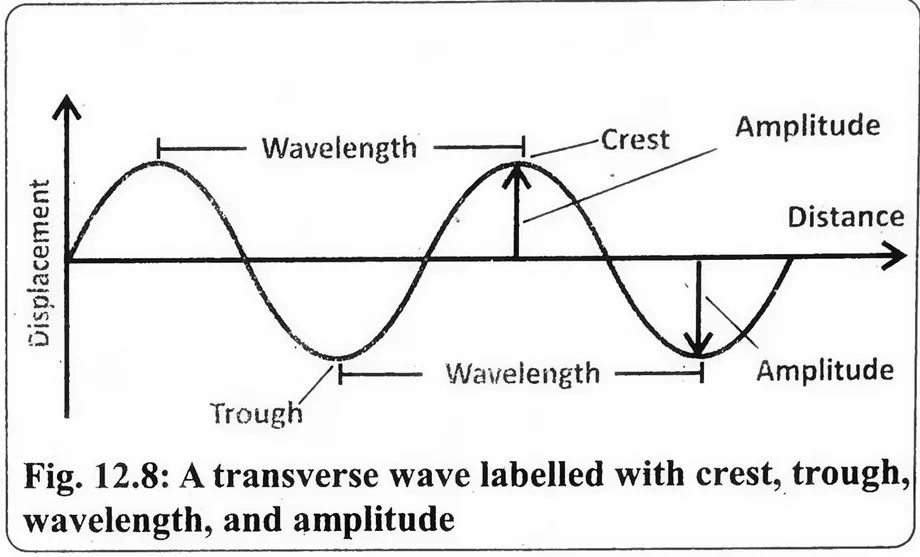
- This motion results in the formation of the highest points known as crests and the lowest points called troughs, as shown in Fig. (12.8).
b. Examples
- An excellent example of a transverse wave is a water wave. As the wave moves forward across the water surface, the water molecules move up and down rather than along with the wave.
- Another important example is electromagnetic radiation (such as light, radiowaves, and X-rays), where the electric and magnetic fields oscillate perpendicular to the direction of energy propagation.
2. Longitudinal Waves
Definition: "In longitudinal waves, the particles of the medium vibrate parallel to the direction in which the wave is travelling."
a. Explanation
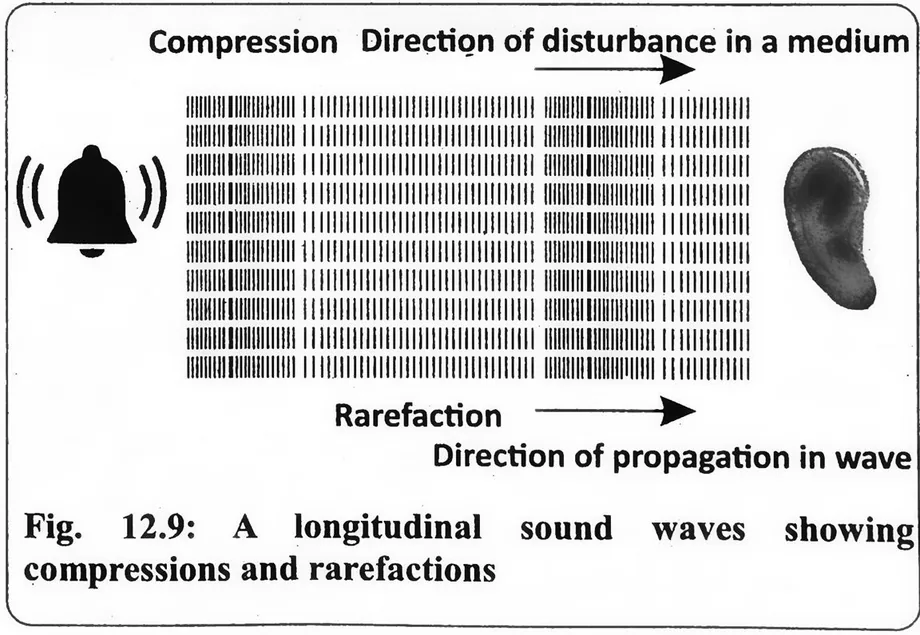
In longitudinal waves the particles move back and forth along the same path as the energy moves. This creates regions where particles are close together, known as compressions, and regions where particles are spread apart, known as rarefactions (Fig.12.9).
b. Examples
- A common and important example of a longitudinal wave is a sound wave.
- When a sound is produced, such as when someone claps his hands, the air molecules near the hands are first pushed together, forming a compression. Immediately after, they spread apart into a rarefaction as the wave continues to move forward through the air.
- This sequence of compressions and rarefactions allows sound to travel to our ears without the air itself moving permanently from the source to the listener.
Terms of Waves
The definitions of these key terms are given below:
1. Crest
The crest is the region of a transverse wave, above the mean position. It is the upper part of a wave.
2. Trough
The trough is the region of a transverse wave, below the mean position. It is the lower part of a wave.
3. Compression
A compression is a region in a longitudinal wave where the particles of the medium are close together, resulting in high pressure.
4. Rarefaction
A rarefaction is a region in a longitudinal wave where the particles are spread apart, resulting in low pressure.
5. Amplitude
The amplitude of a wave is the maximum displacement of a point on the wave from its undisturbed (rest) position. It indicates the energy carried by the wave.
6. Wavelength (λ)
The wavelength is the distance between two consecutive corresponding points on adjacent waves (e.g., crest to crest or trough to trough in transverse waves, or compression to compression in longitudinal waves). Its SI unit is metre (m).
7. Frequency (f)
The frequency of a wave is the number of complete wave cycles that pass a fixed point in one second. It is measured in hertz (Hz), where; 1 Hz = 1 wave per second.
8. Wave Period (T)
The period of a wave is the time it takes for one complete wave cycle to pass a fix point. It is the inverse of frequency:
i.e; T = 1 / f
It is measured in seconds (s).
9. Wave Front
A wave front is an imaginary surface on which all the points have same phase of vibration (i.e., have the same displacement and direction of motion). It represents the leading edge of the wave as it travels through a medium.
Wave Speed (v) / Wave Equation
The wave speed is the rate at which the wave propagates through a medium.
As, Speed = Distance travelled / Time taken
Derivation
Let us consider a wave:
Distance travelled = λ (wavelength)
Time taken = T (time period)
Then,
v = S / t
Since,
S = λ and t = T
Substitute into the formula:
v = λ / T ........................... (1)
Now,
1 / T = f (where f is frequency)
So,
v = f × λ
Properties of Waves
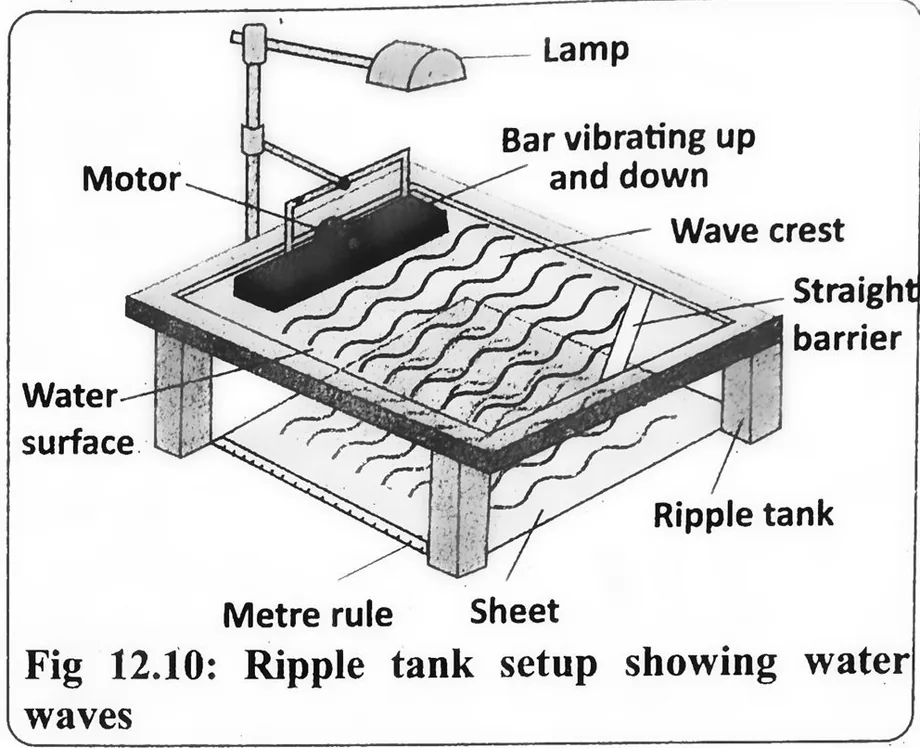
- Ripple tank (a shallow glass container filled with water) is a device used to explain the properties of waves such as reflection, refraction and diffraction.
1. Reflection of Waves
Definition: "Reflection is the bouncing back of waves into the same medium after striking the surface of another medium."
a. Explanation
- Reflection occurs when waves strike a surface and bounce back into the same medium.
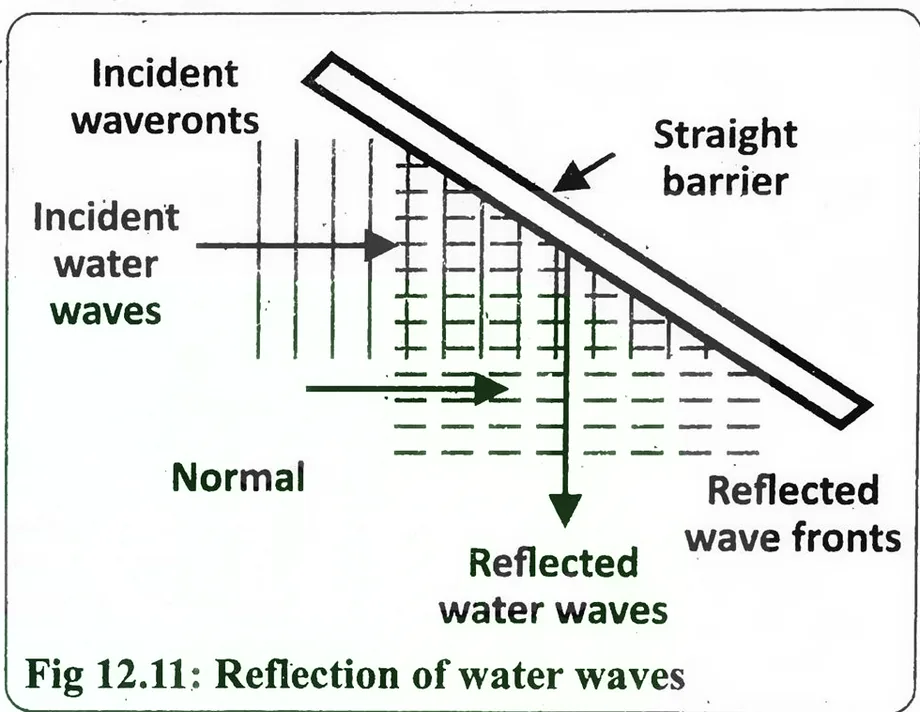
- This behaviour can be clearly observed using a ripple tank, as shown in Fig. (12.10).
- In this setup, when straight water waves generated by a vibrating bar move across the tank and strike a barrier, they reflect from the surface (Fig.12.11).
- The angle at which the waves approach the barrier is called the angle of incidence, and the angle at which they reflect is called the angle of reflection.
- These two angles are always equal. This is called law of reflection. Angle of incidence = Angle of reflection
b. Examples
This property is common to all types of waves, including water waves, sound waves (such as echoes), and light waves (as seen in mirrors).
2. Refraction of Waves
Definition: "When a wave passes from one medium into another at an angle, its wavelength and speed change, causing the wave to change direction. This process is called refraction."
Explanation
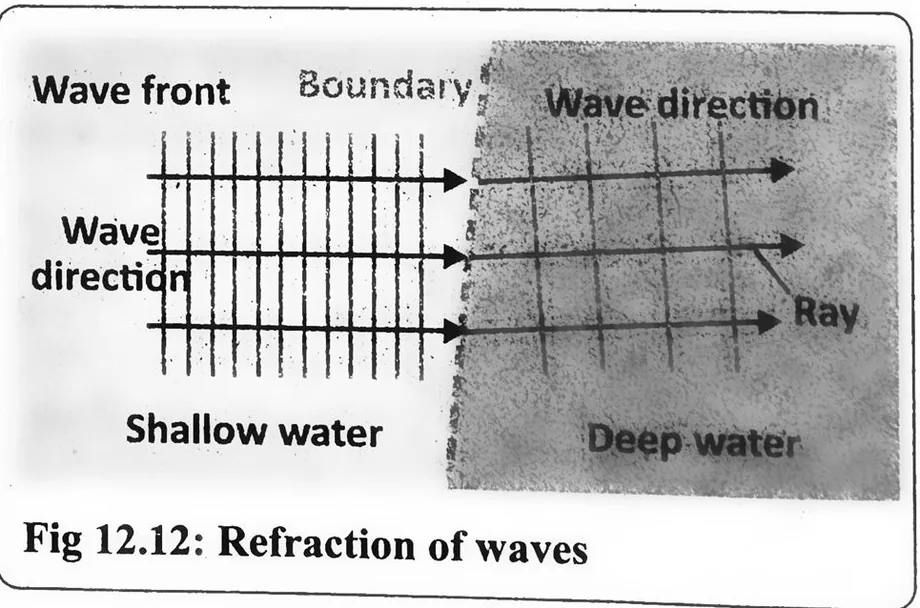
- Refraction occurs when waves pass from one medium into another and change direction due to change in speed.
- As the water waves cross into this shallow region, they slow down and bend, demonstrating the refraction of waves. Although the speed and wavelength of the waves change during this process, their frequency remains the same.
- This bending occurs because waves travel faster in deeper water and slower in shallow water, creating a noticeable change in direction.
- This change in wave behaviour is also illustrated in Fig.(12.12), where wave fronts are shown bending as they pass from deep water into shallow water, with a shorter wavelength in the shallow region.
- The bending clearly shows how the direction and spacing of the waves are affected by the depth of the water.
3. Diffraction of Waves
Definition: "The spreading of waves when they pass through narrow slit (a gap) or move around an obstacle is called diffraction."
a. Explanation
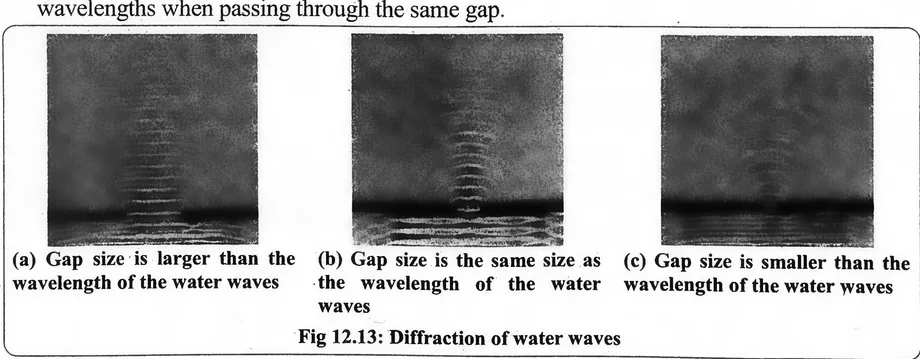
- Diffraction is the bending and spreading of waves as they pass through a narrow gap or move around an obstacle.
- This behaviour can be easily observed in water waves when they encounter openings of different sizes. (i) When the gap is wider than the wavelength, the waves pass mostly straight through with only slight bending at the edges, as shown in Fig. (12.13-a). (ii) If the gap size is nearly equal to the wavelength, the waves spread out more and appear almost circular beyond the gap, as shown in Fig. (12.13-b). (iii) When the gap is smaller than the wavelength, the waves show maximum diffraction, forming strong circular patterns, as seen in Fig. (12.13-c). This shows that the amount of diffraction increases when the gap size is closer to or smaller than the wavelength of the waves.
b. Example
A common example is how we can still hear someone speaking even when he is behind a wall. This happens because sound waves, which have relatively long wavelengths, diffract around corners and obstacles, allowing the sound to reach us even without a direct line of sight.
- Additionally, waves with longer wavelengths diffract more than those with shorter wavelengths when passing through the same gap.
Seismic and Tsunami Waves
Seismic and tsunami waves are natural waves produced by disturbances in the Earth's crust and ocean. Understanding them is important for safety and readiness since they have the potential to do a great deal of harm.
1. Seismic Waves
- Seismic waves are those that pass through the Earth and are typically created by earthquakes, volcanic eruptions, or explosions.
- Seismometers detect these waves, which aid scientists in their investigations of the Earth's insides.
Primary Waves (P-Waves)
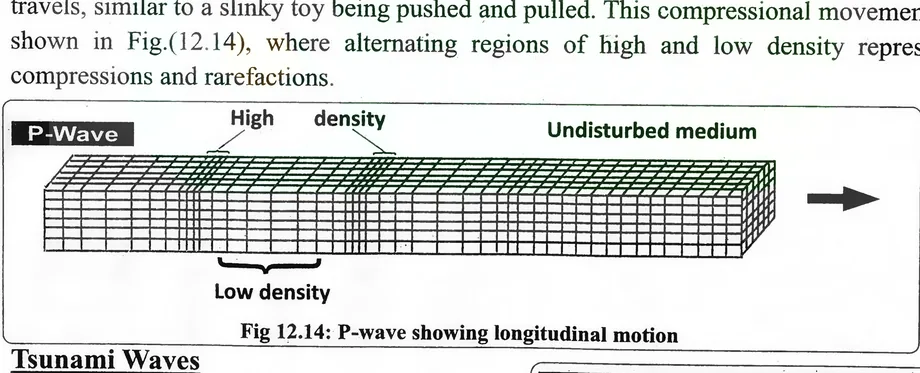
- These are the fastest seismic waves and the first to be detected during an earthquake. P-waves can travel through solids, liquids, and gases.
- They move by compressing and expanding the material in the same direction as the wave travels, similar to a slinky toy being pushed and pulled. This compressional movement is shown in Fig.(12.14), where alternating regions of high and low density represent compressions and rarefactions.
2. Tsunami Waves
- Tsunamis are extremely large and powerful ocean waves caused by sudden disturbances under the sea. These disturbances may include underwater earthquakes, volcanic eruptions, or landslides.
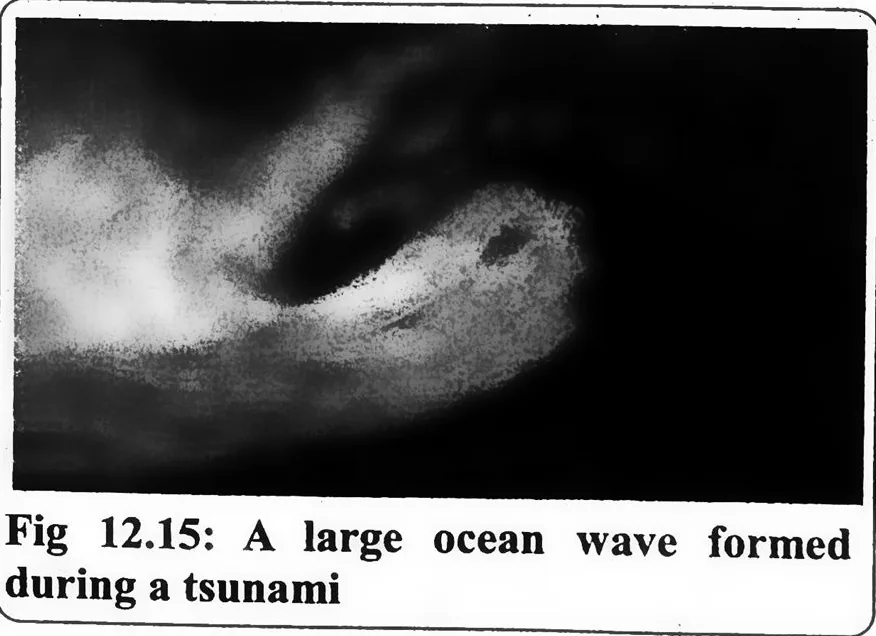
- When such events occur, they can cause a sudden shift in the ocean floor, which pushes a huge volume of water upward. This disturbance creates energy that spreads across the ocean as long, fast-moving waves, as shown in Fig.(12.15).
a. Characteristics of Tsunami Waves
i. In the deep ocean, tsunami waves travel at very high speeds, often reaching up to 800 kilometres per hour. However, in deep water, these waves are often just a few centimetres in height and go unnoticed by ships or people.
ii. As tsunami waves approach shallow coastal areas, their behaviour changes dramatically due to their interaction with the sea floor:
- Wave speed decreases: As the water becomes shallower, the bottom of the wave touches the ocean floor, slowing the wave down.
- Wavelength shortens: The distance between wave crests becomes smaller.
- Frequency increases: More waves arrive at the shore in a shorter period of time.
- Amplitude increases: As the energy gets compressed into a smaller space, the wave height increases significantly.
This transformation can result in towering waves, sometimes reaching heights of 30 metres (100 feet) or more, causing severe coastal flooding, destruction of buildings, and loss of life.
b. Real Life Example
A tragic real-life example is the 2004 Indian Ocean tsunami, caused by a massive undersea earthquake near Sumatra. The earthquake displaced a huge section of the ocean floor, triggering tsunami waves that travelled across thousands of kilometres. These waves struck the coastlines of countries such as Indonesia, Sri Lanka, India, and Thailand, reaching heights of over 15 metres in some areas and causing massive devastation and loss of more than 2,30,000 lives.
More figures from this unit