 StudentAid
Unit 11: Transfer of Thermal Energy — Long Questions
10th Class Physics · Unit 11: Transfer of Thermal Energy
Thermal conduction
Definition: "Conduction is the process by which heat is transferred through direct contact between particles in a material, without any actual movement of the material."
1. Explanation
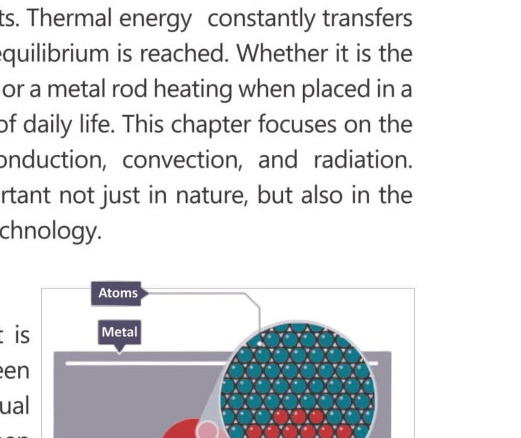
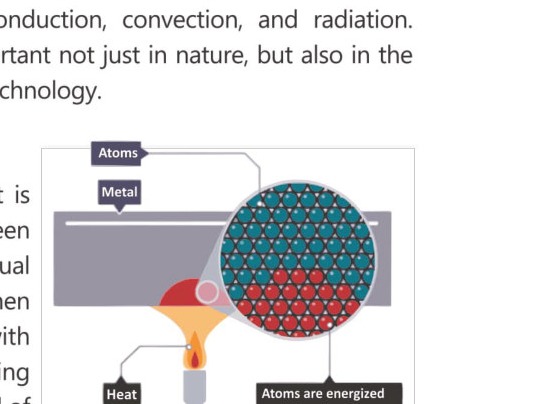
- It happens when fast-moving (hotter) particles collide with slow-moving (cooler) particles, transferring their kinetic energy (Fig. 11.1).
- This method of heat transfer is most efficient in solids, especially in metals, as their particles are densely packed, and freely moving electrons facilitate the quick transfer of energy.
2. Thermal Conduction in Solids
- When the handle of a metal spoon is placed in hot water, it quickly becomes warm, whereas the handle of a wooden spoon does not heat up. This difference highlights how materials transfer heat in different ways. Both metals and non-metals can conduct heat, but metals are typically much better at it.
- In solids, the atoms and molecules are tightly packed and constantly vibrate around their mean positions as shown in Fig. 11.1. When one end of the solid is heated, the particles at that end begin to vibrate more vigorously. These vibrating particles collide with nearby atoms or molecules, transferring some of their energy.
- This process causes the neighbouring particles to vibrate more rapidly and, in turn, pass some of their energy to other surrounding particles. Gradually, heat spreads throughout the solid, but the transfer is slow, with only a small amount of heat moving from the hotter to the cooler parts.
- In conduction, heat transfers through a solid medium due to a temperature difference.
3. Role of Free Electron in metals
Metals have free electrons that can move freely within the material. These fast-moving electrons carry energy quickly from the hot areas to the cooler areas of the metal. This is why heat moves more rapidly through metals than non-metals.
Convection
1. Convection in liquids and gases
Definition
"Convection is the transfer of heat through the actual movement of molecules from a hot area to a cooler area."
a. Mechanism of Convection
- Liquids and gases are not very efficient in conducting heat. However, heat can still be transferred through these fluids (liquids or gases) by a process called convection. When a liquid or gas is heated, it becomes less dense (lighter) and expands. The heated liquid or gas rises above the heat source, and cooler fluid from the surrounding area moves in to take its place.
- This cooler fluid then gets heated as well. In this way, heat is transferred through fluids by the movement of heated molecules from the hotter parts to the cooler parts of the fluid.
b. Experiment (for liquid convection)
- Fill a beaker two-thirds with water and heat it by placing a burner underneath.
- Now drop two or three potassium permanganate crystals into the water.
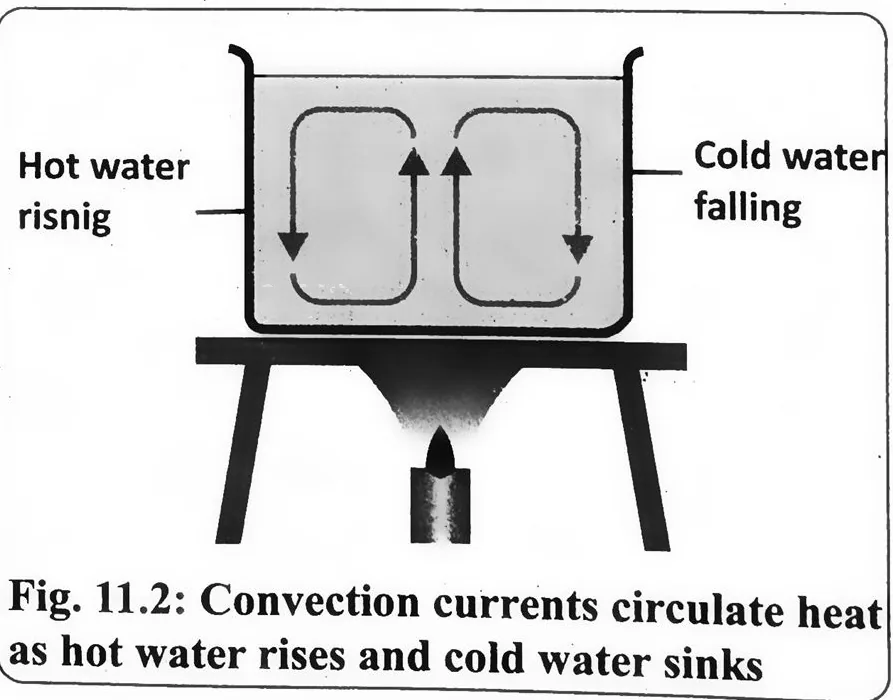
- We will notice coloured streaks moving upward above the flame, then flowing downward along the sides, as shown in Fig. 11.2. These coloured streaks reveal the movement of currents within the liquid.
- As the water at the bottom of the beaker heats up, it expands, becoming lighter and rising. Meanwhile, the cooler, denser water sinks to replace it.
2. Convection Currents in Air
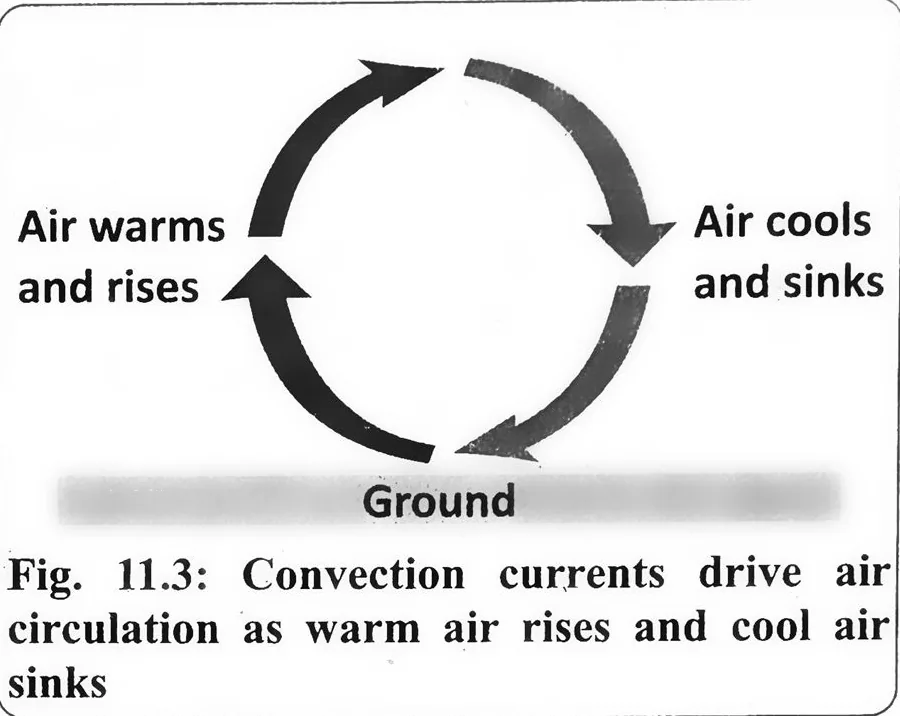
- When gases get heated, they expand, and this creates convection currents due to the differences in air density at various points in the atmosphere. This can be demonstrated with a simple experiment, as shown in Fig. 11.3.
- This process begins when the Sun heats the Earth's surface, warming the air close to the ground. As the air warms up, it becomes lighter and less dense, causing it to rise.
- As it rises, it cools down, becomes denser, and sinks back toward the surface.
- The cooler air then gets heated, and the cycle repeats. This movement of air creates convection currents, which are responsible for various natural phenomena such as winds, sea breezes, and weather patterns.
- These currents help to distribute heat throughout the atmosphere, playing a vital role in regulating Earth's climate and weather.
3. Applications of Convection Currents
- Convection currents created by electric, gas, or coal heaters are used to warm our homes and offices.
- Central heating systems also rely on convection to distribute heat throughout the buildings.
- On a larger scale, convection currents occur naturally in the environment.
- The daily changes in temperature in the atmosphere are caused by the movement of warm or cool air.
- Land and sea breezes are examples of convection currents in nature.
a. Land and sea breezes
- Land and sea breezes are caused by convection.
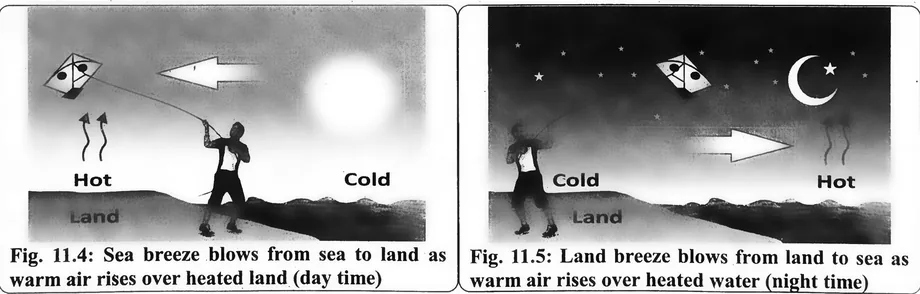
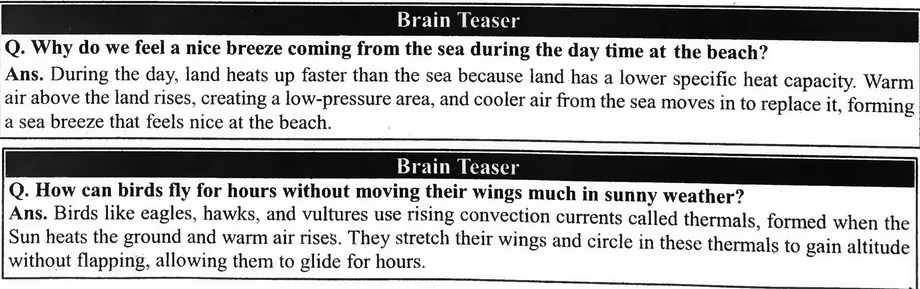
- During the day, the land heats up faster than the sea due to the land's lower specific heat capacity. The warm air above the land rises, and cooler air from the sea moves in to replace it, creating a sea breeze, as shown in Fig. 11.4.
- At night, the land cools down more quickly than the sea. As a result, the air above the sea becomes warmer and rises, while cooler air from the land moves towards the sea, creating a land breeze, as illustrated in Fig. 11.5.
b. Gliding
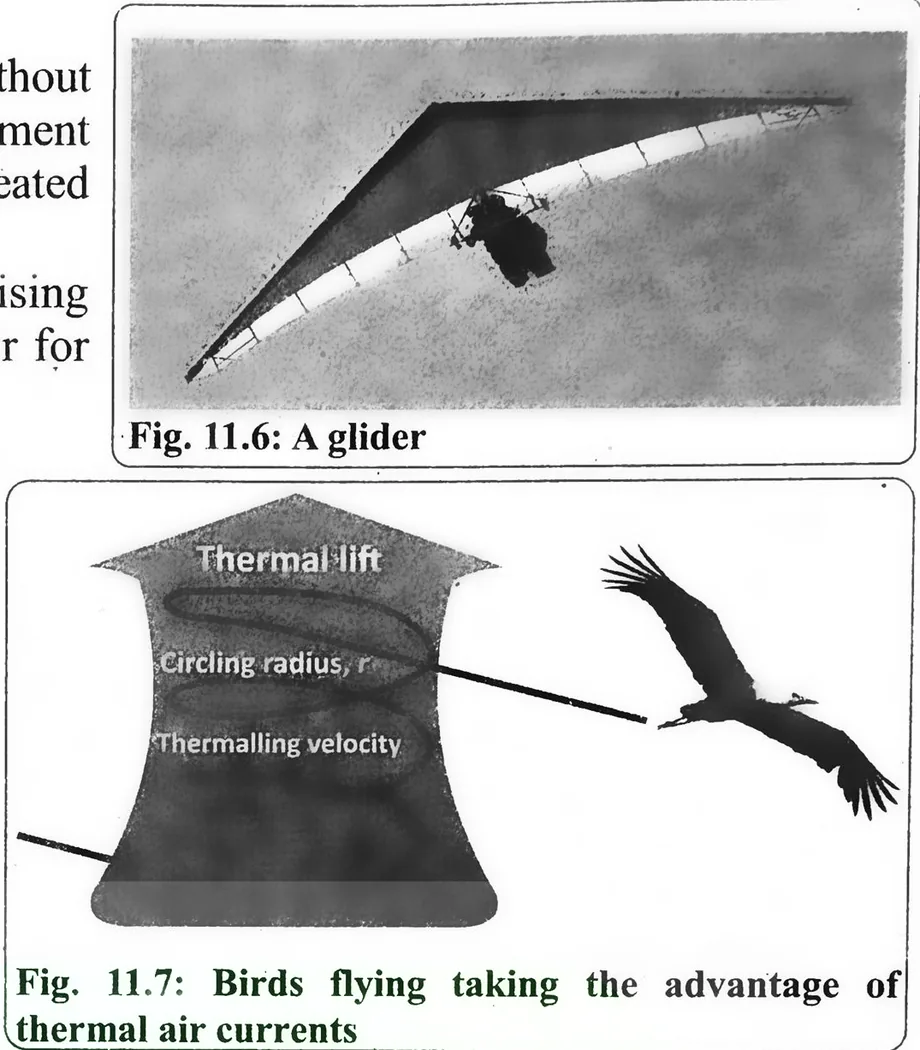
- A glider, which is like a small plane without an engine, relies on the upward movement of warm air currents, or thermals, created by convection (Fig. 11.6).
- Gliders take advantage of these rising currents of warm air to stay in the air for extended periods.
c. Bird Lift
- Similarly, birds use thermals to stay aloft for hours without flapping their wings. They stretch their wings and circle in the thermals, allowing them to gain altitude as the warm air rises.
- Birds such as eagles, hawks, and vultures are especially skilled at using thermals to glide over long distances with little effort, barely needing to flap their wings (Fig. 11.7).
d. Convection in Seawater and Marine Life
- Convection plays an important role in seawater and is important for supporting marine life.
- When sunlight heats the surface of the ocean, the warm water becomes lighter and stays at the top, while the cooler, denser water sinks to the bottom. This difference in temperature causes convection currents in the ocean.
- These currents continuously move water up and down, helping to mix oxygen from the surface into deeper layers and bringing nutrients from the ocean floor to the surface.
- This process is very important for the survival of marine animals and plants because it ensures that there is enough oxygen and food available at different depths.
- Without convection, the deep ocean would lack oxygen, and surface waters would lack nutrients, making it difficult for marine ecosystems to thrive.
e. Heating and cooling of Room by Convection
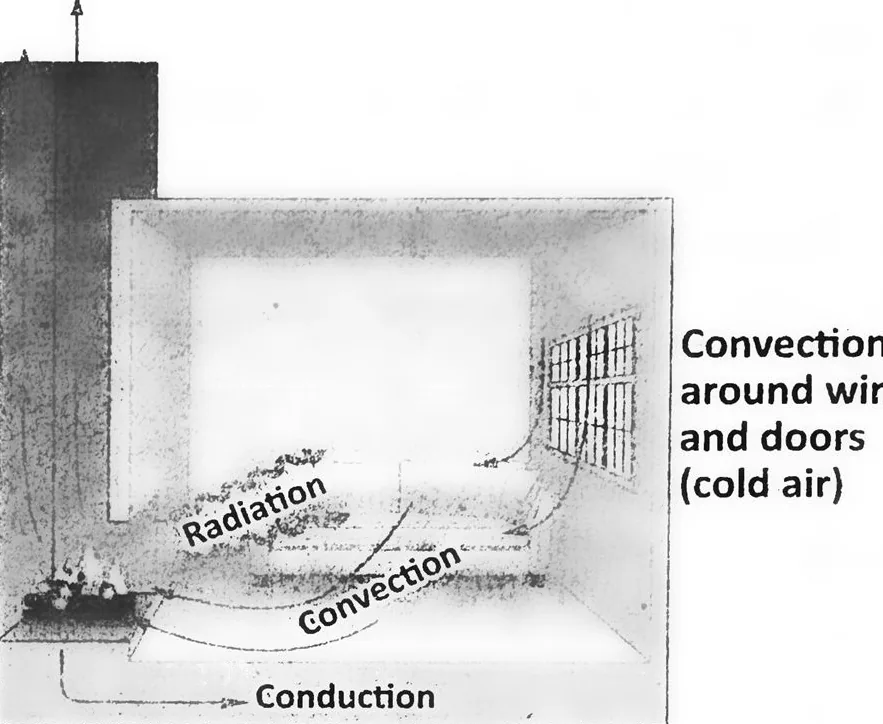
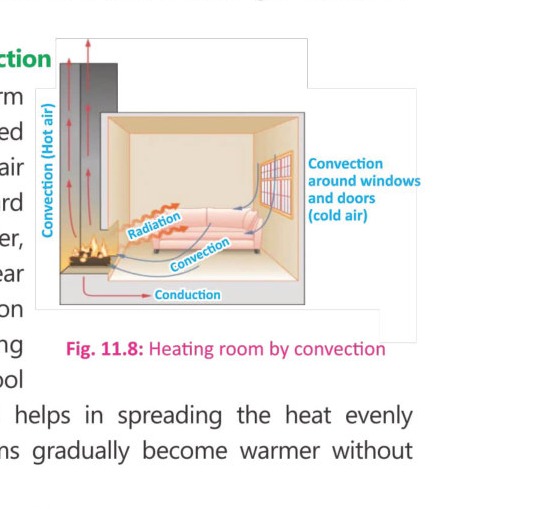
- In winter, gas heaters are often used to warm rooms (Fig. 11.8). When the heater is turned on, it warms the air near it. This warm air becomes lighter (less dense) and rises toward the ceiling. As the hot air moves up, cooler, heavier air moves down to take its place near the heater. This process is called a convection current, that distributer heat throughout the room.
- Similar effect is applied during summer when air conditioning is used to cool the room. It keeps the air moving and helps in spreading the heat evenly throughout the room. That is why, rooms gradually become cooler without needing fans.
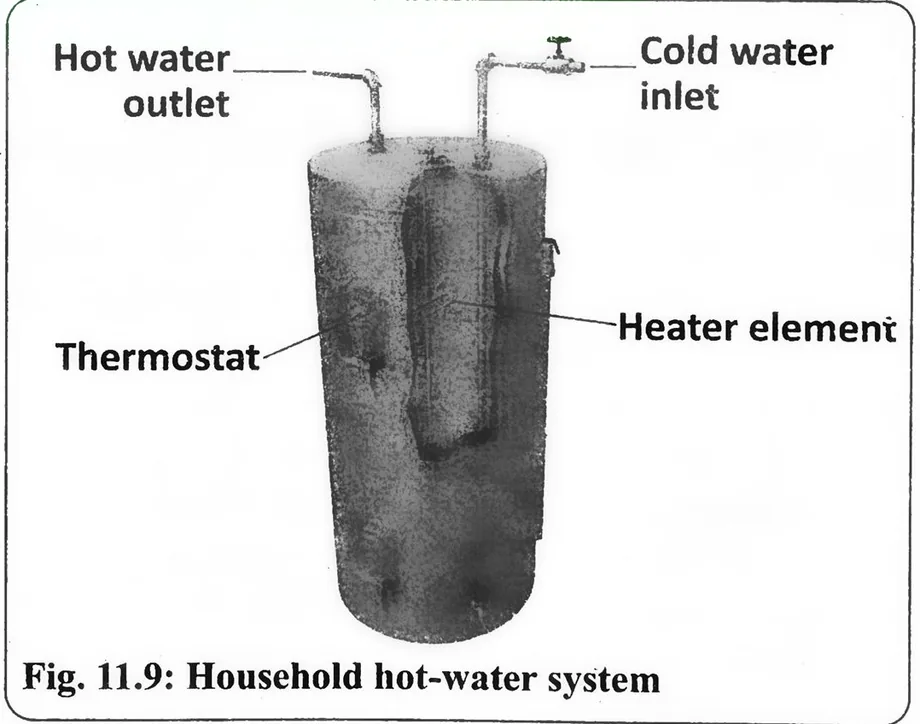
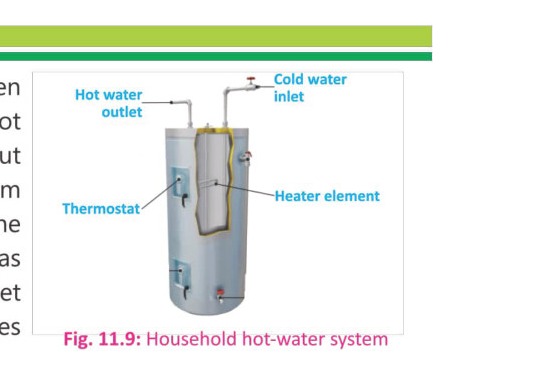
f. The Mechanism of a Household Hot-Water System
- In most homes, hot water is provided using a storage tank water heater. The system works by bringing cold water into the house through pipes, where it splits into two lines: one for cold water use and one that goes into the water heater.
- Inside the water heater, the cold water is heated using an electric heating element or a gas burner, depending on the type of system.
- As the water heats up, it becomes less dense and rises naturally to the top of the tank, while the cooler, denser water stays at the bottom.
- When someone turns on a hot water tap, the hot water from the top of the tank flows out easily, and new cold water enters from below to be heated.
- A thermostat inside the tank controls the heating element or gas burner, ensuring that the water stays at a set temperature (Fig. 11.9). This system ensures a steady supply of hot water.
Heat Transfer through Radiation
Definition: "In radiation, heat transfer occurs through electromagnetic waves without requiring a medium."
1. Explanation
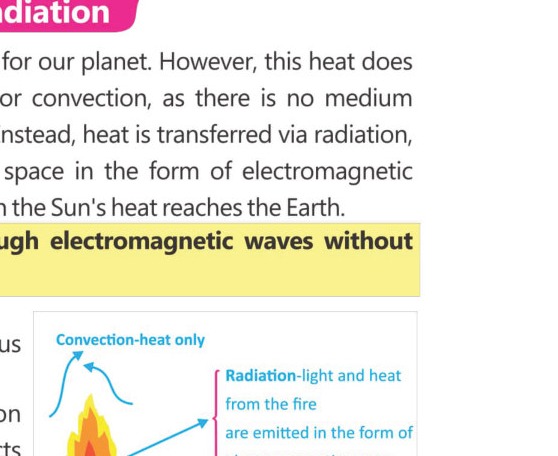
- The Sun serves as the main source of heat for our planet. However, this heat does not reach the Earth through conduction or convection, as there is no medium between the Sun and Earth's atmosphere. Instead, heat is transferred via radiation, a process in which energy travels across space in the form of electromagnetic waves.
- This is the mechanism through which the Sun's heat reaches the Earth.
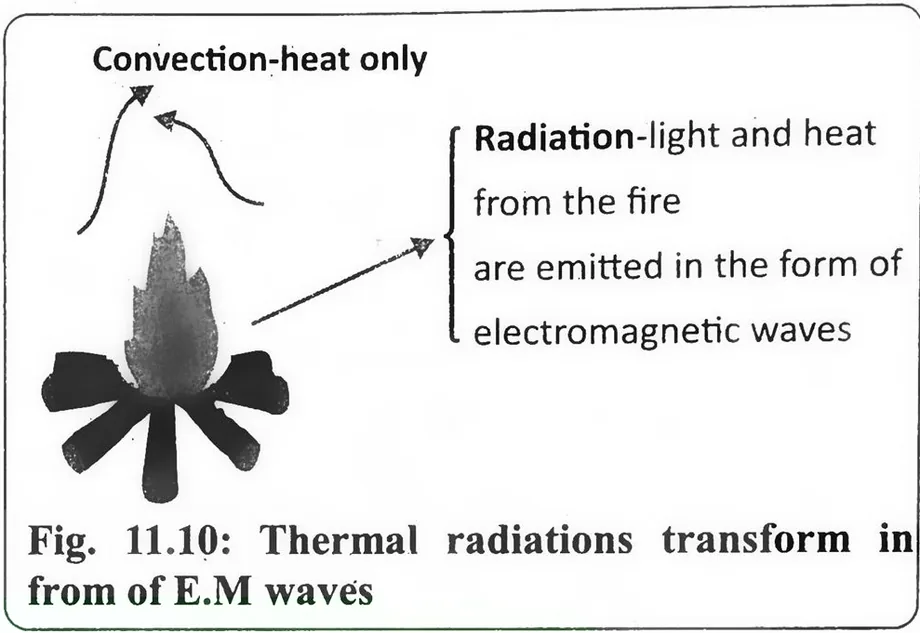
2. Radiation from a Fireplace
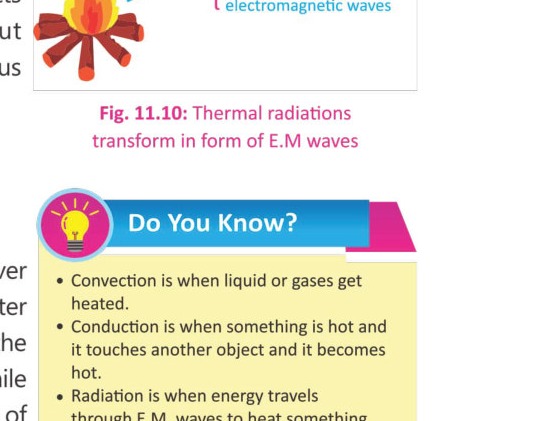
The heat travel from a fireplace to us (Fig. 11.10). Heat does not reach us via conduction through the air because air neither conducts heat efficiently nor transfers heat.
3. Factors affecting radiation
Radiation emitted is influenced by various factors, including:
- the colour and texture of the surface
- the temperature of the surface
- the surface area
4. Why Objects Cool or Warm Over Time?
Why does a hot cup of tea cool down over time, and why does a cold glass of water warm up?
- All objects in a room, including the walls, ceiling, and floor radiate heat while simultaneously absorbing it.
- If temperature of an object is higher than that of its surroundings, it radiates more heat than it absorbs. Consequently, its temperature decreases until it matches the temperature of the surrounding environment.
- On the other hand, if the temperature of the object is lower than its surroundings, it absorbs more heat than it radiates, causing its temperature to rise until it reaches equilibrium with the environment.
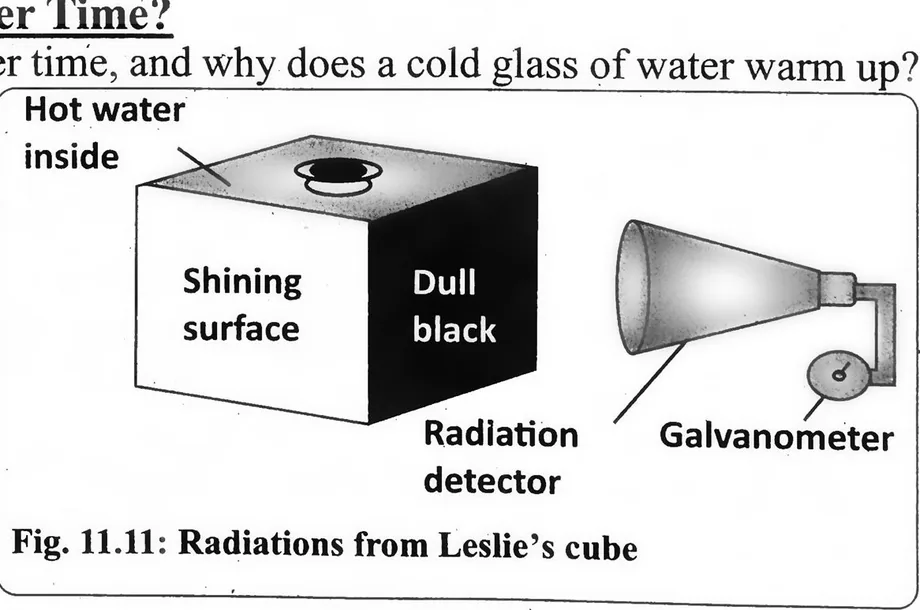
- The rate at which different surfaces emit heat depends on their characteristics. This phenomenon can be illustrated with Leslie's cube (Fig. 11.11).
5. Leslie's Cube – Emission and Absorption of Radiation
Leslie's cube is a metal box with faces of different materials, such as:
- a shiny silver surface
- a dull black surface
- a white surface
- a coloured surface
When the cube is filled with hot water and one face is directed towards a radiation detector.
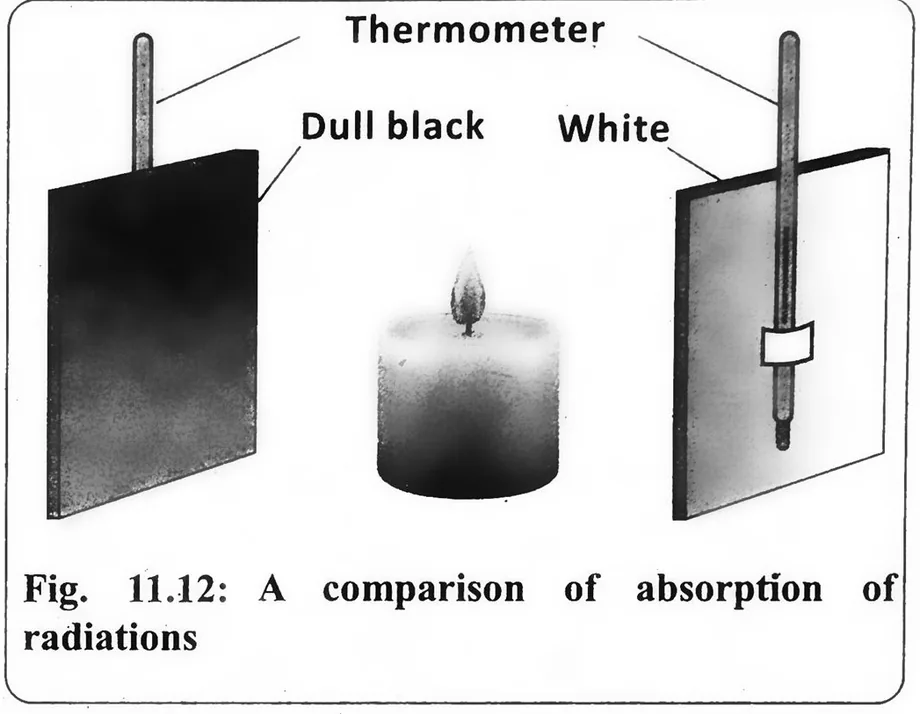
- It is found that the dull black surface is the most effective emitter of heat (Fig. 11.12).
- The rate at which different surfaces absorb heat also varies based on their nature. For example, when comparing a dull black surface with a polished silver one, the dull black surface absorbs heat more rapidly, causing its temperature to rise quickly, while the polished silver surface absorbs heat more slowly and warms up at a much slower rate.
Conclusion
The experiment shows that dull, black surface emits the most radiation, while the shiny surface emits the least, proving surface nature affects emission.
6. Effect of Surface Colour and Texture on Infrared Radiation
- The colour and texture of a surface have a strong effect on how it emits, absorbs, and reflects infrared radiation.
- Dull and dark-coloured surfaces are very good at absorbing and emitting infrared radiation. That is why a dull black surface heats up quickly and cools down faster by giving off more heat.
- On the other hand, shiny and light-coloured surfaces are poor absorbers and emitters of radiation. Instead, they reflect most of the infrared radiation away. This is why shiny surfaces, like polished metals, stay cooler under the Sun compared to dark surfaces.
- The texture also matters. Rough surfaces absorb and emit radiation better, while smooth surfaces tend to reflect more radiation.
7. Impact of Surface Temperature and Surface Area on Heat Transfer
- The rate of radiation emitted by an object depends greatly on two important factors: the surface temperature and the surface area.
- When the surface temperature of an object increases, it radiates more energy because hotter objects emit more heat compared to cooler ones. For example, a hot iron rod glows and emits more heat than a warm one.
- Similarly, the surface area also plays a major role. If an object has a larger surface area, it can emit or absorb more heat at a faster rate. This is why radiators used for heating rooms are made with lots of thin slots or fins to increase the surface area without taking up too much space.
- A larger area means more radiation can happen at the same time, making heat transfer more efficient. Thus, both a higher surface temperature and a larger surface area help an object emit thermal energy more quickly through radiation.
8. Measuring Temperature Using an Infrared Thermometer (Application)
- An infrared thermometer (Fig. 11.13). measures the temperature of objects without touching them.
- It detects the heat (infrared radiation) emitted by the object.
- During the COVID-19 pandemic, these thermometers were used widely to check body temperatures safely.
- They are also useful for checking the heat of ovens, machines, or even dangerous radioactive materials.
- To use it, we point the thermometer at the object, press the trigger, and read the temperature on the screen.
Applications of Conduction
Heating Objects such as Kitchen Pans
- One everyday application of heat transfer is when we cook food using kitchen pans.
- When a pan is placed on a stove, heat from the flame or heating element transfers to the pan mainly by conduction.
- The metal of the pan, being a good conductor, quickly absorbs the heat and passes it through the surface.
- This causes the entire pan to become hot, allowing food placed inside to cook evenly (Fig. 11.14).
Thermal Insulation
1. Using Thermal Insulation to Maintain the Temperature of a Liquid
- Thermal insulation helps to keep hot things hot and cold things cold. For example, a thermos flask (vacuum flask) has double walls with a vacuum between them (Fig. 11.15).
- The vacuum stops heat transfer by conduction and convection because there is no air or material to move heat.
- The inside walls of the flask are coated with a reflective layer (silvered coating) that bounces back radiation to keep the liquid warm.
- The outer casing and lid are made of insulating materials like plastic or stainless steel to prevent heat loss.
- This smart design helps liquids like tea, coffee, or soup to stay at the right temperature for many hours.
2. Reducing Thermal Energy Transfer in Buildings
- Thermal insulation in buildings helps to keep them warm in winter and cool in summer.
- By adding things like thick curtains, foam in the walls, double-glazed windows (Fig. 11.16.-a), or false ceilings (Fig. 11.16-b). We can reduce heat loss through conduction, convection, and radiation.
- In cold weather, insulation stops warm indoor air from escaping.
- In hot weather, it prevents heat from entering from outside.
- This reduces the need for heaters and air conditioners, saving energy and lowering costs.
- Even simple ideas like using proper shading outside the windows or ensuring good ventilation can make a big difference in controlling indoor temperature.
Greenhouse Effect
The greenhouse effect refers to the process by which the Earth's atmosphere traps some of the Sun's heat, maintaining a temperature that is suitable for life.
Without this effect, the planet would be too cold to support life.
1. Temperature Regulation in a Greenhouse
- The Sun emits both short wavelength light and ultraviolet radiations and long-wavelength thermal radiations (infrared).
- Transparent materials such as glass and plastic allow short-wavelength radiations to pass through but block long-wavelength infrared radiation.
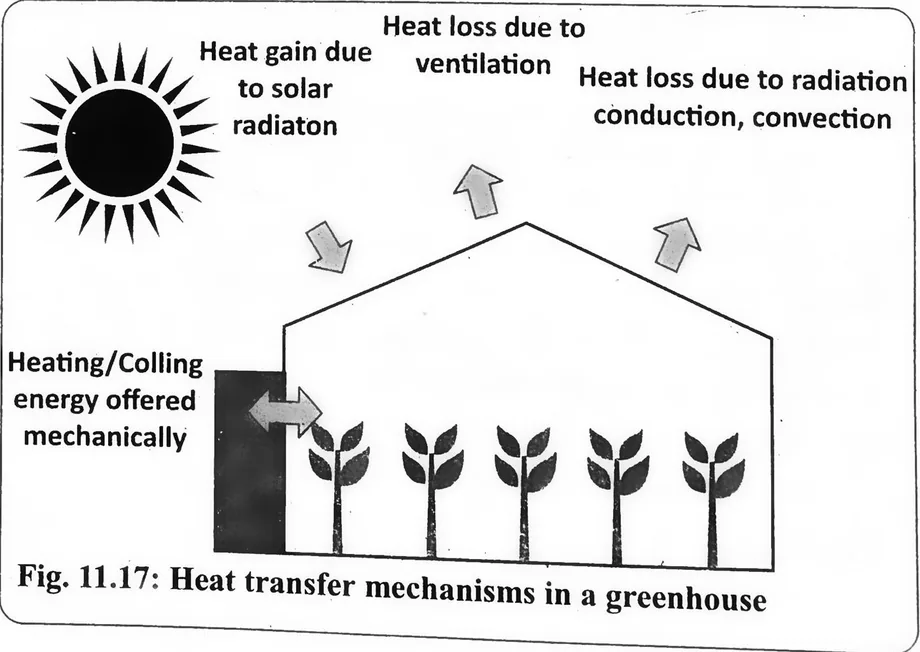
- This creates a heat trap inside the greenhouse. The rays from the Sun warm the objects inside the greenhouse, and these objects emit radiations with longer wavelengths. However, the glass or plastic sheets prevent this longer-wavelength radiation from escaping, reflecting it back into the greenhouse and maintaining a warm environment that benefits plant growth.
2. Greenhouse Effect on Earth
- The Earth's atmosphere functions in a similar way to a greenhouse, trapping heat from the Sun with gases such as carbon dioxide and water vapours (Fig. 11.17). This helps to maintain the Earth's temperature.
- In recent years, the amount of carbon dioxide in the atmosphere has increased significantly, strengthening the greenhouse effect. As a result, more heat is trapped, leading to a rise in the Earth's average temperature, a phenomenon known as global warming.
- This increase in temperature has serious implications for global climate patterns.