StudentAid
Unit 13: Sound — Long Questions
10th Class Physics · Unit 13: Sound

Production of Sound
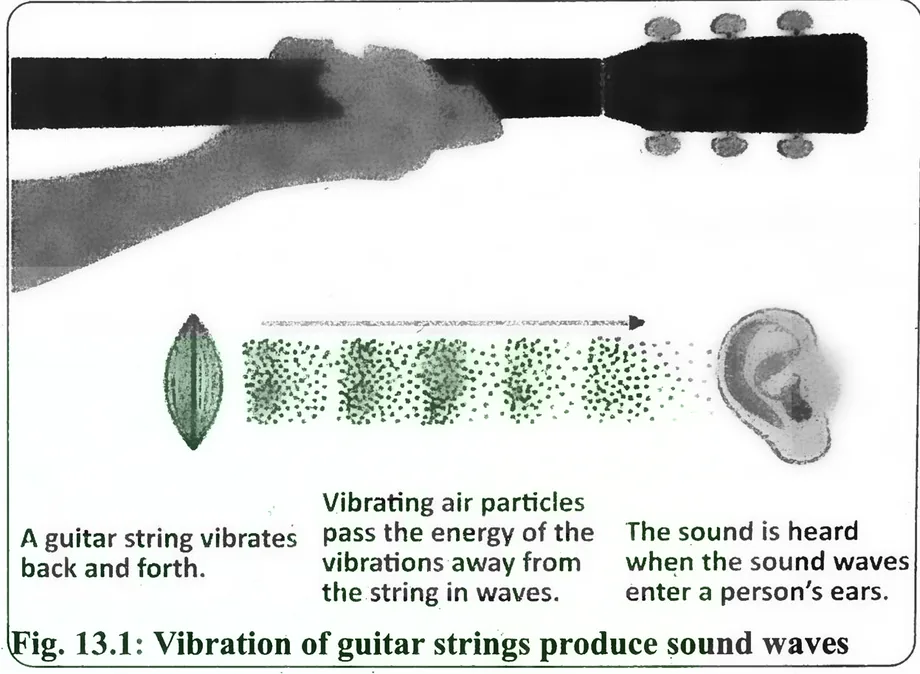
Sound is produced by vibrating objects. When an object vibrates, it makes the air around it to vibrate as well. These air vibrations travel to our ears and create the sensation of sound.
Examples
- For example, in a guitar, the sound is produced when its strings vibrate (Fig.13.1).
- Similarly, our voice is produced by the vibrations of our vocal cords.
- The human heart and other organs like the lungs also create sound waves when they vibrate. Doctors use a stethoscope to listen to these sounds.
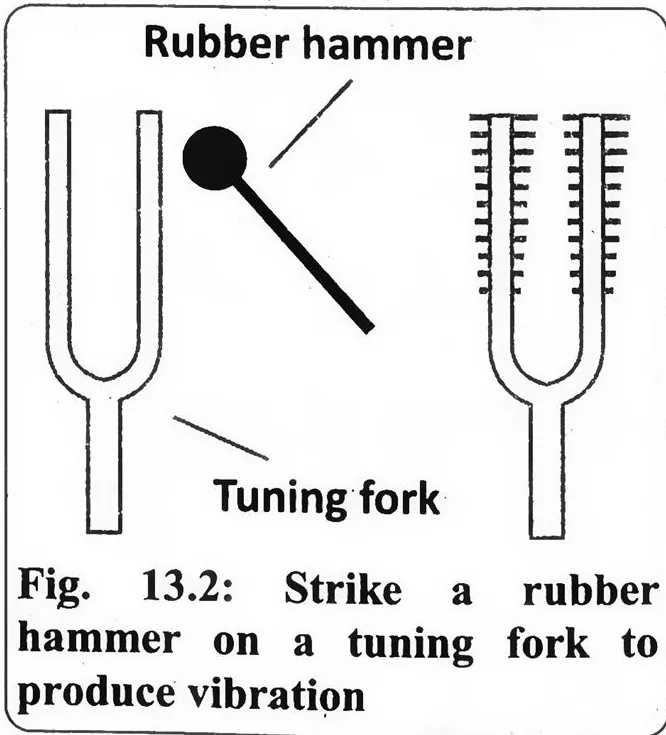
- In school laboratories, tuning fork is used to produce a specific sound. When a rubber hammer is struck with the tuning fork, it begins to vibrate (Fig.13.2). By bringing it close to our ear, we can hear the sound produced by these vibrations.
- We can also observe the vibrations of a tuning fork by bringing one of its prongs in contact with a small table tennis ball hanging from a thread (Fig.13.3). When the vibrating prong touches the ball, the ball moves, showing the presence of vibrations.
- Similarly, if we place the vibrating tuning fork into a glass of water, we will notice water splashing. The vibrating tuning fork generates sound waves, which transfer energy to water, making it splash, this simple activity demonstrates that vibrations are responsible for producing sound.
Propagation of Sound
- Sound needs a medium, such as air, water, or a solid, to travel from one place to another.
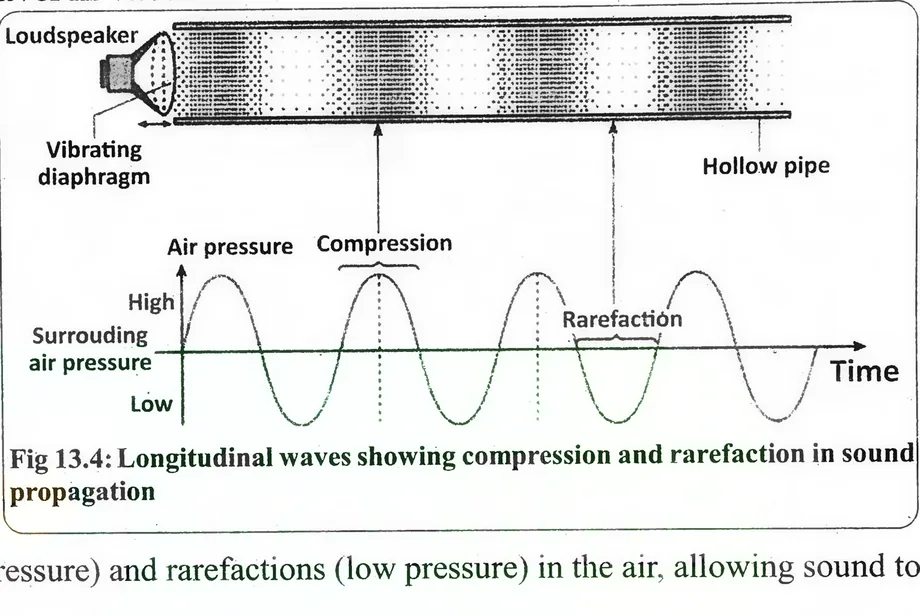
- When a tuning fork vibrates, it creates compressions (high pressure) and rarefactions (low pressure) in the air, allowing sound to travel.
- As the prong moves forward, it pushes air molecules together, forming a compression that moves outward.
- When it moves back, it creates a rarefaction, where air molecules spread apart.
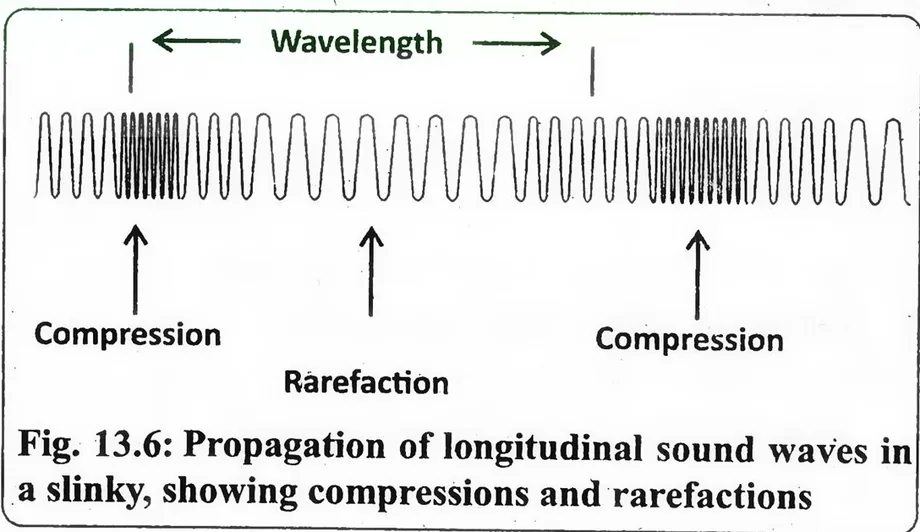
- This continuous cycle of compressions and rarefactions propagates sound as a longitudinal wave, meaning air molecules move in the same direction as the wave travels (Fig. 13.4).
- The wavelength of a sound wave is the distance between two successive compressions or rarefactions.
Experiment to Show Sound Waves Require a Medium
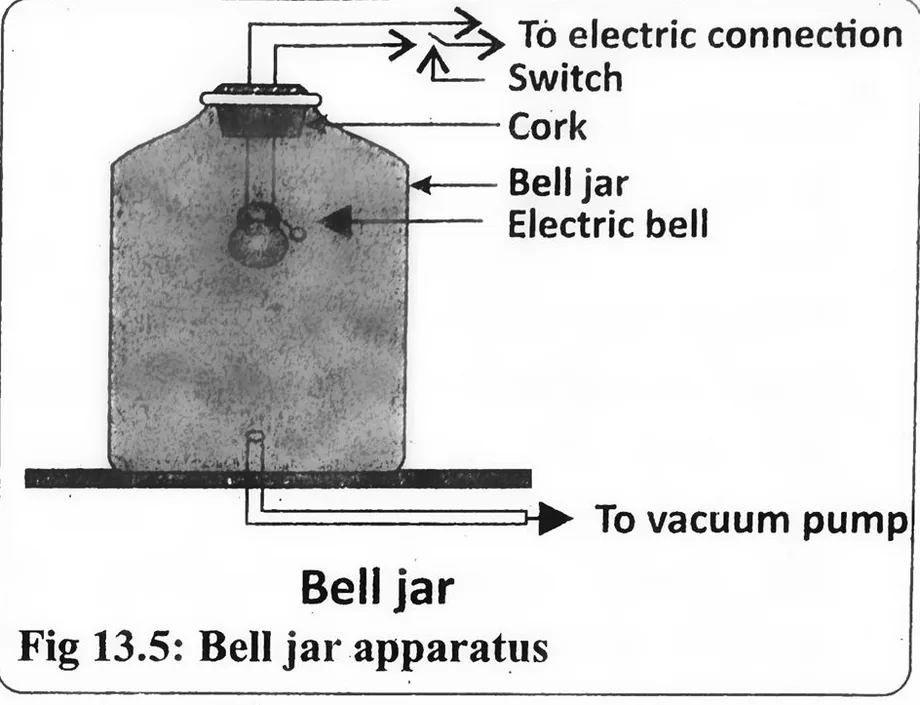
- Sound waves need a material medium to propagate. This can be demonstrated using a bell jar setup (Fig. 13.5).
- The bell jar is placed on the base of a vacuum pump, with an electric bell suspended inside using two wires connected to a power supply.
- When the power supply is turned ON, the electric bell rings, and we can hear the sound.
- Next, air is pumped out of the jar using the vacuum pump. As the air is removed, the sound of the bell becomes weaker and eventually fades, even though the bell continues ringing.
- When air is reintroduced into the jar, the sound becomes audible again. This demonstrates that sound waves require a medium, such as air, to propagate.
Longitudinal Nature of Sound Waves
- The propagation of sound waves can be understood through the example of a slinky (Fig.13.6).
- Sound travels in the form of a longitudinal wave. This means the particles of air move back and forth in the same direction as the sound wave. If we push and pull one end of the slinky, we will see some parts where the coils come close together (called compression) and some parts where they spread apart (called rarefaction).
- In the same way, when sound moves in air, it creates compressions (where air particles are closer) and rarefactions (where particles are far apart).
- The distance between two compressions or two rarefactions is called the wavelength.
- So, just like the slinky, sound moves by making compressions and rarefactions, showing that it is a longitudinal wave.
Speed of Sound
- Sound waves require a medium with vibrating particles to travel and cannot propagate through vacuum.
- The speed of sound varies with the type of medium. It moves 5 times faster in liquids and 15 times faster in solids than in gases.
- In air, factors like temperature, and humidity affect its speed.
- At room temperature (21°C), sound travels at 343 m s⁻¹ in air, increasing with higher temperature and humidity.
- Since solids and liquids transmit sound faster than gases, the material of the medium plays a key role in determining sound speed.
- The speed of sound v is calculated using a specific equation:
v = f λ ...................(13.1)
where v is the speed of sound, f is the frequency, and λ is the wavelength of the sound wave. The speed of sound in various media is shown in Table 13.1
Characteristics of Sound
Sounds from different objects can be identified based on their distinct characteristics, as explained below.
1. Loudness
Definition "Loudness is a property of sound that allows us to differentiate between loud and faint sound."
a. Example
For example, when speaking with friends, our voice is soft, but while addressing a large audience, we speak louder. The loudness of a sound depends on several factors, which influence how we perceive its intensity.
b. Factors Affecting Loudness
Some of these factors are discussed below:
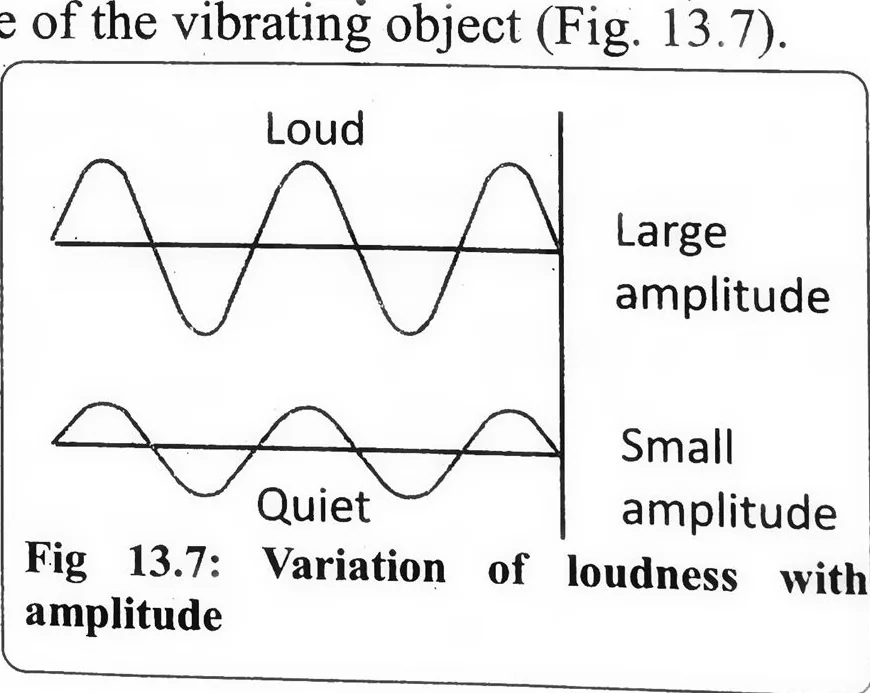
i. Amplitude of the vibrating body
- The loudness of sound depends on the amplitude of the vibrating object (Fig. 13.7)
- If we pluck the strings of a guitar with more force, the vibrations will have greater amplitude, producing a louder sound.
- Likewise, striking a drum harder causes its membrane to vibrate more intensely, resulting in a louder noise.
ii. Area of the vibrating body
- The loudness of sound is also influenced by the size of the vibrating surface.
- A large drum produces a louder sound than a smaller one because its greater surface area allows more air to vibrate.
- Similarly, striking a tuning fork alone creates a faint sound, but placing it on a solid surface, like a bench, amplifies the sound.
- This demonstrates that a larger vibrating area increases loudness, while a smaller area produces a weaker sound.
iii. Distance from the vibrating source
- The loudness of a sound decreases as the distance between the vibrating source and the listener increases. This occurs because the amplitude of the sound wave diminishes with distance.
iv. Listener's hearing ability
A person with sensitive ears perceives sound as louder compared to someone with hearing impairment. However, there is a physical characteristic of sound that remains independent of the listener's hearing ability. This is known as the intensity of sound, which is a measurable quantity and does not rely on human perception.
2. Pitch
Definition "Pitch is the characteristic of sound that allows us to differentiate between a shrill and a deep (grave) sound."
Explanation
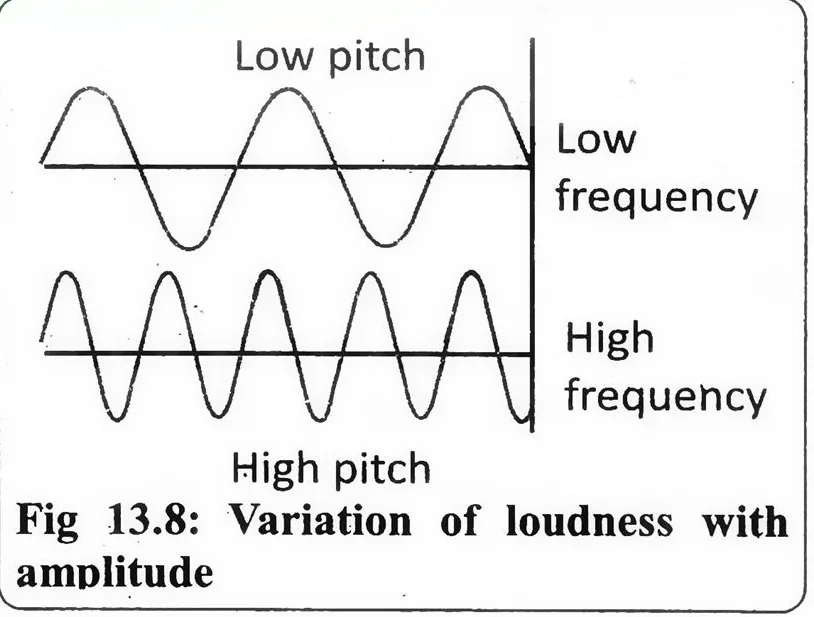
- It is directly related to frequency, higher frequency results in higher pitch, while lower frequency produces lower pitch.
- For example, the voices of women and children have a higher frequency, making them shrill and high-pitched, whereas the voices of men have a lower frequency, giving them a deeper and lower-pitched sound.
- The relationship between pitch and frequency is represented in Fig. (13.8).
3. Quality of Sound
Definition "The quality of sound, is the characteristic that allows us to differentiate between two sounds having the same loudness and pitch."
Explanation
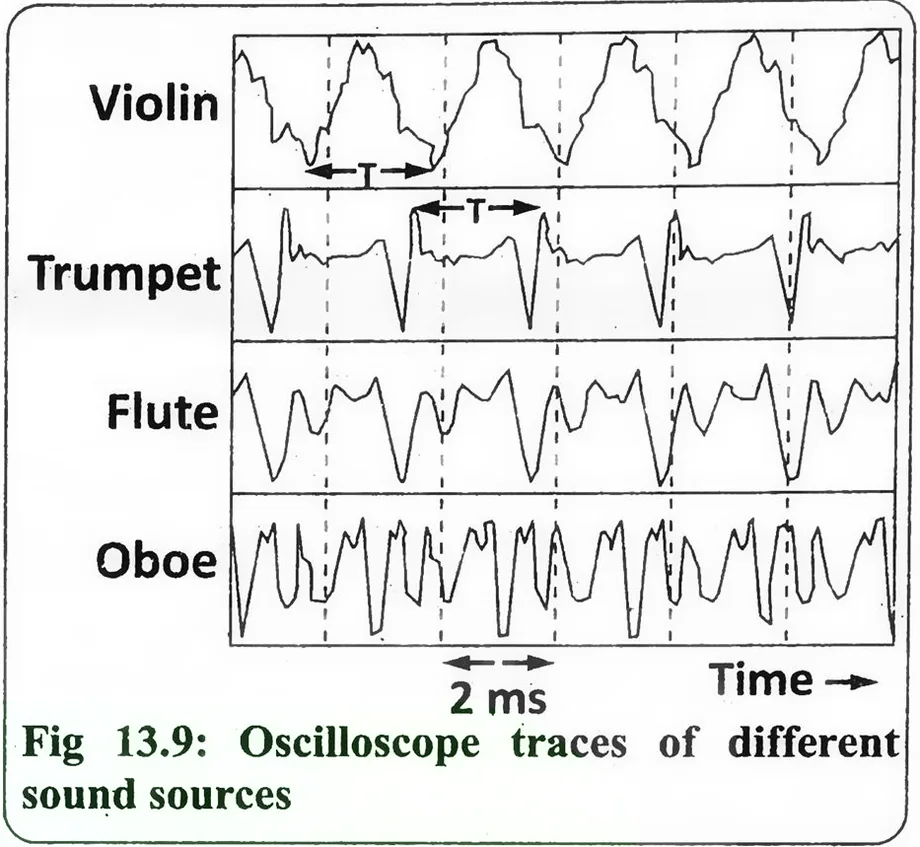
- This distinct quality arises due to the unique waveforms produced by each sound source. For example, a violin, trumpet, flute, and oboe each generate a distinctive waveform. As illustrated in Fig. 13.9, the oscilloscope traces of these instruments show different shapes, with varying levels of complexity and harmonic content.
- The violin has a rich, complex waveform, while the flute produces a simpler, more regular waveform.
- The trumpet and oboe each exhibit their own unique oscillation patterns, further demonstrating the diversity in sound production among instruments.
- The shape of these waveforms, when displayed on an oscilloscope, visually represents the timbre (quality) of each instrument.
- These differences in waveform structure are key to understanding how different sound sources can produce sound waves with varying qualities, despite having the same pitch and loudness.
Musical Sounds and Noise
In daily life, we hear sounds of different qualities. Musical instruments like the guitar, violin, recorder, and drum produce sounds with controlled pitch and quality, which are pleasant to hear. Such sounds are called musical sounds. However, some sounds, like traffic noise, door slamming, and machinery, are harsh and unpleasant. These are classified as noise. Noise results from irregular and sudden vibrations and is considered a form of pollution that affects both humans and animals.
Effects of Noise Pollution
Excessive noise from industrial machinery, vehicle horns, alarms, and construction work can lead to stress, lack of concentration, hearing loss, sleep disturbances, aggression, and hypertension.
Controlling Noise Pollution
The recommended safe noise level is 85 – 90 dB for a maximum of eight-hour workday. Noise pollution can be reduced by
(i) using quieter, eco-friendly machinery.
(ii) installing sound barriers.
(iii)wearing hearing protection devices.
By controlling noise pollution, we can create a healthier environment.
Reflection (Echo) of Sound
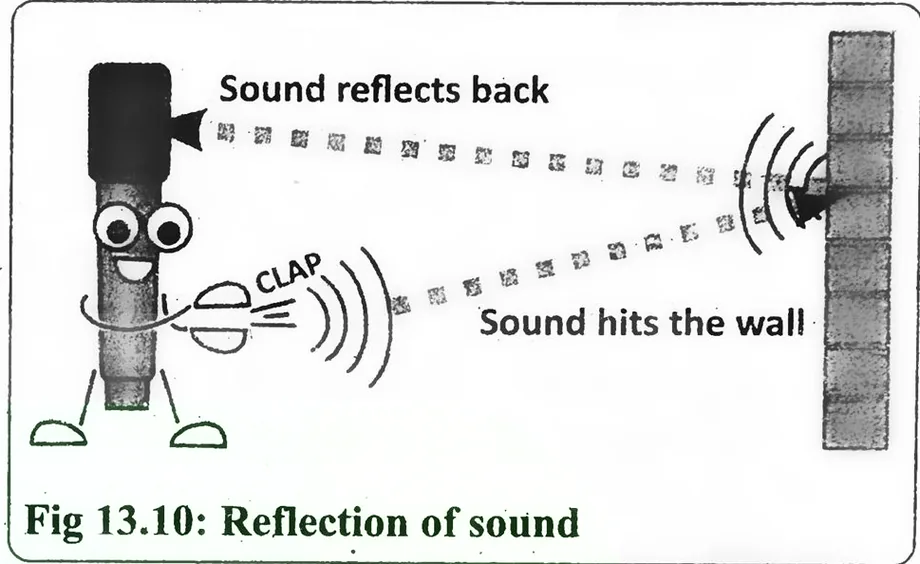
Definition "When sound waves hit a surface and bounce back into the same medium, the phenomenon is called an echo or reflection of sound."
Explanation
- When we clap or shout near a tall building or mountain, we hear the sound return after a brief delay (Fig.13.10). This repeated sound is called an echo, caused by the reflection of sound waves from a surface.
- The human brain retains sound for about 0.1 seconds, so to hear a distinct echo, the reflected sound must reach us after at least 0.1 seconds. Given the speed of sound in air (340 m s⁻¹), the minimum distance for 'an echo to form is 34 metres (total distance travelled by sound), meaning the reflecting surface must be at least 17
metres away. Echoes can also repeat multiple times due to successive reflections.
Activity (Reflection of Sound)
- Take two identical plastic tubes of appropriate length (or create them using chart paper) as shown in Fig. 13.11
- Position the tubes on a table, ensuring they are near a wall.
- Place a clock close to the open end of one tube and listen for its sound through the other tube.
- Adjust the alignment of the tubes until the sound of the clock is distinctly heard.
- Measure the angles of incidence and reflection, then analyze their relationship.
- Gently raise the right tube slightly upward and observe any changes that occur.
Measuring Speed of Sound by Echo Method
1. Apparatus: Measuring tape, stopwatch, flat wall that can produce a good echo.
2. Procedure
a. Use a measuring tape to mark a 50 m distance from a wall.
b. Stand at this point and clap your hands, listening carefully for the echo from the wall. Ensure the echo is not reflecting from any other nearby structures. The time interval between the clap and its echo represents the time taken for sound to travel 100 m.
c. Begin clapping rhythmically and start a stopwatch with the first clap. Count each clap and stop both the clapping and the stopwatch upon hearing the echo of the 10 th clap.
d. Determine the average time for 10 claps. By calculating the time interval t between consecutive claps and applying the formula; S = vt, the speed of sound can be computed.
Refraction and diffraction of sound
1. Refraction of Sound
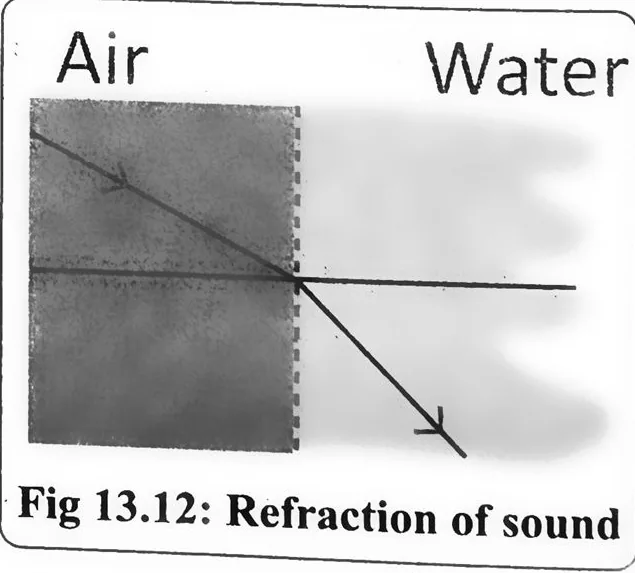
Definition "Refraction occurs when sound waves change direction due to a variation in the medium's properties, such as density or temperature. This change occurs because the speed of sound differs in various materials."
a. Explanation
Sound waves, like other waves, exhibit various behaviours, including refraction and diffraction, in addition to reflection.
b. Example
When sound waves travel from air into water, they bend due to the difference in density, causing sound to move faster in water than in air. This is why a submerged person can clearly hear underwater sounds, person can clearly hear underwater sounds, while someone above the surface may struggle to hear them (Fig.13.12).
2. Diffraction of Sound
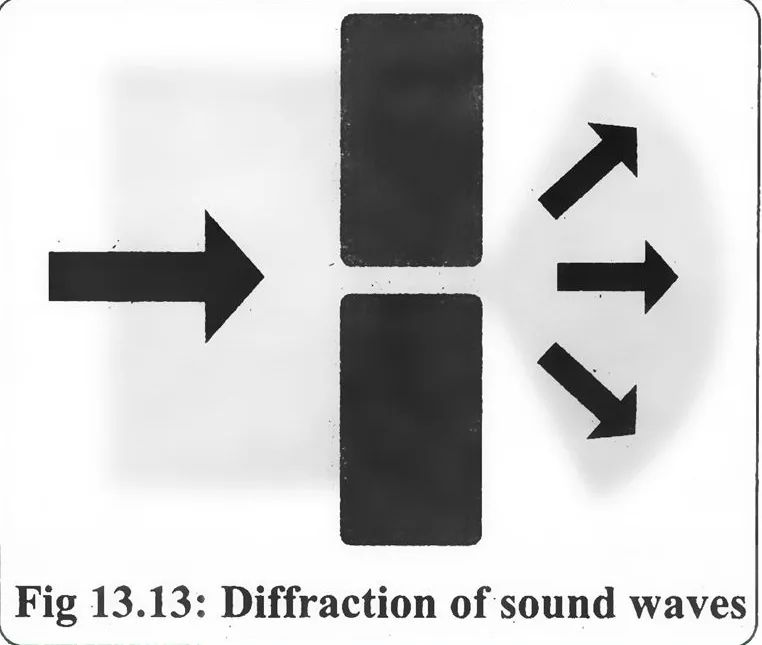
Definition "Diffraction is the bending of sound waves around obstacles or through openings. It allows sound to spread out and be heard even when the source is not directly visible."
a. Explanation
Diffraction occurs when sound waves bend around obstacles or spread out after passing through narrow openings (Fig. 13.13). This property allows sound to be heard even when the source is not in direct view.
b. Examples
- If someone is speaking from behind a wall, his voice can still be heard because the sound waves bend around the barrier.
- Similarly, sound can travel through an open doorway and spread into a room, allowing people inside to hear noises from the outside even if they cannot see the source.
- We can hear someone speaking even if he is around a corner or behind a wall. This is because sound waves diffract around the obstacle and reach our ears.
Audible Frequency
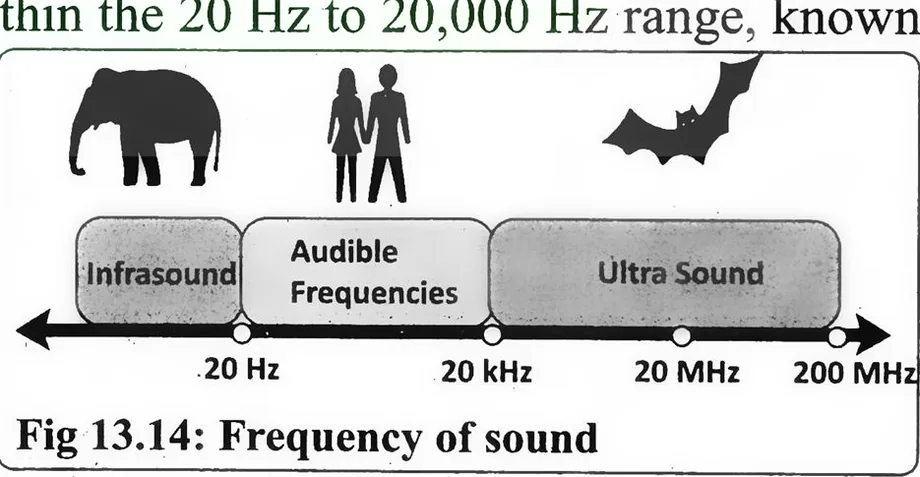
Definition "The human ear can detect sounds within the 20 Hz to 20,000 Hz range, known as the audible frequency range."
Explanation
- Sounds below 20 Hz or above 20,000 Hz are inaudible to humans (Fig. 13.14).
- Hearing ability declines with age.
- Young children can hear up to 20,000 Hz, while older individuals may struggle with sounds above 15,000 Hz.
Infrasound
Definition "Infrasound refers to sound waves below 20 Hz, which humans cannot hear but may feel as vibrations."
1. Explanation
- Many animals, like elephants and whales, use infrasound for communication.
- It is produced by natural events (earthquakes, volcanoes), industrial processes, and human activities (machinery, explosions).
- Due to its ability to travel long distances, infrasound is used for monitoring natural disasters.
2. Uses of Infrasound
a. Elephant Communication
- Elephants use infrasound to communicate over long distances.
- Their deep rumbles travel far through air and ground, helping them stay connected.
- They can sense these vibrations not just with their ears but also through their feet and trunks.
b. Earthquake Detection
- Scientists use infrasound to detect earthquakes before the strong shaking starts.
- These low frequency waves act as an early warning system.
c. Volcano Monitoring
- When a volcano erupts, it creates unique infrasound waves.
- Scientists study these waves to predict eruptions and assess risks.
d. Nuclear Explosion Detection
Special sensors track infrasound waves from nuclear explosions.
Ultrasound
Sounds with frequencies above 20,000 Hz, which are inaudible to humans, are called ultrasound or ultrasonics.
Uses of Ultrasound
a. Medical Applications
- Ultrasound is widely used in medical. When ultrasonic waves pass through the body, they reflect differently from various tissues and organs.
- These reflected waves are then captured and converted into images on a screen, a process known as ultrasonography.
- This helps in visualizing organs such as the heart, liver, and kidneys, as well as in monitoring pregnancies. For example, parental scanning uses ultrasound to observe the fetus inside the womb, assess its development, and detect any potential issues. Additionally, ultrasound aids in thyroid gland imaging for diagnosis, providing clear visual representations that help doctors evaluate thyroid health.
b. Underwater Exploration (SONAR)
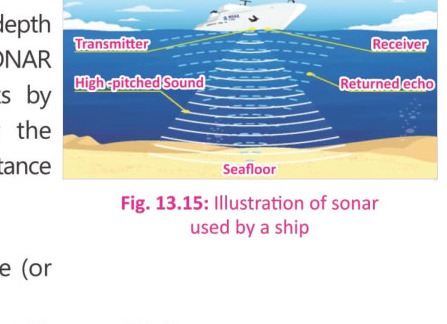
Ultrasound is used to measure ocean depth and locate objects on the seabed. SONAR (Sound Navigation and Ranging) works by sending ultrasonic waves into water; the reflected waves help to determine the distance and shape of an object (Fig. 13.15).
c. Calculating Distance in Sonar
The formula used to calculate distance (or depth) in sonar systems is:
Distance = (Speed of Sound in Water × Time) / 2 ............. (13.2)
Where speed of sound in water is approximately 1500 ms⁻¹ at room temperature.
- Time is the duration it takes for the ultrasound pulse to travel to the object and return to the source.
- The distance is divided by 2 because the pulse travels to the object and then returns to the source.
d. Industrial Applications
- Ultrasound helps to detect cracks in machines like turbines, ship engines, and airplane parts. Ultrasound waves reflect from damaged areas, revealing hidden defects.
- It is also used to destroy bacteria in liquids through high-intensity waves.
Acoustics of Buildings
- Acoustic protection reduces unwanted sound using soft, porous materials like carpets and curtains, which absorb sound and minimize echoes.
- Hard, smooth surfaces reflect more sound, while excessive absorption can weaken audibility in classrooms and halls (Fig.13.16-a).
- Multiple reflections, known as reverberation, can distort sound, so a balance between reflection and absorption is essential in auditoriums, lecture halls, and theaters.
- Reflective surfaces behind the stage help direct sound to the audience.
- Additionally, curved ceilings and sound boards are often used to ensure even sound distribution throughout the hall (Fig.13.16-b).
More figures from this unit