 StudentAid
Unit 15: Electrostatics — Long Questions
10th Class Physics · Unit 15: Electrostatics
Definition "Electric charge is a fundamental property of matter that causes it to experience a force when placed in an electric field leading to attraction or repulsion."
Explanation The phenomenon of attraction or repulsion between objects is due to a property called electric charge.
- We have already learnt that an object's mass is an inherent property. Objects with smaller mass have less inertia than those with larger mass.
- Similarly, another intrinsic property of an object is its electrical charge.
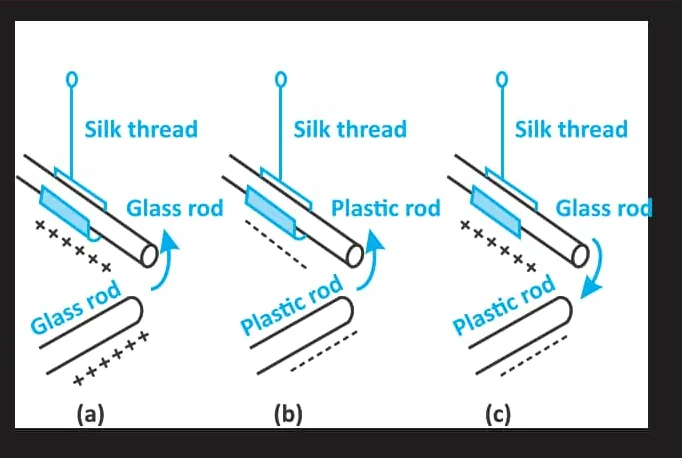
- There are two types of electric charges, known as positive and negative, which can be demonstrated through a simple experiment (Fig. 15.1).
- The SI unit of charge is the coulomb (C).
Experiment Figure 15.1 shows electrostatic interactions between glass and plastic rods after being charged by friction.
- In the first scenario (a), two glass rods that have been rubbed with silk cloth are brought close to each other. Since both rods acquire a positive charge, they repel each other due to the fundamental principle that like charges repel.
- In the second scenario (b), two plastic rods, likely rubbed with wool or fur, are placed near each other. Both rods gain a negative charge, leading to repulsion, as similar charges push away from each other.
- Lastly, in scenario (c), a positively charged glass rod (rubbed with silk) is brought near a negatively charged plastic rod (rubbed with fur or wool). Unlike the previous cases, attraction is observed because opposite charges attract.
Conclusion This set of experiments clearly demonstrates the basic electrostatic rule that like charges repel while opposite charges attract.
Nature of Charge
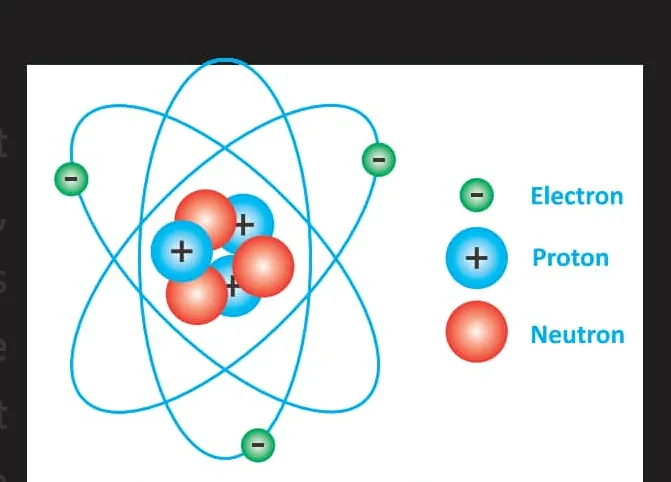
- Matter is composed of atoms, which consist of subatomic particles. Among these, protons are positively charged particles located in the nucleus, while electrons are negatively charged particles that orbit around the nucleus (Fig. 15.2).
- Since everything is composed of atoms, every material carries either a positive charge, a negative charge, or neutral.
Transfer of Charge
- Charge is an essential property of materials that causes them to either attract or repel.
- Charge can be transferred between objects through various processes, including rubbing, direct contact, or induction.
Conservation of Charge The total amount of charge in an isolated system remains constant.

(a) When a plastic comb (or rod) is rubbed through dry hair and is brought near small pieces of paper, it attracts them (Fig. 15.3).
(b) Similarly, an amber rod when rubbed with silk attracts small pieces of paper.
(c) We often experience a shock when we touch a metal doorknob, after sliding across a car seat or walking on a synthetic carpet. In each of these cases, the electrostatic force, resulting from electric charges, is in action.
Definition "In the presence of a charged object, an insulated conductor develops a positive charge at one end and a negative charge at the other end. This process is known as electrostatic induction."
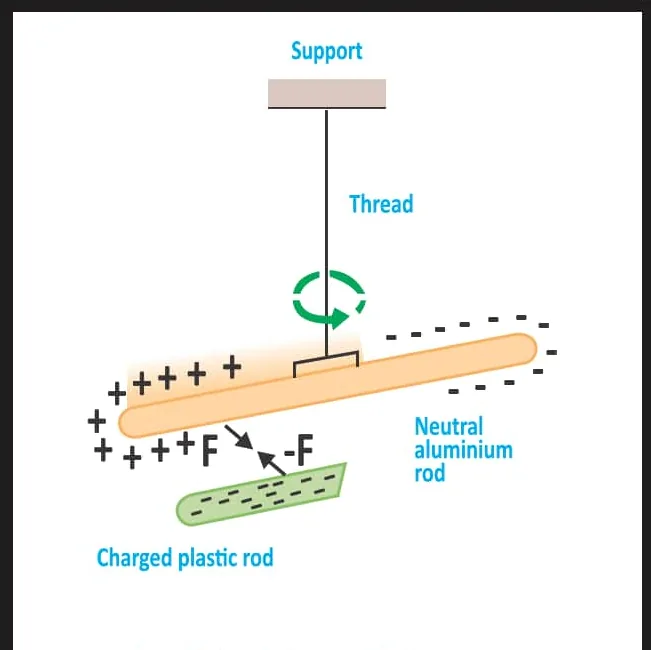
Activity When a charged plastic rod is brought near a suspended neutral aluminum rod, both rods are drawn toward each other, as shown in Fig. 15.4. At first glance, this attraction suggests that the rods have opposite charges. However, this is not the case. The charged plastic rod causes a redistribution of positive and negative charges within the neutral aluminum rod, leading to the attraction. Despite this, the total charge on the aluminum rod remains zero. This indicates that attraction alone is not a reliable method to determine if an object is charged. The observed behaviour is an example of a phenomenon known as electrostatic induction.
Explanation
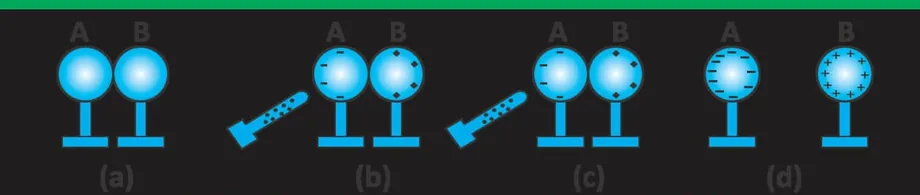
- Take two metal spheres, A and B, and place them on insulated stands so that they are in contact with each other, as shown in Fig. 15.5(a).
- Now bring a positively charged rod close to sphere A, as shown in Fig. 15.5(b). The charged rod will attract the negative charges towards it and repel the positive charges away from it. This clearly shows that unlike charges attract each other, while like charges repel each other.
- As a result, negative charge accumulates on the left surface of sphere A, which is closer to the rod, while positive charge appears on the right surface of sphere B.
- Now separate the spheres while keeping the charged rod near sphere A.
- Upon testing the two spheres, we will find that they are oppositely charged, as shown in Fig. 15.5(c). After removing the rod, the charges are evenly distributed across the surfaces of the spheres, as seen in Fig. 15.5(d).
- In this process, equal and opposite charges appear on each sphere. This phenomenon is known as charging by induction.
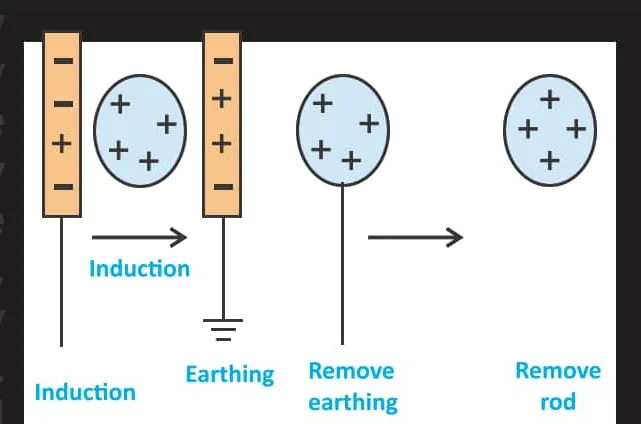
Charging by Induction — Definition "Charging by induction is a method of charging a conductor without directly touching it with a charged object. It involves the redistribution of electric charges within a conductor when exposed to a nearby electric field."
Explanation Bringing a negatively charged rod near a neutral metal sphere causes free electrons in the conductor to move away due to repulsion, leaving the near side positively charged and the far side negatively charged. This separation is electrostatic induction.
Charging by Earthing Earthing is the process of connecting a conductor to the Earth using a conducting wire. While the charged rod is still in place, the conductor is connected to Earth (Fig. 15.6). Since the far side of the sphere is negatively charged, electrons flow from the sphere to the Earth, neutralizing the negative charge. After the unwanted charges have flowed away the grounding connection is removed, then the charged rod is taken away. The conductor now has a net positive charge, even though it was never touched by the rod.
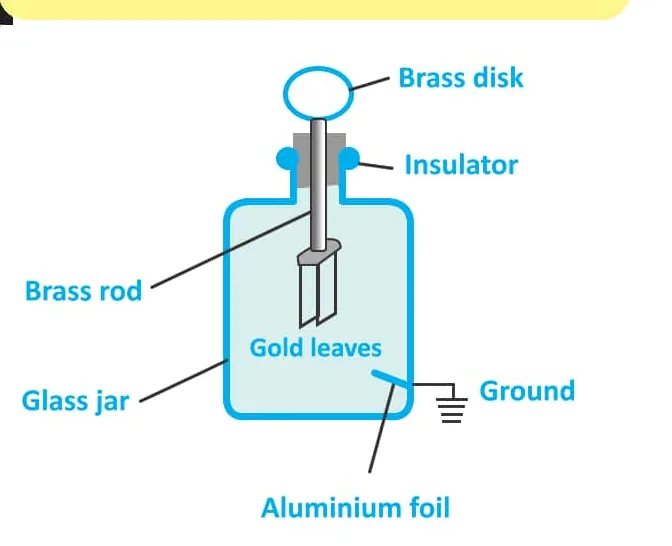
Definition "The gold leaf electroscope is a sensitive device which is used to detect electric charges."
Construction It consists of a brass rod with a brass disk at the top and two thin gold leaves suspended at the bottom (Fig. 15.7). The rod passes through an insulating material which holds it in place. Charges can move freely from the disk to the leaves via the rod. A thin aluminium foil is attached to the lower part of the inside of the jar, typically grounded by a copper wire, which protects the gold leaves from external electrical interference.
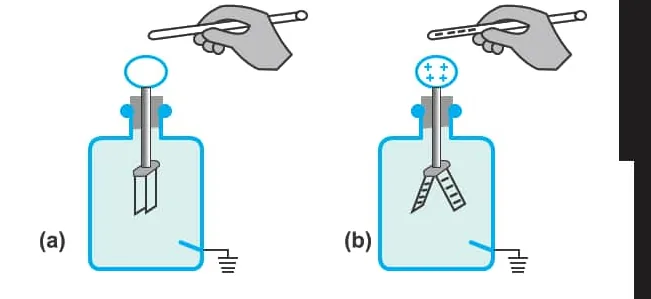
Working Bring the object near the disk of an uncharged electroscope. If the object is neutral there is no deflection of the leaves (Fig. 15.8-a). If the object is charged either positively or negatively the leaves diverge; for a negatively charged object, induction causes a positive charge on the disk and a negative charge on the leaves (Fig. 15.8-b), and since both leaves carry the same charge they repel. The extent of divergence depends on the amount of charge. An electroscope can also distinguish conductors from insulators: if the leaves collapse from a previously diverged position, the material is a good conductor, as charge can flow.
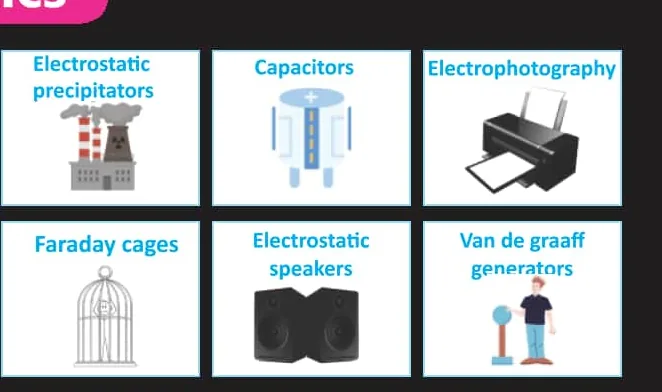
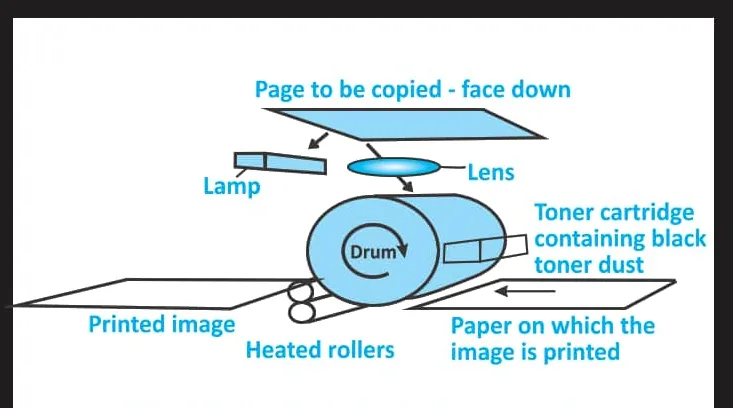
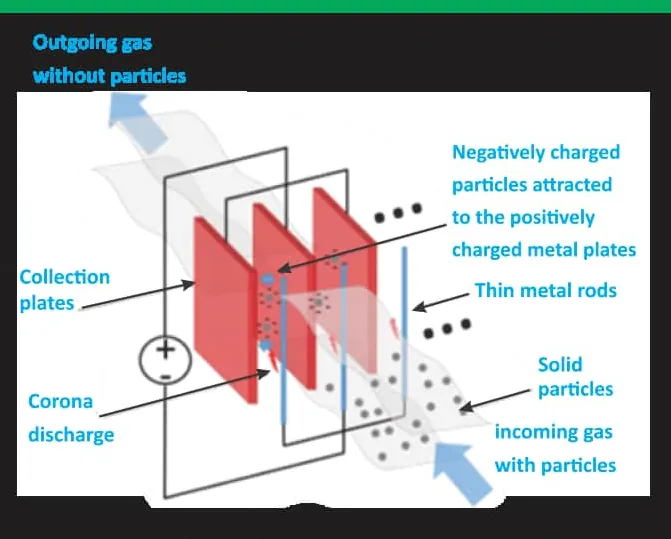
There are many applications of electrostatics with conductors (Fig. 15.9): electrostatic precipitators, capacitors, electrophotography, Faraday cages, electrostatic speakers and Van de Graaff generators.
Photocopier — Definition "A photocopier is an electronic machine used to make copies of documents and images." Working principle: it works on a process called xerography, derived from the Greek words "xeros" (dry) and "graphos" (writing), meaning "dry writing."
Photocopier construction the central part contains a rotating drum composed of aluminium and coated with a layer of selenium. Aluminium is a good conductor of electricity, while selenium is a photoconductor — it behaves like an insulator in the dark but conducts electricity when exposed to light (Fig. 15.10).
Photocopier working the process begins by applying a positive charge to the drum. In the dark this charge stays on the surface because selenium does not allow current to pass. When light falls on the drum, electrons from the aluminium move through the selenium and remove the positive charge from those areas. When the image of the document is projected on the drum, the bright areas lose their charge and the dark areas remain positively charged, creating an invisible electrostatic image. A fine dry black powder called toner is given a negative charge and spread over the drum; it sticks only to the positively charged image areas. A neutral sheet of paper passes under the drum with a slightly positive roller behind it, which pulls the toner onto the paper. Finally the paper goes through heated rollers that melt and press the toner into the paper, making the image permanent.
Electrostatic Precipitator — Definition "An electrostatic precipitator (ESP) is a device used to remove particulate matter from industrial exhaust gases." Working: corona discharge is an electrical phenomenon where a high voltage ionizes the air around a conductor (e.g. a thin wire), creating a plasma region that releases electrons. These electrons attach to nearby gas molecules, forming negative ions. The device charges the particles in the gas stream by passing them through a corona discharge, which imparts a negative charge to the particles. These charged particles are then attracted to positively charged collection plates, where they adhere and are removed from the gas stream. Periodically the collection plates are discharged to remove the accumulated particles, which fall into a hopper for disposal.
Importance this process ensures efficient removal of pollutants from the air, making electrostatic precipitators essential in reducing industrial emissions (Fig. 15.11).
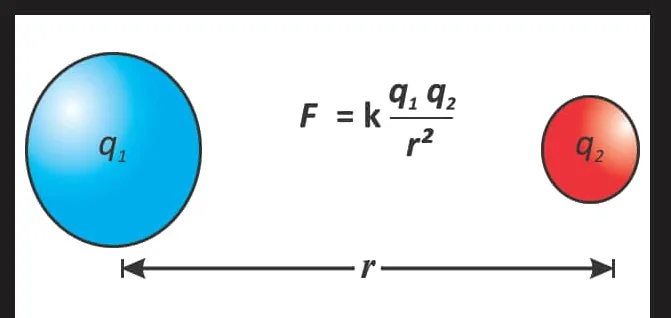
Coulomb's Law Charges can repel and attract each other with a force called electrostatic force. Charles Coulomb in 1785 provided an experimental law to explain the nature and magnitude of electrostatic force between the charges.
Statement The magnitude of the electrostatic force between two point charges is directly proportional to the product of magnitude of these charges and inversely proportional to the square of the distance between them.
Explanation
Consider two charges q₁ and q₂ separated by distance r (Fig. 15.12).
F ∝ q₁q₂ … (15.1)
F ∝ 1/r² … (15.2)
F ∝ q₁q₂/r²
F = k q₁q₂/r² … (15.3)
Where 'k' is a constant of proportionality which quantifies the strength of the electrostatic force between two point charges. The value of k is determined by the medium between the charges. In vacuum or air, k is approximately 9 × 10⁹ N m² C⁻². Coulomb's law is applicable primarily to point charges whose sizes are negligible compared to the distance separating them.
Electric Field — Definition "An electric field is the region around a charge where it exerts a force on other charges."
Explanation One charge exerts a force on another charge. This force is present everywhere around the charge, theoretically extending to infinity; however, the strength of the force decreases with distance. The region around a charge where it can attract or repel another charge is described by the concept of the electric field.
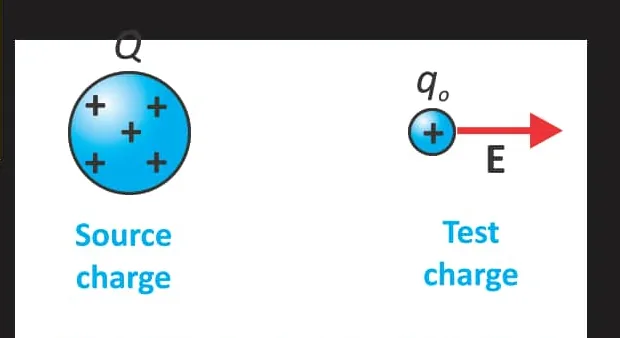
Electric Field Intensity — Definition "The electrostatic force per test charge (unit positive charge) when it is brought to the electric field of a source charge is called electric field intensity."
Mathematically
E = F / q₀ … (15.4)
Unit: The SI unit of electric field intensity is newton per coulomb (N C⁻¹).
The electric field strength decreases with distance from the charge, following an inverse square law for point charges: E = k q / r² … (15.5)
Consider a test charge q brought into the electric field of a source charge Q (Fig. 15.13). The source charge exerts an electrostatic force FE on the test charge. Electric field intensity is a vector quantity having both magnitude and direction. The direction of electric field intensity at a point is the direction of force on a positive test charge at that point.
Definition "The imaginary lines which give the information about strength and direction of electric field at any point in space is called electric field lines." (OR) "It represents the path followed by a small positive test charge in an electric field."
Explanation
- The concept of an electric field demonstrates how a charged object affects other nearby charged objects.
- The electric field is a vector field, which means it has both magnitude and direction.
- The direction of the electric field at any point is the direction in which a positive test charge would move if placed at that location.
Around a Point Charge
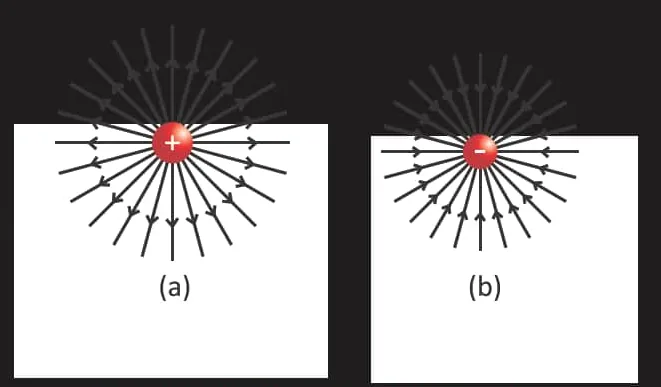
- Around a point charge, the electric field is radial, extending outward in all directions. For a positive point charge (Fig. 15.14-a), the electric field lines radiate outward, indicating that a positive test charge placed nearby would be repelled.
- In contrast, for a negative point charge (Fig. 15.14-b), the electric field lines point inward, showing that a positive test charge would be attracted towards it.
- This reflects the repulsive force around positive charges and the attractive force around negative charges.
Around a Charged Conducting Sphere:
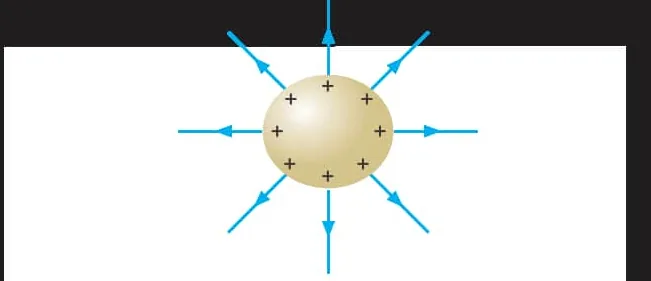
- A charged conducting sphere distributes its charge evenly on its surface, and the electric field around it behaves similar to that of a point charge, but only outside the sphere.
- Outside, the electric field lines are radial, radiating outward for a positively charged sphere and inward for a negatively charged one (Fig. 15.15).
- Inside the sphere, the electric field is zero because the charges on the surface rearrange to cancel any internal electric field.
Between Two Oppositely Charged Parallel Conducting Plates:
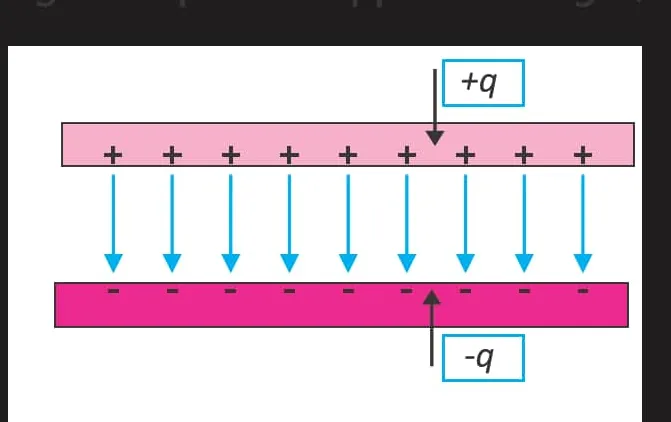
- When two large parallel conducting plates are given equal and opposite charges, a uniform electric field is created between them, commonly used in capacitors (Fig. 15.16). The electric field lines point from the positively charged plate to the negatively charged plate.
- They are parallel and equally spaced, showing a uniform electric field. This uniformity means the electric field has the same magnitude and direction at all points between the plates, which is due to the plates being large and close together, minimizing edge effects.
1. Electrical Conductors — Definition: "Electrical conductors are materials that allow electric charge to flow freely through them."
Atomic structure: they have loosely bound electrons in their atomic structure, which can flow easily when a voltage is applied, creating an electric current.
Examples: metals such as copper, aluminum and silver, as well as materials like graphite and electrolytes.
Use: power transmission, kitchen pans, electronics and wiring.
2. Electrical Insulators — Definition: "Electrical insulators are materials that resist or prevent the flow of electric charge."
Atomic structure: in insulators, electrons are tightly bound to their atoms and cannot move freely. As a result they do not allow electric current to pass through them.
Examples: rubber, plastic, glass, wood and ceramics.
Uses: to block the flow of electricity and provide safety in electrical systems.
Experiment build a circuit with a battery, a bulb and a gap to test materials. Insert objects like a metal key, a plastic spoon or a wooden stick into the gap. If the bulb lights up the material is a conductor; if it stays off, it is an insulator.
Differentiation (Free Electron Model) in conductors, such as metals, the outermost electrons of atoms are loosely bound and can move freely throughout the material. These "free electrons" act like a sea of mobile charges, allowing electric current to flow easily when a voltage is applied. In contrast, insulators like rubber or plastic have electrons that are tightly bound to their atoms and cannot move freely. When a voltage is applied to an insulator the electrons remain fixed, preventing the flow of electric current.
Accumulation of Charges the accumulation of charges, often referred to as static electricity, occurs when electrons are transferred from one object to another, leading to an imbalance of positive and negative charges.
Consequences this buildup can have several consequences. In everyday life it can cause minor shocks when touching metal objects, or make clothes cling together. In industrial settings accumulated charges can be more serious, potentially damaging electronic components, igniting flammable substances, or disrupting manufacturing processes.
Precautions proper grounding, antistatic measures and humidity control are often employed to mitigate these risks and prevent the harmful effects of charge accumulation.
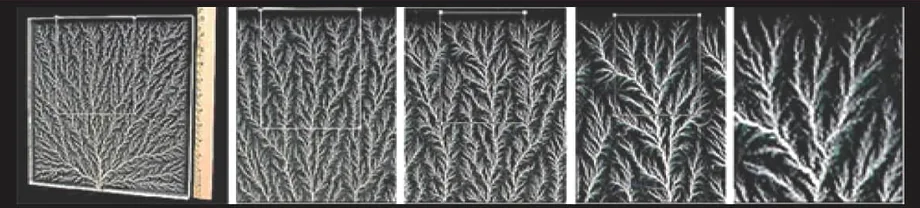
Electrical breakdown — Definition "Electrical breakdown occurs when a strong electric field passes through a gas (or insulating material), causing its atoms to ionize. This ionization creates free electrons and ions, which can conduct electricity."
Explanation when the electric field is strong enough it can lead to a sudden, dramatic increase in conductivity, often resulting in a spark or arc. This phenomenon is responsible for natural events like lightning, where the electric field in the atmosphere ionizes air, creating a conductive path for the discharge.
Examples
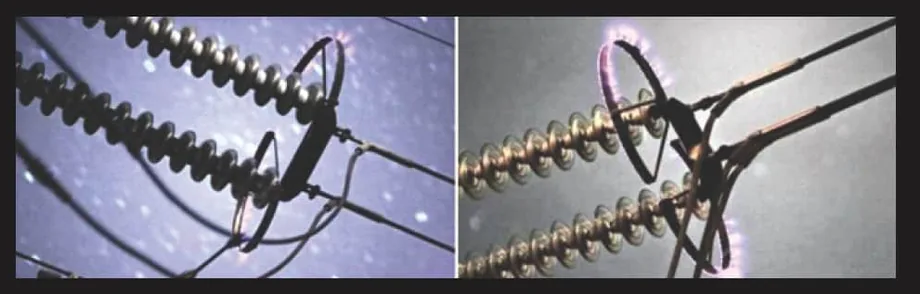
(a) Corona discharge — a visible form of electrical breakdown that occurs when a high-voltage electric field ionizes the air around a conductor, typically near sharp points or edges where the electric field is strongest (Fig. 15.17). This ionization produces a faint glow or "corona" and is often seen around high-voltage power lines or antennas, while less intense than a full spark.
(b) Lichtenberg figures — branching, tree-like patterns that form on insulating materials (like wood or acrylic) when a high-voltage electrical discharge passes through them (Fig. 15.18). The patterns result from the electrical breakdown of the material, leaving behind visible traces of the discharge path. They are named after the German physicist Georg Christoph Lichtenberg, who first documented them.
Both corona discharge and Lichtenberg figures are visible examples of electrical breakdown, demonstrating how strong electric fields can ionize materials and create conductive paths.
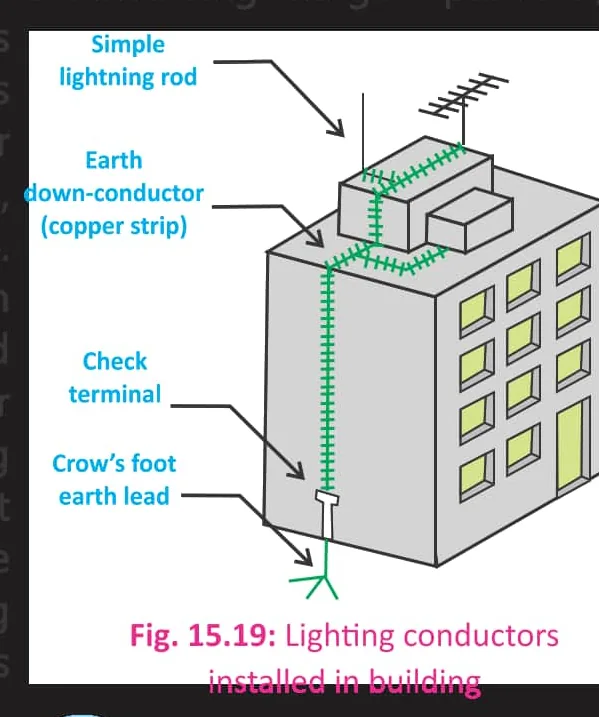
Lightning conductors, or lightning rods, are protective devices installed on tall structures to safeguard them from lightning strikes. A lightning rod provides a low-resistance path for the electrical discharge to follow, directing the massive current safely into the ground. This prevents the lightning from passing through the building, which could cause fires, structural damage, or harm to humans. By channeling the lightning's energy safely away, the rod protects both the structure and its occupants (Fig. 15.19).
Lightning is generated through a complex process involving charge separation, electric field buildup, and discharge. It begins with friction between water molecules suspended in clouds during thunderstorms, or between smoke particles in volcanic plumes, leading to the accumulation of electric charge.
As these charges separate within the cloud, an intense electric field develops. When this field reaches a critical level, the surrounding air undergoes electrical breakdown, forming lightning streamers — ionized channels that create a conductive path for current flow. In the case of cloud-to-ground lightning, the strong electric field from the charged clouds induces an opposite charge on the Earth's surface, particularly in conductive materials. When the electric potential difference becomes large enough, it overcomes air resistance, allowing a rapid discharge of electricity between the cloud and the ground. This discharge results in the brilliant flash and thunder that characterize lightning, with some strikes occurring from cloud to cloud or even from the ground to the cloud in response to charge redistribution.