 StudentAid
Unit 20: Water — Long Questions
10th Class Chemistry · Unit 20: Water
Key points Water | Identification of Presence of Water
Water
Water is essential for all forms of life on earth.
• All living organisms contain plenty of water in them. They also need water every day to support life.
• About 60 – 70% of human body is made of H₂O.
• Water regulates body temperatures.
• Plants need water for photosynthesis.
• It transports nutrients and oxygen to all cells of body
Identification of presence of water
Identifying the presence of water has many important applications which include determining the purity of substances and analyzing chemical reactions.
Test for water
Testing water is important for food and pharmaceutical industries where the presence of water can affect the product quality and safety
Procedure
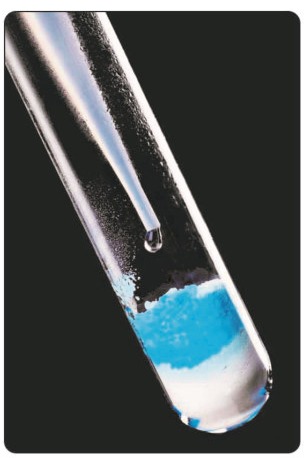
Hydrated copper(II) sulphate (CuSO₄. 5H₂O) is blue in colour but when it is heated, it loses water molecules to become anhydrous copper(II) sulphate which is white in colour
A drop of water on anhydrous sample of copper(II) sulphate changes its colour from white to blue figure 20.1
CuSO₄ + 5H₂O ⟶ CuSO₄ .5H₂O
White Blue
It is a very sensitive test and can detect even a small amount of water
Key pints
Purity of water | Boiling Point Determination
Determination of Melting Point
Purity of water
Pure water boils at 100°C and freezes at 0°C under standard conditions of temperature and pressure. The impurities present in water will change both these physical constants.
Following methods are used to check the purity of water
1. Boiling point determination
The purity of a sample of water can be checked by determining its boiling point at STP
• Pure water: If it boils at 100°C it is pure sample of water.
• Impure water: The presence of impurities in water will slightly increase its boiling point.
2. Determination of melting point
Another test to check the purity of water is to determine melting point of the sample.
• Procedure: For this purpose, cool the sample of water until it freezes. Observe and record the temperature at which the ice begins to melt.
• Pure water: If its melting point is 0°C it is pure water.
• Impure water: A melting point below 0°C suggests the presence of impurities in the sample. The impurities present in water raise the boiling point but lowers the melting point. Both these constants are specific to standard conditions. At high altitudes or lower pressure, these values will change.
Key point Difference Between Tap Water and Distilled Water
Tap water
Source
Water which is supplied to our homes, shops and offices comes through taps and is readily available for any usage is called tap water.
• It may either come from rivers, lakes and ponds or from underground sources.
Purity
Tap water contains.
• Minerals like calcium (Ca⁺²) and magnesium (Mg⁺²) depending upon the source from where it is obtained.
• It also contains chlorine and fluorine, salts which are mixed with it during treatment
• Particles of dust, rust and other particulate matter may also be present.
pH of tap water: Its pH has the range of 6.5 to 8.5 depending upon its source.
Conductance It is a conductor of electricity due to the presence of free ions from dissolved minerals.
Uses It is used in cooking, washing, cleaning and sometimes drinking purpose.
Distilled water
Source Water obtained after the process of distillation. The process involves heating water to get steam and then condensing this steam back into liquid water
Purity This water is obtained by the process of distillation is called distilled water The process effectively removes all dissolved minerals, microorganisms and contaminants from water leaving behind only pure water Distilled water contains only water .molecules without any bacteria, ions, gases or other contaminants.
pH of distilled water: Its pH is exactly equal to 7.
Conductance It is a bad conductor of electricity due to absence of ions.
Uses The purity of distilled water makes it ideal for use in the laboratories, medical procedures and pharmaceutical industry. Its purity ensures accurate scientific measurements, sterilization of medical equipments and to prevent corrosion. It is safe to drink but may not have necessary minerals needed for the body.
Key points
Substances Present in Water Obtained from Natural Sources |
Useful Substances | Harmful Substances and their Effects on the Quality of Water
Substances present in water obtained from natural sources
Water from natural sources such as rivers, lakes and aquifers contains a number of substances which may be useful or harmful for our health.
1. Useful substances
Dissolved oxygen Oxygen enters the natural water from the atmosphere through the process of diffusion. It is also produced by aquatic plants and algae in the process called photosynthesis.
Use of dissolved oxygen This absorbed oxygen is then used by the aquatic organisms including fish to breathe and survive. The health and diversity of an ecosystem directly depends upon the amount of dissolved oxygen in a water body.
2. Harmful substances and their effects on the quality of water
(i) Harmful microbes
Both surface and ground water which are vital sources of fresh water can be contaminated by various human activities.
Sources Harmful microorganisms like bacteria, viruses and parasites enter into natural water through human and animal wastes, landfills, agricultural runoff and waste water from industries.
Faulty Septic tanks Sewage from wastewater treatment plants or from faulty septic tanks can release pathogens directly into nearby water body.
Diseases caused by bacteria These bacterial contents in waste water can cause such infectious diseases as dysentery, typhoid, hepatitis and cholera.
(ii) Heavy metals and their compounds
Heavy metals like lead, mercury, cadmium and chromium and their compounds can enter in natural water through many routes.
Sources Waste water from factories may contain heavy metals and their compounds, which are eventually released into rivers and other water bodies. Similarly, mining operations and use of fertilizers and pesticides can contaminate both ground and surface water with heavy metals and their compounds.
Harmful effects Heavy metals and their compounds not only damage vital organs like liver and kidney, they can also lead to neurological problems. Arsenic and cadmium are known to increase the risk of certain cancers.
(iii)Plastics
Very small particles of plastics called microplastics are present in both tap and bottled water.
Sources These tiny particles can enter water through wastewater, rainwater when it carries plastic debris to water sources, and by degradation of plastic waste.
Harmful effects Plastic tiny particles have been found in some human organs like lungs and blood. These particles can disturb the immune and reproductive systems.
(iv) Nitrates and phosphates
Sources Nitrates and phosphates enter natural waters through weathering of rocks. They can also enter in water through human sources such as agriculture fertilizers, detergents and industrial waste water. They are essential nutrients for plant and animal life. However, if amounts of these compounds exceed a limit they can affect the quality of water and cause eutrophication.
Eutrophication Eutrophication is the name of the process which starts in a water body containing excess of phosphorus and nitrogen nutrients.
Harmful effects The excessive amounts of phosphate and nitrate nutrients cause algae and other aquatic plants to grow excessively. This overgrowth of algae, in turn, can decrease the dissolved oxygen level in water which is not only harmful for aquatic life but can also disrupt the entire ecosystem.
Key point Treatment of Domestic Water Supply
Treatment of domestic water supply
Three types of impurities are mostly present in water obtained from natural sources.
(i) Dissolved impurities
(ii) Suspended impurities
(iii) Microorganisms
In order to remove these impurities different methods are applied which include sedimentation, filtration, distillation and treatment with liquid chlorine etc.
1. Sedimentation (Removal of insoluble impurities)
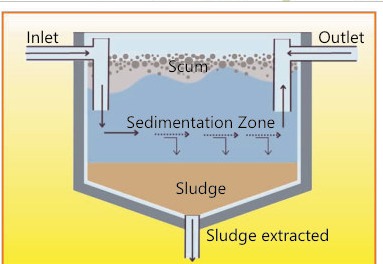
Insoluble impurities present in natural water include soil, pieces of plants and other organic matter and sand. These impurities are bigger in size and are often removed by the process called sedimentation.
Sedimentation tanks In this process water obtained from natural sources is pumped into sedimentation tanks (figure 20.2) where water is allowed to stand for a few hours. The suspended particles present in water settle down at the bottom of the tank due to gravity and form a layer of sediment. The cleaner water at the top can then be extracted for the next stage.
2. Filtration (Removal of Suspended impurities)
This process is used to remove suspended particles of smaller size which are generally not removed in the sedimentation process.
Use of sand and gravel filters: For this purpose, water is allowed to trickle through layer of sand and gravel filters which trap these solid particles.
3. Chlorination (Sterilization)
Water must be sterilized before humans can use it. For this purpose all harmful bacteria and other microbes, must be killed. Mostly a small amount of liquid chlorine is added which has the power to kill all these germs.
4. Removal of odours
Water is passed through powdered activated carbon in the form of charcoal to remove tastes and odours. Activated carbon removes a wide range of organic compounds responsible for taste and odour through absorption.
Aeration Odour can also be removed by exposing water to air in a process called aeration.
Key point Effects of Pollutants Present in Water
Effects of pollutants present in water
Water pollution affects, human health, ecosystems, aquatic organisms and industries that are dependent on good water quality.
Methods to control negative effects of pollutants
Water Pollutants can disrupt aquatic ecosystems through eutrophication and destruction of habitats. Polluted water can also lower crop yields and contaminate food sources.
Negative effects due to water pollution can be controlled by taking a number of steps:
(i) Sewage and industrial waste water should be treated before it is discharged into water bodies.
(ii) Plastics must be reused or recycled to minimize their production.
(iii)Chemical cleaners, fats or oils and grease should never be thrown down the drain.
(iv)Minimize the use of pesticides and fertilizers in agriculture.
(v) General public should be made aware of the harmful effects of water pollution through public campaigns.
(vi)Implement and enforce laws for the strict control of all types of water pollution.
Key points Water Borne Diseases | Prevention of Water – Borne Disease
Water born diseases
The World Health Organization (WHO) has estimated that 80% of the sickness and diseases in the world are caused by polluted water and lack of sanitation. Water-borne diseases include:
• Cholera • Typhoid • Malaria • Nausea • Leprosy
In all nearly 500 million people suffer from water-borne diseases every year in the world.
Examples of diseases people suffer every year
Trachoma Millions of persons are suffering from a disease called 'trachoma' which often causes blindness. This disease is particularly prevalent among babies and children in developing countries.
Liver disease The liver diseases particularly viral hepatitis is also caused by drinking contaminated water.
Prevention of water – borne disease
Water-borne diseases can be avoided if we strictly follow the following instructions.
(i) Drink clean water after removing impurities and boiling to kill the germs.
(ii) Practice hygiene by keeping your body especially hands clean. Ensure proper sanitation facilities are available.
Key points
Water Scarcity in Pakistan | Causes of Water Scarcity |
Steps to Remove Water Scarcity
Water scarcity in Pakistan
Our world is divided into different regions depending upon the annual rainfall which they receive every year
• Pakistan is included in a semi-arid region and hence receives a low rainfall annually.
• Northern Pakistan including Punjab generally receives rainfall within the range 250-600 mm per year mostly during monsoon season.
• In southern Pakistan precipitation is scarce, below 200mm per year
Causes of water scarcity
Pakistan, at present, is facing a severe water scarcity crisis due to a number of different factors.
Some of the reasons responsible for scarcity of water in Pakistan are:
(i) Less rainfall
(ii) Growth in population
(iii) Flood irrigation
(iv) Climate change
(v) Depleting aquifers
(vi) Poor water management.
(vii) If the current situation continues then Pakistan could face very serious challenges in coming years.
Steps to remove water scarcity
The problem can be addressed by taking a number of steps which are as follows:
(i) Collecting rain water especially during monsoon season by constructing water reservoirs and other water storage facilities.
(ii) Using better crop irrigation techniques.
(iii)Taking appropriate measures to face effects of climate change.
(iv)Effective management of water resources.
Key point Elements Essential for Plant Growth
Elements essential for plant growth
Plants need nutrients from the soil for a healthy growth. The elements essential for the plant growth can be classified as micro-nutrients and macronutrients.
(i) Micro – nutrients (Trace elements)
The nutrients which are required in a very small amount for the growth of plants are called micro-nutrients. These include boron, copper, iron, manganese, zinc, molybdenum and chlorine.
Elements in minute amounts Only minute amounts of these elements are needed for healthy plant growth and it may be dangerous to add too much quantity because they are poisonous in larger quantities.
Range These are generally required in quantities ranging from 6 grams to 200 grams per acre.
(ii) Macro-nutrients
The nutrients which are required in a large amount for the growth of plants, are called macro-nutrients. These include nitrogen, phosphorous, potassium, calcium, magnesium, sulphur, carbon, hydrogen and oxygen.
Range These are generally required in quantities ranging from 5 Kg to 200 Kg per acre.
Key points Fertilizers | Essential Qualities of a Good Fertilizer
Fertilizers
Fertilizers are the substances added to the soil to make up the deficiency of essential elements like nitrogen, phosphorus and potassium (NPK) required for the proper growth of plants.
Fertilizers enhance the natural fertility of the soil and provide the chemical elements taken up from soil by the previous crops.
Requirements of a fertilizer
• Every compound of the desired elements cannot be a fertilizer. The desired elements should be present in the compound in a water soluble form readily available to the plants
• The compound employed as fertilizer should be stable in soil as well as in storage.
Examples: It should not absorb moisture or set to hard stony materials with time.
• Above all it should be cheap to manufacture.
Essential qualities of a good fertilizer
The essential requisites of a good fertilizer are:
(i) The nutrient elements present in it must be readily available to the plants.
(ii) It must be fairly soluble in water so that it thoroughly mixes with the soil.
(iii) It should not be injurious to plants.
(iv) It should be inexpensive.
(v) It must be stable so that it is available for a longer time to the growing plants.
(vi) It should not alter the pH of the soil.
(vii) By rain or water, it should be converted into a form, which the plant can absorb easily.
Key points Classification of Fertilizers | Nitrogenous Fertilizers
Classification of fertilizers
Fertilizers are classified according to the nature of the elements like nitrogen, phosphorus and potassium which they provide to the soil.
This classification gives the following types of fertilizers.
(i) Nitrogenous fertilizers
(ii) Phosphatic fertilizers
(iii) Potassium fertilizers
Nitrogenous Fertilizers
These fertilizers supply nitrogen to the plants or soil. Nitrogen is necessary for plants because it is required during the early stage of plant growth for the development of stem and leaves.
• It is the main constituent of proteins
• It imparts green colour to the leaves.
• It enhances the yield and quality of the plants.
Examples of nitrogenous fertilizers Some examples of nitrogen fertilizers are: ammonium sulphate, calcium cyanamide, ammonia, ammonium nitrate, ammonium phosphate, ammoniium chloride and urea.
(a) Urea: Urea is a high quality nitrogenous fertilizer. It contains about 46% nitrogen and is the most concentrated solid nitrogen fertilizer. It is the most widely used nitrogen fertilizer in Pakistan.
(b) Ammonium nitrate: Ammonium nitrate is a useful fertilizer for many crops except paddy rice because the microbial bacteria in flooded fields decompose it to nitrogen gas. It is also used in combination with limestone. It is hygroscope in nature.
Key points Phosphatic Fertilizers | Potassium Fertilizers
Phosphatic fertilizers
These fertilizers provide phosphorus to the plants or soil.
Phosphorus is essential for plants because:
• Phosphorus is required to stimulate early growth and to accelerate the seed and fruit formation during the later stages of growth.
• It also increases resistance to diseases.
Examples The various phosphatic fertilizers have different compositions, due to which they have different solubilities. The two most important water soluble fertilizers are super phosphate (calcium super phosphate) Ca(H₂PO₄)₂, and triple phosphate (diammonium-phosphate (NH₄)₂HPO₄).
Potassium fertilizers
These fertilizers provide potassium to the plant or soil.
It is essential for plants because:
• Potassium is required for the formation of starch, sugar and the fibrous material of the plants.
• They increase resistance to diseases and make the plants strong by helping in healthy root development.
• They also help in ripening of seeds, fruits and cereals.
• Potassium fertilizers are especially useful for tobacco, coffee, potato and corn.
Examples Some common examples of potassium fertilizers are potassium chloride, potassium sulphate and potassium nitrate.