StudentAid
Reproduction — Long Questions
10th Class Biology · Unit 6: Reproduction
Key Points Reproduction | Sexual Reproduction
Reproduction All organisms have the ability to produce new individual of their own kind.
Sexual Reproduction
- In sexual reproduction two parents are involved.
- Gametogenesis occurs in gonads of both parents.
- It involves the joining (fusion) of male and female gametes (fertilization).
- New generations are always with variations.
Key Points Formation of Gametes | Spermatogenesis | Oogenesis
1. Introduction
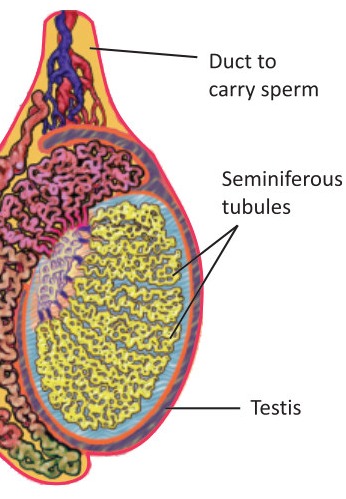
Animals have special organs i.e., gonads where special cells called gametes are made. The gonads in male animals are called testes (Singular: testis) where male gametes i.e., sperms are produced. The gonads in female animals are called ovaries where female gametes i.e., egg cells or ova are produced.
2. Formation of Gametes
The process of formation of gametes is called gametogenesis. It involves the cell division meiosis. Meiosis results in a reduction of the number of chromosomes in gametes to haploid (1n) as compared to the diploid (2n) number in other body cells (Somatic cells).
a. Formation of Male Gametes / Describe the process of spermatogenesis
i. Introduction: The formation of male gametes (Sperms) is called spermatogenesis.
ii. Explanation
- Seminiferous Tubules: This process occurs in seminiferous tubules of testes.
- FSH: Follicle stimulating hormone (FSH) along with the male sex hormone i.e., testosterone stimulate sperm production. FSH is produced by the anterior pituitary gland while testosterone is produced by testes.
- Primary Spermatocytes: In seminiferous tubules, the diploid gamete mother cells, called primary spermatocytes are present.
- Secondary Spermatocyte: Each primary spermatocyte divides by meiosis-I and forms two haploid secondary spermatocytes.
- Spermatids: Each secondary spermatocyte divides by meiosis-II. In this way, four haploid spermatids are formed.
- Formation of Sperms: Spermatids are immature sperms (Non-motile). Changes occur in spermatids (Acrosome formation, Development of tail and mitochondrial ring) and they mature into motile sperms.
b. Formation of Female Gametes / Describe the process of Oogenesis
i. Introduction: The formation of female gametes (egg or ovum) is called oogenesis.
ii. Explanation
- Follicles: Ovaries contains small, fluid-filled sacs called follicles in which eggs are formed.
- FSH: Follicle stimulating hormone released by the anterior of pituitary gland stimulates the formation of ovum in follicle.
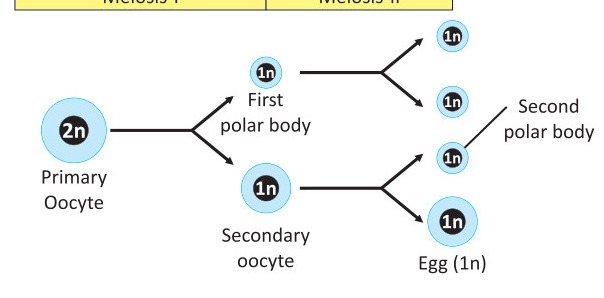
- Primary Oocyte: In follicle, there is a diploid gamete mother cell called primary oocyte.
- Secondary Oocyte: Primary oocyte divides by meiosis-I and two haploid cells are produced. The larger cell is called secondary oocyte while the smaller cell is called first polar body.
- Formation of Egg: In meiosis II, secondary oocyte produces two haploid cells i.e., a second polar body and an egg.
Key Points Fertilization | Ovulation | Steps of Fertilization
1. Fertilization
Fertilization means the fusion of male and female gametes to form a new cell, called zygote. In humans, fertilization occurs inside the body of female after the release of egg cell from ovary (Ovulation).
2. Steps of Fertilization
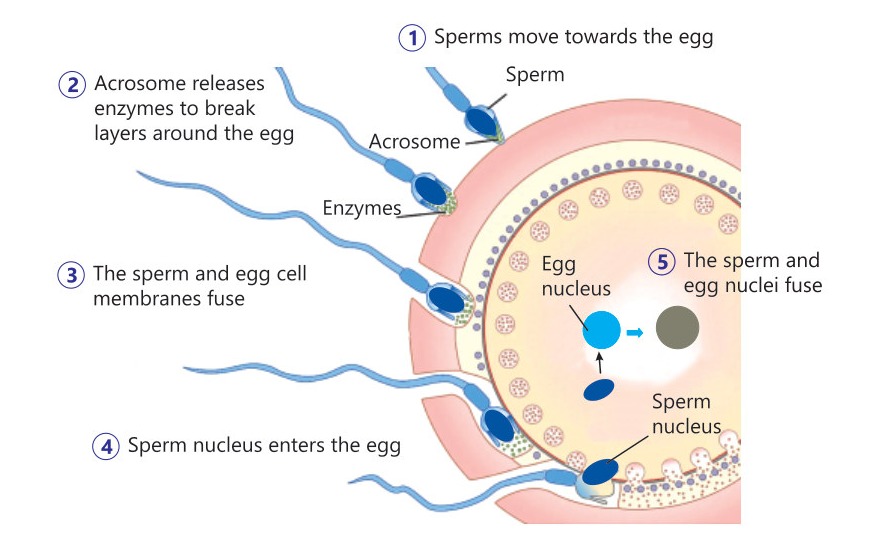
Fertilization occurs in the following steps:
- Sperms move towards the egg due to the chemical signals released by the egg or surrounding cells.
- The acrosome, a cap-like structure on the head of the sperm, releases enzymes which digest the egg's outer layers, allowing the sperm to reach the egg cell membrane.
- The sperm and egg cell membranes are fused. This fusion triggers reactions in egg. So, the egg's outer layers become impermeable for more sperms.
- After fusion of membranes, the sperm nucleus enters the egg.
- Both nuclei (nucleus of egg and nucleus of sperm) fuse to form a diploid zygote.
Key Points Testosterone | Follicle-Stimulating Hormone (FSH) | Luteinizing Hormone (LH) | Gonadotropin-Releasing Hormone (GnRH)
Hormones in Male Sexual Development
The hormones which are involved in male sexual development are:
1. Testosterone
a. Introduction: It is primarily produced by the testes.
b. Functions:
- It initiates and regulates the development of male secondary sexual characteristics during puberty, such as deepening of the voice, growth of facial and body hair, and increased muscle mass.
- It is also essential for spermatogenesis.
2. Follicle-Stimulating Hormone (FSH):
In males, it is produced by the anterior pituitary gland. It stimulates the testes to produce sperm.
3. Luteinizing Hormone (LH)
It is produced by the anterior pituitary gland. It stimulates the production of testosterone by the testes.
4. Gonadotropin-Releasing Hormone (GnRH)
It is released by hypothalamus. It stimulates the pituitary to release LH and FSH.
Key Points Oestrogen | Progesterone | FSH | LH | GnRH
Hormones in Female Sexual Development
The hormones which are involved in female sexual development are:
1. Oestrogen
a. Introduction
It is primarily produced by the ovaries.
b. Functions
- It initiates and regulates the development of female secondary sexual characteristics during puberty, such as breast development, widening of the hips, and the onset of menstrual cycles.
- It also regulates the female reproductive cycle.
2. Progesterone
It is produced by the ovaries after ovulation. It prepares the uterus walls for implantation of fertilized egg (zygote). It maintains pregnancy by preventing contractions of the uterus.
3. Follicle-Stimulating Hormone (FSH)
It is released from anterior pituitary gland. In females, it stimulates the growth of follicles in which oogenesis occur. It also stimulates the production of oestrogen.
4. Luteinizing Hormone (LH)
In females, it triggers ovulation (the release of an egg from the ovary) and stimulates the production of progesterone.
5. Gonadotropin-Releasing Hormone (GnRH)
In females, it stimulates the pituitary to release LH and FSH.
Key Points Testes | Epididymis | Vas deferens | Seminal vesicles | Prostate gland | Urethra | Penis
Male Reproductive System
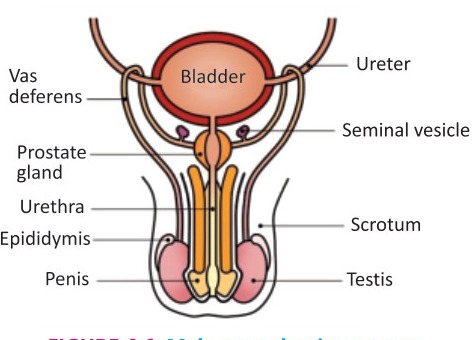
It consists of the following parts:
1. Testes
Pair of oval-shaped glands that produce sperm and the male hormone testosterone.
2. Epididymis
A long, coiled tube attached to each testis where sperm are stored and matured.
3. Vas deferens
A muscular tube that transports mature sperm from the epididymis to the urethra.
4. Seminal vesicles
Two small glands behind the bladder that produce a sugary fluid to nourish sperm.
5. Prostate gland
A walnut sized gland below the bladder that adds protective fluid to the semen.
6. Urethra
A tube inside the penis that carries semen and urine to the outside of the body.
7. Penis
An external organ that transfers sperm into female reproductive tract.
Key Points Ovaries | Fallopian Tubes | Uterus | Cervix | Vagina
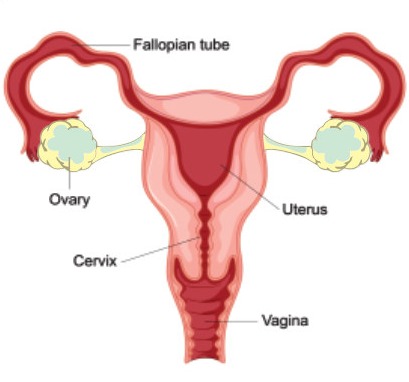
Female Reproductive System
It consists of the following main parts:
1. Ovaries
Pair of almond-shaped glands that produce eggs (ova) and hormones like oestrogen and progesterone.
2. Fallopian Tubes
Two tubes that transport eggs from the ovaries to the uterus. Fertilization occurs here.
3. Uterus
A hollow, muscular organ where a fertilized egg implants and develops into a fetus during pregnancy.
4. Cervix
The lower, narrow part of the uterus.
5. Vagina
A muscular canal that connects the cervix to the outside.
Key Points STDs | AIDS
1. STDs
a. Introduction: Sexually transmitted diseases (STDs) are the infections which are primarily transmitted through sexual contact.
b. Causes: These diseases can be caused by bacteria, viruses, or parasites.
c. Effects
- STDs often affect the genital, urinary, and reproductive organs. Common STDs include AIDS, syphilis, herpes etc. Many STDs can be asymptomatic, (individuals may carry and spread the infection without showing signs).
- If STDs are left untreated, they can lead to serious health complications such as infertility, organ damage, and other infections.
2. Acquired Immunodeficiency Syndrome (AIDS)
a. Introduction: AIDS is a serious and life-threatening disease caused by the Human Immunodeficiency Virus (HIV). HIV primarily attacks and weakens the body's immune system, making it difficult to fight infections and certain cancers.
b. Causes: The HIV spreads mainly through unprotected sexual contact, sharing of contaminated needles, transfusion of infected blood, and from an infected mother to her child during childbirth or breastfeeding.
c. Signs and Symptoms
- Early signs and symptoms are fever, fatigue, swollen lymph nodes, and skin rashes.
- As the disease progresses, individuals become vulnerable to severe infections, weight loss, chronic diarrhoea, pneumonia, and certain cancers. d. Treatment
- There is no cure for AIDS.
- Antiretroviral therapy (ART) can control the virus, strengthen the immune system, and help patients live longer and healthier lives.
More figures from this unit