StudentAid
Inheritance — Long Questions
10th Class Biology · Unit 7: Inheritance
Key Points
Introduction | Explanation | S.Q: How the Characteristics are determined in the body?
Ans. Every cell in the body contains the instructions for making characteristics. Inside the cells, this information is present in long molecules of Deoxyribonucleic acid (DNA). The cells use the information in their DNA to produce particular proteins. The proteins made by a cell determine its characteristics.
1. Introduction: The process by which characteristics are transferred from parents to offspring is called inheritance or heredity.
2. Explanation: An organism is made of a lot of structural and behavioural characteristics. Organisms are able to pass these characteristics to their off spring. Offspring get some characteristics from each parent. They also get characteristics which are not present in their parents.
Key Points Structure | Chromosomes in Eukaryotes | Chromosomes in Prokaryotes
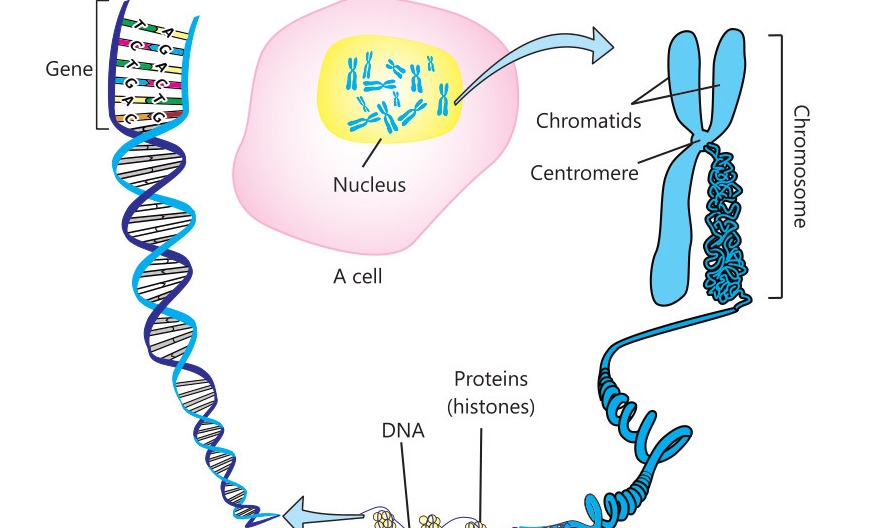
1. Chromosome in Eukaryotes: Chromosome is made of chromatin material. In eukaryotes, chromatin consists of DNA and special proteins called histones.
2. Structure
i. Chromatin: Chromatin is a thread-like material. In chromatin, a long molecule of DNA is wrapped around the bundles of histones. When a cell is not dividing its chromatin is in the form of fine thread, scattered in the nucleus. During cell division, chromatin coils and makes compact structures of chromosomes.
S.Q
What do you know about 2n?
Ans. All the cells of the organisms of a species have a constant number of chromosomes. The body cells are diploid (2n). It means that the chromosomes are in pairs (homologous chromosomes).
Before cell division, the DNA makes a copy of itself. In this way, chromatids are formed. When the cell divides, each daughter cell receives one chromatid from each chromosome.
ii. Chromatid: A Chromosome is rod-shaped and consists of two identical halves. Each half of chromosome is called a chromatid.
iii. Centromere: The two chromatids of a chromosome are attached at a point called centromere. The centromere holds the two chromatids together until they separate during cell division.
3. Chromosome in Prokaryotes
The prokaryotes have only one chromosome which is made of a circular DNA molecule. It is not bound by a nuclear envelop and is present in cytoplasm.
Key Points Structure of DNA | Structure of RNA | Functioning of DNA and RNA
1. Structure of DNA
The structure of DNA (Deoxyribonucleic Acid) is following:
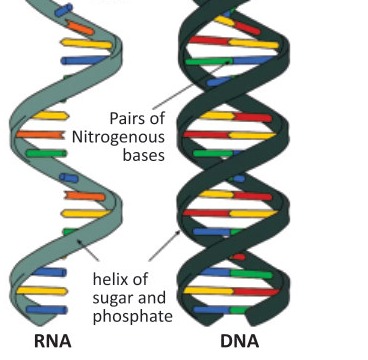
i. DNA is a double-stranded, helical molecule.
ii. It is made of nucleotides (Deoxyribonucleotide).
iii. Each nucleotide of DNA is made of:
- A deoxyribose sugar
- A phosphate group
- A nitrogenous base (adenine, thymine, cytosine, or guanine) iv. The two strands are held together by base pairing (A with T, and C with G).
2. Structure of RNA
i. RNA is single stranded chain of nucleotides.
ii. Its nucleotides have:
- A sugar called ribose
- A phosphate group
- Nitrogenous bases (adenine, uracil, cytosine, and guanine).
3. Functioning of DNA and RNA / Describe how DNA and RNA take part in the synthesis of a protein?
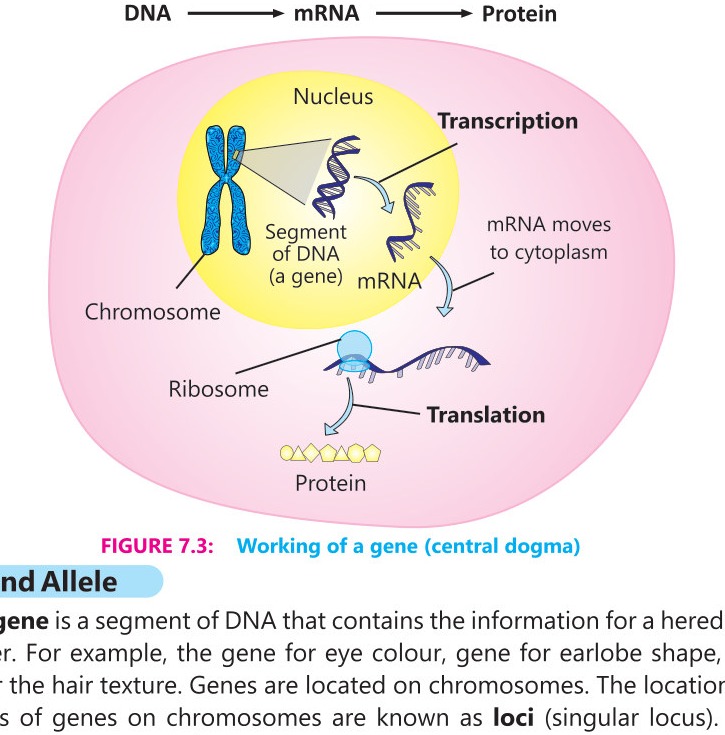
a. Gene: A gene is a segment of DNA that has the information for making a particular protein.
b. Working of a gene: The following processes occur for making a proteins according to the information present in a gene:
i. Transcription
The segment of DNA (gene) acts as a template. A type of RNA, called messenger RNA (mRNA), is synthesised according to this template. In this way, DNA transfers the information to mRNA. This process is called transcription. mRNA helps in converting information into proteins.
ii. Translation
The mRNA moves out into the cytoplasm. Here, ribosome attaches with mRNA. The ribosome joins amino acids according to the information present on mRNA. In this way, a protein is produced. This process is called translation.
iii. Central Dogma
This concept of the working of a gene is called central dogma and includes transcription and translation.
Key Points Gene | Loci | Allel
a. Gene: A gene is a segment of DNA that contains the information for a hereditary character.
Example The gene for eye colour, gene for earlobe shape, and gene for the hairs texture.
b. Loci: Genes are located on chromosomes. The locations or positions of genes on chromosomes are known as loci (singular locus). Like chromosomes, genes are also in pairs.
c. Allele: The pair of genes on homologous chromosomes may not contain identical genes. The homologous chromosomes may have different forms of the same gene. These alternate (different) forms of a gene are called its alleles.
Example The gene of hair colour can have two alleles. One allele makes hair pigments while the other does not make pigments.
Key Points Genotype | Dominant Allele | Recessive Allele | Expression of Alleles | Phenotype
1. Genotype: The combination of the alleles is called genotype. There are two major types of genotypes.
- When both alleles are the same, the genotype is homozygous
- The genotype, in which both alleles are different, is called heterozygous genotype.
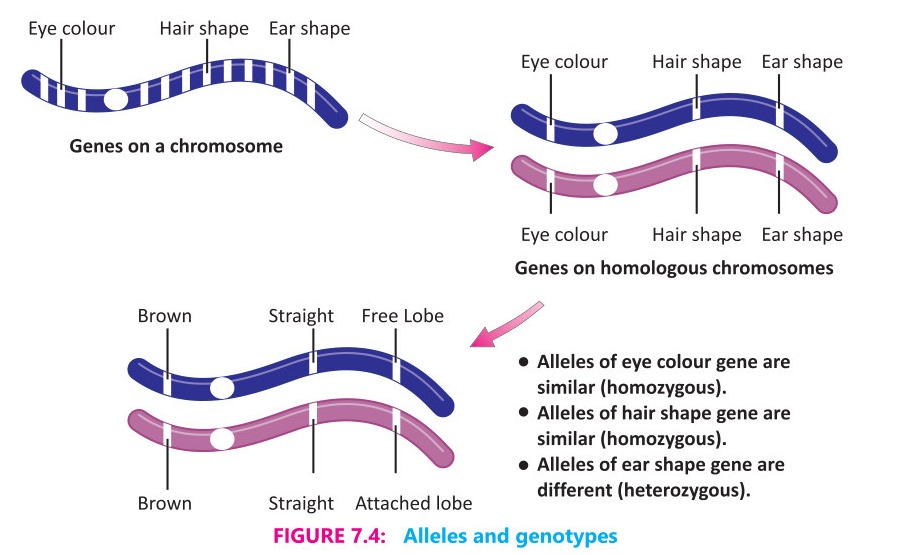
For example, in Fig 7.4, a cell has genes for eye colour, hair shape and ear shape. All genes are in pairs.
a. Both alleles of the eye colour gene are similar. It means that the genotype for eye colour is homozygous. Similarly, both alleles of the hair shape gene are similar. It means that its genotype is also homozygous genotype.
b. The alleles of the ear shape gene make different characteristics. One allele makes free earlobe while the other allele makes attached earlobe. It means that the genotype for ear shape is heterozygous genotype.
c. Dominant Allele: In the heterozygous genotype one allele may mask the working of the other allele. Such an allele is called the dominant allele.
d. Recessive Allele: The allele which is masked (not expressed) is called recessive allele.
e. Expression of Alleles: Dominant alleles are expressed by capital letters while the recessive alleles are expressed by lowercase letters. For example, in the pair Tt, the dominant alleles T is responsible for tall plant while the recessive allele t is for dwarf plant. So, if a plant has genotype Tt, it will be a tall plant.
2. Phenotype: The expression of genotype in form of characteristics or physical traits is called phenotype. These observable outcome of genotype, in the form of characteristic, is called phenotype.
Key Points Introduction | Genetic Experiments
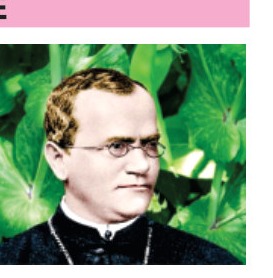
1. Introduction: Gregor Mendel was an Austrian monk, working in a monastery garden. From 1856 to 1863, he performed experiments on garden pea. The results of these experiments cleared the views of heredity.
2. Selection of garden pea for experiments
Mendel selected the garden pea for his experiments. His choice was a good one for several reasons.
- Pea plants have a relatively short generation time.
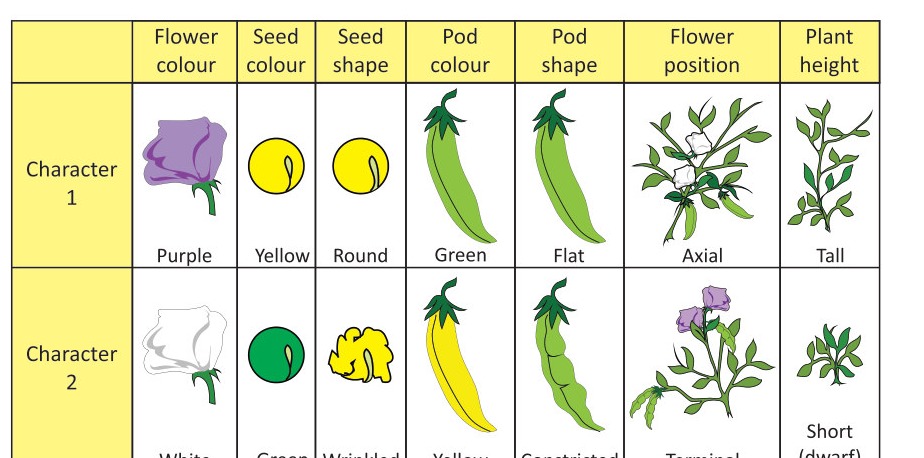
- Pea plant has seven easily distinguishable characteristics, such as round versus wrinkled seeds and purple versus white flowers.
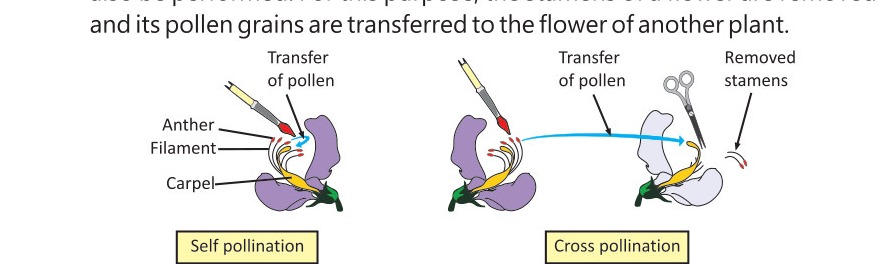
- Normally, self-pollination occurs in pea flowers. But cross-pollination can also be performed. For this purpose, the stamens of a flower are removed and its pollen grains are transferred to the flower of another plant.
Key Points True-breeding plants | Monohybrid Crosses | Experiment | Concept of Dominance | Interpretation of the results | Law of Segregation
Mendel's Experiments
1. True-breeding plants: Mendel got the true-breeding plants for each characteristic. If a plant produces offspring with the same characteristic on self-pollination; it means that the plant is true-breeding for that characteristic. For example, when a true-breeding tall plant self-pollinates, it will always produce tall plants.
2. Monohybrid Crosses: After choosing the true-breeding varieties Mendel performed monohybrid crosses. It is a cross in which only one characteristic is studied.
3. Experiment
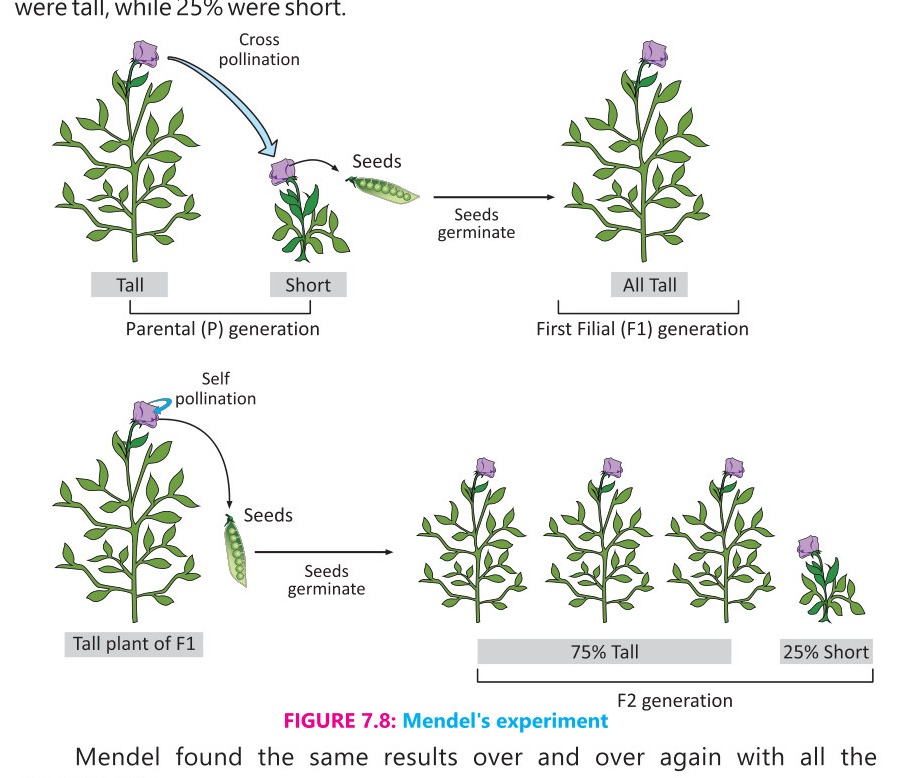
- Mendel crossed a true-breeding tall plant with a true-breeding short plant.
- He called these true-breeding parents as P generation.
- The offspring of this cross were called the first filial generation, or F1 generation.
- All offspring of F1 were tall.
- Next, Mendel allowed the tall plants of F1 generation to self-pollinate.
- He called the next generation as F2 generation.
- He found that 75% of F2 offspring were tall, while 25% were short. Mendel found the same results over and over again with all the seven characteristics.
4. Conclusions
a. Concept of Dominance: Mendel explained his results and proposed that there were two forms (alleles) of the gene of plant height. When two different alleles are together in an organism, one allele may mask the expression of the other. The allele that shows its effect is called dominant, while the one that is hidden is called recessive. This is called as the concept of dominance.
b. Interpretation of the results:
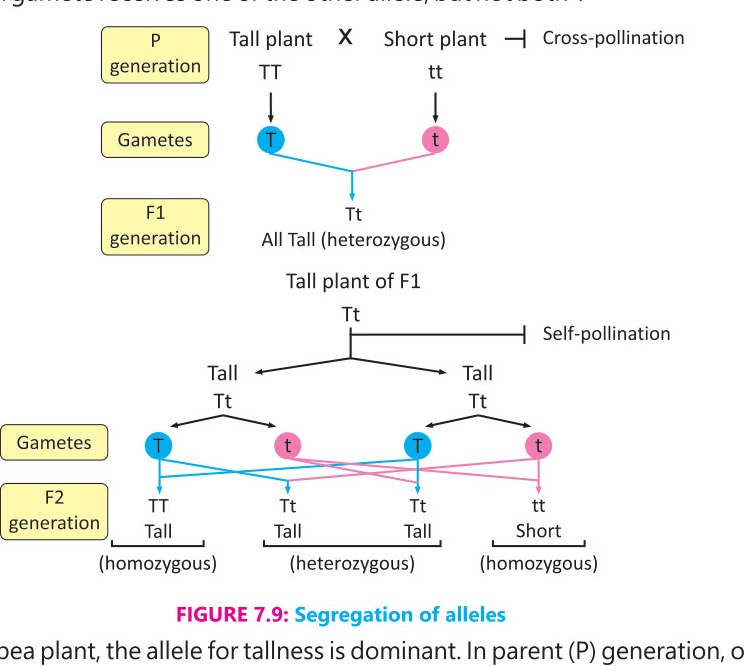
In pea plant, the allele for tallness is dominant. In P generation, one parent had alleles TT. Each of its gametes received a single T allele. The second parent had alleles tt. Each of its gametes had a single t allele. When these gametes (T and t) joined, the new plants in F1 generation received the pair as Tt. So, all F1 plants were tall. When self-pollination was allowed in F1 tall plant, the results were:
- 25% of the F2 generation received both alleles of shortness i.e. tt. So, they were short.
- 50% plants of F2 received one T allele and one t. So, they were tall (Tt).
- 25% plants of F2 received both alleles of tallness i.e., TT. So, they were also tall.
5. Law of Segregation: Mendel explained that each parent has two alleles of a gene. But a parent can only pass one allele to the offspring. During gamete formation, the alleles separate and there is only one allele in each gamete. When fertilization occurs, the offspring has the two alleles again. It is called the law of segregation. It states that "the alleles are separated during gamete formation and each gamete receives one or the other allele, but not both".
6. Applications: This law is applied to all sexually reproducing organisms, governing how alleles separate during meiosis.
Key Points Dihybrid Crosses | Mendel's Procedure and Observations | Law of Independent Assortment
1. Dihybrid Crosses
In a dihybrid cross, the inheritance of two characteristics is studied at the same time.
2. Mendel's Procedure and Observations
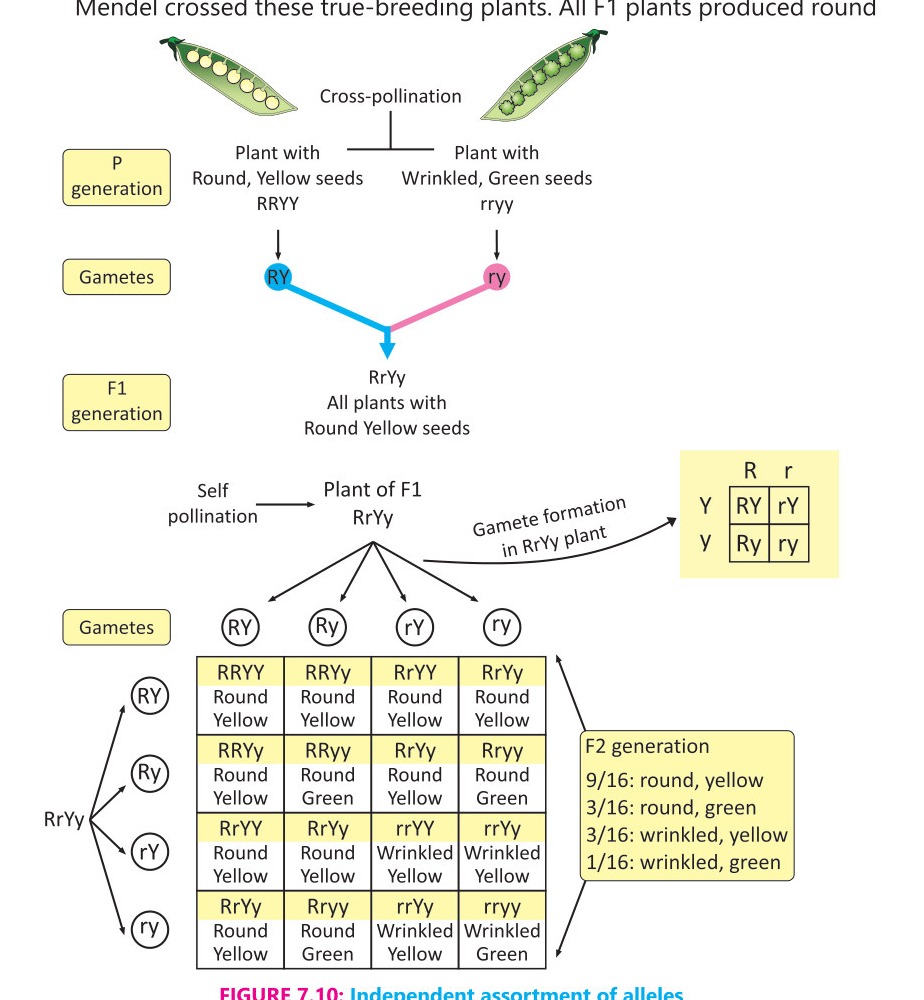
i. In such experiments, Mendel studied the characteristics of seed shape (Round or Wrinkled) and seed colour (Yellow or Green).
ii. He first grew true-breeding varieties of pea plants.
iii. One plant had round yellow seeds and the other had wrinkled green seeds.
iv. Mendel crossed these true-breeding plants. All F1 plants produced round yellow seeds. It proved that the allele for round seeds (R) is dominant over the allele for wrinkled seeds (r).
v. Similarly, the allele for yellow seeds (Y) is dominant over the allele for green seeds (y). All the F1 plants were heterozygous for both seed shape and seed colour (Genotype: RrYy).
vi. He allowed self-pollination in the F1 plants and got the F2 generation. The F2 generation had the following four phenotypes:
(a) 9/16 that have round, yellow seeds (Genotypes: RRYY, RRYy, RrYY and RrYy)
(b) 3/16 that have round, green seeds (Genotypes: RRyy and Rryy)
(c) 3/16 that have wrinkled, yellow seeds (Genotypes: rrYY and rrYy)
(d) 1/16that have wrinkled, green seeds (Genotype: rryy)
3. Conclusions
Law of Independent Assortment
The F1 plants (RrYy), produced four types of gametes i.e., RY, Ry, rY and ry. When these plants were allowed to self-pollinate, there were 16 combinations of alleles in F2 generation. It means that alleles R and r segregated independently of the alleles Y and y. Mendel's discovery is referred to as the law of independent assortment. It states that "alleles separate independently of one another during the formation of gametes".
More figures from this unit