StudentAid
Unit 2: Human Respiratory System — Long Questions
10th Class Biology · Unit 2: Human Respiratory System
Key Points Cellular Respiration | Gaseous Exchange | Breathing
1. Cellular Respiration
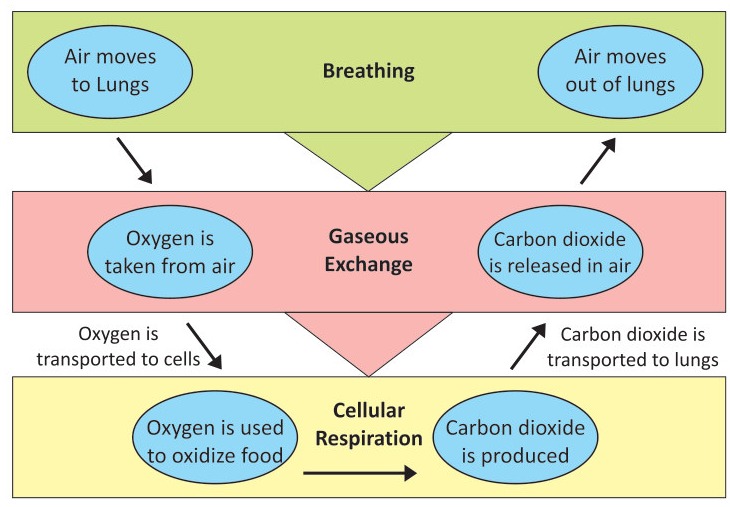
Organisms get energy by doing cellular respiration. It is the process in which cells oxidize food (glucose) and get energy. For this purpose, organisms need to carry oxygen to their cells and to remove carbon dioxide from cells.
2. Gaseous Exchange
Gaseous exchange is the process in which oxygen present in the inhaled air (in lungs) moves into blood, and carbon dioxide from the blood moves into the air to be exhaled. For gaseous exchange, animals do breathing.
3. Breathing
Breathing is the process in which animals move air into and out of their body. It is done to get oxygen from air and to release carbon dioxide in it.
4. Breathing Versus Respiration
Breathing and respiration are not the same processes.
• Respiration is a chemical process while breathing is a physical process.
• Breathing helps in gaseous exchange.
• Gaseous exchange, in turn, helps in respiration.
Key Points Air Passageway | Parts of Air Passageway | Lungs
Introduction
Respiratory system is responsible for breathing and gaseous exchange. The human respiratory system consists of two main parts i.e., air passageway and lungs.
1. The Air Passageway/Write a short note on the major parts of the human air passageway.
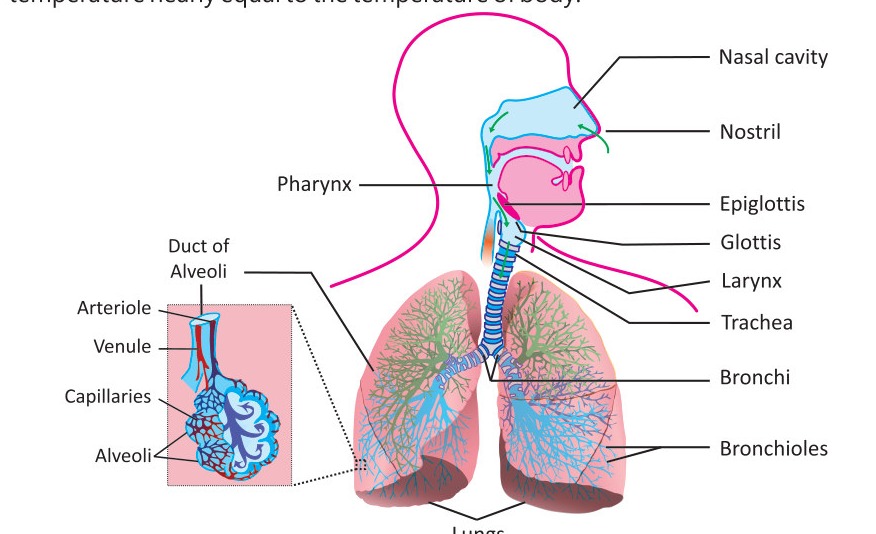
a. Introduction: When air enters the body, it passes through connected tubes to reach the lungs. After gaseous exchange, air moves from the lungs to outside through the same connected tubes. These connected tubes are collectively called air passageway.
b. Parts of the Air Passageway
It consists of the following parts.
(i) Nostrils and Nasal Cavity
The nasal cavity is made up of two narrow cavities between nostrils and pharynx. Air enters the nasal cavity through nostrils.
• Functions of fine hairs: In nasal cavity filter the incoming air by trapping large dust particles. Mucus on the walls of nasal cavity traps small dust particles.
• Functions of mucus: Mucus also warms the air and keeps its temperature nearly equal to the temperature of body
(ii) Pharynx
• Introduction: Nasal cavity opens into pharynx.
• Glottis: At the floor of pharynx there is an opening called glottis. It opens in larynx.
• Epiglottis: The glottis is guarded by a flap called epiglottis. It prevents food and liquid from entering the windpipe and lungs.
(iii) Larynx
• Location: It is a box present between pharynx and trachea. Larynx is also called the voice box.
• Vocal cords & Sound Production: Two fibrous bands called vocal cords are attached to the inner walls of larynx. The vibrations of vocal cords produce sounds.
(iv) Trachea and Bronchi/Describe the functions and location of the trachea, bronchus and alveoli.
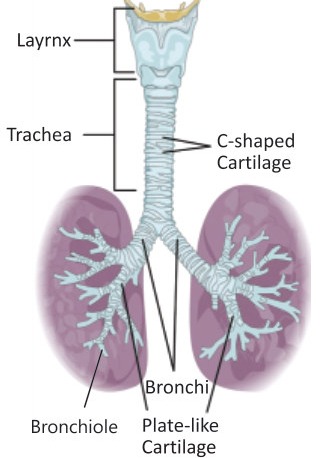
• Introduction: Trachea (windpipe) is a 12 cm (4.72 inches) long tube attached with larynx. It ends in two branches called bronchi (singular: bronchus). Each bronchus enters into the lung of its side.
• Inner walls of Trachea and Bronchi: The inner walls of trachea and bronchi are lined with mucus and cilia. Mucus traps fine dust particles and bacteria. Cilia move these particles and mucus upwards to the pharynx.
• Structure: In the walls of trachea, C-shaped cartilages are present. While the walls of bronchi have plate-like cartilages. These cartilages prevent trachea and bronchi from collapsing even when there is no air in them.
(v) Bronchioles and Alveoli
• Bronchioles: Inside lungs, both bronchi continue to divide into very small tubes called bronchioles. As the branching continues, the amount of cartilage in the walls decreases. Cartilage is absent in the smallest bronchioles.
• Alveolar Ducts and Alveoli: Each bronchiole ends at an alveolar duct. This duct opens into a cluster of pouches. These thin-walled pouches are called alveoli (singular: alveolus).
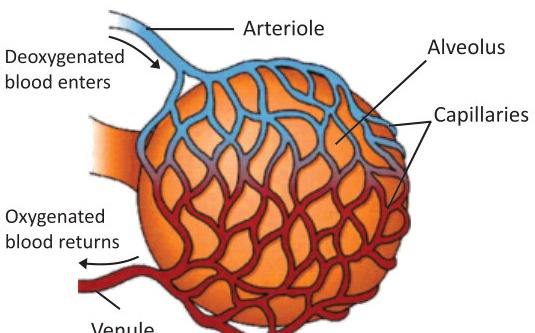
• Gaseous Exchanges: Each alveolus is surrounded by blood capillaries. When air reaches alveoli, oxygen moves from the air into blood, and carbon dioxide passes out of blood into the air in the alveoli.
2. The Lungs
a. Introduction
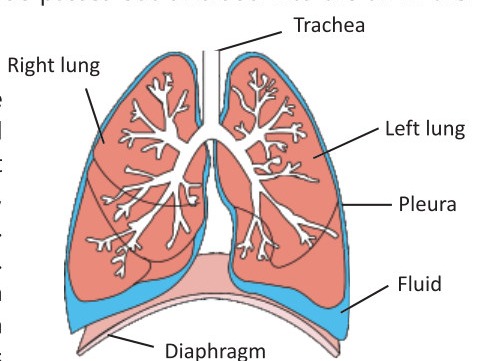
There is a pair of lungs in the thoracic cavity.
b. Diaphragm
From above and sides, lungs are enclosed by the chest wall. While, there is a thick muscular structure, called diaphragm below lungs.
c. Structure of Lungs
Lungs are spongy and elastic organs. The left lung is slightly smaller than the right lung. There are two lobes in the left lung while right lung has three lobes.
d. Pleura and Pleural Fluid
Lungs are enclosed in a double membrane called pleura. Its inner layer is attached to the surface of the lungs while the outer layer lines the inner surface of the chest wall and the diaphragm. It contains a pleural fluid for reducing friction between lungs and the chest wall.
e. Blood circulation in Lungs
i. Pulmonary Artery: Pulmonary artery carries deoxygenated blood from heart to lungs.
ii. Arterioles: Inside each lung, the pulmonary artery divides into smaller arterioles.
iii. Capillaries: The arterioles divide further and make capillaries around the alveoli.
iv. Venules: After surrounding the alveoli, the capillaries join to form venules.
v. Pulmonary Vein: The venules join to form pulmonary vein which carries oxygenated blood back to heart.
Key Points Phases of Breathing (Inhalation and Exhalation) | Rate of Breathing
1. Introduction
The physical movements for taking air to lungs and then removing air from lungs are called as breathing.
2. Phases of Breathing
There are two phases of breathing:
(a) inhalation (b) exhalation.
(a) Inhalation (Inspiration)
(i) Definition: Inhalation means intake of air to the lungs.
(ii) Events during inhalation
The following events occur during inhalation;
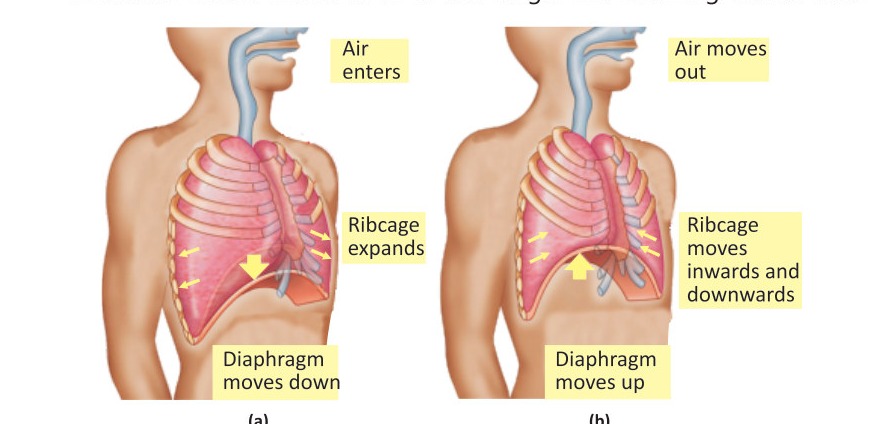
• The inter-coastal muscles (muscles located between the ribs) contract to expand the ribcage.
• At the same time, diaphragm also contracts and moves down.
• These two contractions increase the volume of the chest.
• So, pressure inside the chest is reduced and air is moved into lungs.
(b) Exhalation (Expiration)
(i) Definition: Exhalation means moving the air out of the lungs.
(ii) Events during exhalation
The following events occur during exhalation;
• The inter-coastal muscles relax to move ribcage inwards.
• At the same time diaphragm also relaxes and moves up.
• These two movements decrease the volume of the chest.
• So, pressure inside the chest increases and air is forced out.
3. The Rate of Breathing / Describe the effect of exercise on the rate of breathing.
(a) Normal Breathing Rate at Rest
Humans breathe 16 -20 times per minute in normal conditions i.e., at rest.
(b) Breathing Rate During Exercise
During exercise or hard job, muscles carry out cellular respiration at greater rate. So, more carbon dioxide is produced. The respiratory centre in brain detects greater concentration of carbon dioxide in blood. It sends messages to the muscles of ribs and diaphragm at greater speed. The speed of contraction and relaxation of these muscles increases. So, the breathing rate increases up to 30- 40 times per minute.
Composition of Inhaled and Exhaled Air
Feature | Inspired Air | Expired Air
Oxygen %age | 21 | 16
Carbon dioxide %age | 0.04 | 4
Nitrogen %age | 79 | 79
Water vapours | Variable | Saturated
Temperature | Variable | Almost equal to body temperature
Dust particles | Variable | Almost none
Key Points Bronchitis | Emphysema | Pneumonia | Asthma | Lung Cancer
1. Bronchitis
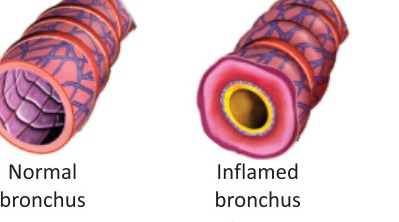
(a) Introduction: "Bronchitis means inflammation (swelling) in bronchi or bronchioles". In bronchitis, the inner space of bronchioles decreases.
(b) Acute and Chronic Bronchitis
It may be short term i.e., acute (two weeks) or long-term i.e., chronic (years). In chronic bronchitis, mucus producing cells in the walls of bronchi increase in number. Thus, there is thick mucus in bronchi. It obstructs the inhaled and exhaled air.
(c) Causes: Infections by viruses or bacteria, chemical irritants (e.g. tobacco smoke).
(d) Symptoms: Coughing, wheezing, fever, chills and shortness of breath.
(e) Treatment: Medications (cough suppressants) to ease breathing, antibiotics (if it is due to bacterial infection), antiviral medicines (if it is due to viral infection), avoiding irritants like smoke and pollution.
2. Emphysema
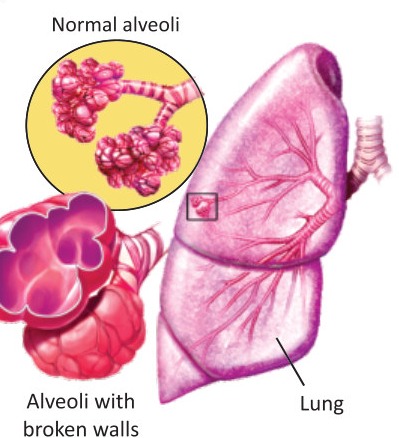
(a) Introduction: In emphysema, the inner walls of alveoli become weak and then rupture. Thus, one larger air space is created instead of many small ones. So, the space for gaseous exchange decreases and the patient cannot inhale properly.
(b) Causes: Long-term exposure to irritants in air e.g., tobacco smoke, chemical fumes and other air pollutants.
(c) Symptoms: Shortness of breath, chronic cough (with or without mucus), wheezing and chest tightness.
(d) Treatment: Medicines to relieve cough and breathing problems. Emphysema cannot be cured completely.
3. Pneumonia
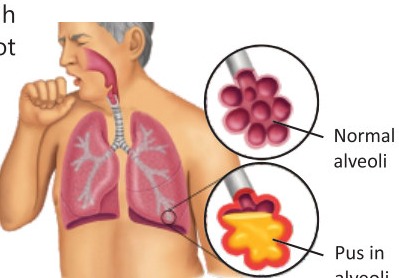
(a) Introduction: Pneumonia is an inflammation in the lungs, due to infection in alveoli. In pneumonia, the alveoli are filled with pus.
(b) Causes: Infections by bacteria, viruses or fungi.
(c) Symptoms: The pneumonia patient suffers from high fever, chills, shortness of breath, and cough with sputum.
(d) Treatment:
• Bacterial pneumonia is treated by using antibiotics.
• The viral and fungal pneumonia are treated by using antiviral and antifungal drugs.
• Vaccines are also available to prevent bacterial pneumonia.
4. Asthma
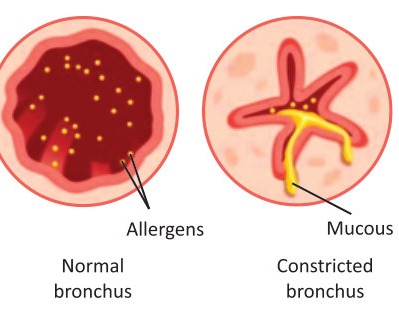
(a) Introduction: It is an inflammation of bronchi in which bronchi and bronchioles swell and are constricted.
(b) Symptoms: Recurring attacks of shortness of breath, wheezing (whistling sound when breathing out), coughing and chest tightness.
(c) Causes: Allergens (dust mites, pollen, mold, and pet dander), air pollutants (smoke, chemical fumes, and strong fragrances), weather changes, especially cold air, genetic factors (family history of asthma or allergies).
(d) Treatment: Medicines (bronchodilators) to dilate bronchioles during asthma attack.
5. Lung Cancer
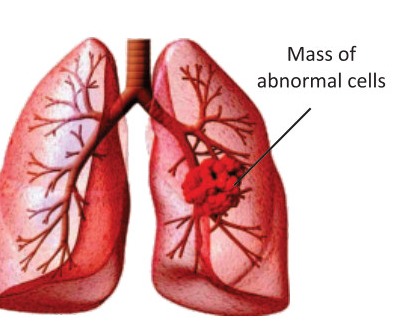
(a) Introduction: Cancer means uncontrolled increase in the number of cells in any part of the body. When the masses of non-functional cells are formed in lungs, it is called lung cancer. It is the most common cancer in the whole world.
(b) Causes:
• Carcinogens (such as those in tobacco smoke), ionizing radiation, viral infection.
• Passive smoking i.e., the inhalation of smoke from another's smoking is also a cause of lung cancer.
• The smoke from the upper burning portion of cigarette is more dangerous than smoke exhaled by the smoker.
(c) Symptoms: The most common symptoms are shortness of breath, coughing (including coughing up blood), and weight loss.
(d) Treatment: The patient of lung cancer is given one or more treatments, including surgery, chemotherapy, or radiation therapy.
Key Points Abnormalities and Cancer | Number of Chemicals in Tobacco Smoke | Carcinogens | Other effect of Smoking
Effects of Smoking
1. Abnormalities and Cancer
Smokers have a much higher risk of developing life threatening diseases. The most important risk of smoking is the abnormalities and cancers in lungs, kidneys, oral cavity, larynx, breast, bladder, oesophagus, pancreas and stomach.
2. Number of Chemicals in Tobacco Smoke
Tobacco smoke contains over 4,000 different chemicals.
3. Carcinogens (Cancer causing agents)
Out of these 4000 chemicals present in Tobacco smoke there are more than 69 known carcinogens (cause cancer in humans). For example:
(a) Nicotine is the major component of cigarettes. It damages many tissues including brain. It also hardens the walls of arteries and results in heart problem.
(b) Carbon monoxide is produced when tobacco is burnt during smoking. It is a poisonous gas. It combines with RBCs and prevents oxygen transport.
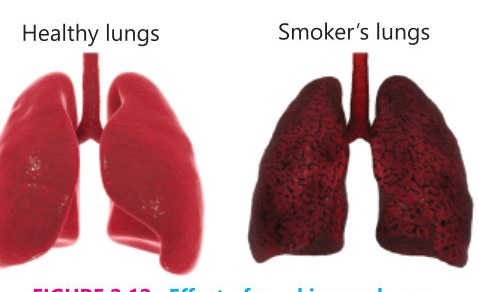
(c) Tar is present in cigarettes in the form of solid particles. When it is inhaled along with smoke, it is deposited in lungs. It reduces the surface area for gaseous exchange.
(d) Benzene is a major component of cigarettes. It is a carcinogen and causes blood cancer (leukaemia).
(e) Formaldehyde present in cigarettes causes cancers and respiratory, skin and gastrointestinal problems.
(f) Ammonia (toilet cleaner) frees nicotine from tobacco turning it into a gas. It is poisonous for the body.
(g) There are many other irritants in cigarettes. These irritants damage the air passageways (respiratory tract) and cause many respiratory diseases, including cancer.
4. Other Effects of Smoking
(a) Smoking also increases blood cholesterol levels blood pressure. It weakens blood vessels.
(b) Smoking causes the staining of teeth and bad breath.
(c) Tooth loss is 2 to 3 times higher in smokers than in non-smokers.
(d) Smoking increases the risk of tuberculosis by 2 to 4 times and of pneumonia by 4 times.
More figures from this unit