StudentAid
Unit 10: Evolution — Long Questions
10th Class Biology · Unit 10: Evolution
Key Points
Introduction | Explanation
1. Introduction: Evolution is the change in heritable traits of population over the course of successive generations. In 1850s, Charles Darwin explained the mechanism of evolution in a comprehensive way.
2. Explanation
• It involves gradual changes in characteristics passed from one generation to the next.
• Such changes allow organisms to adapt to their environment.
• Over time, these changes accumulate, resulting in formation of new species.
Key Points
Darwin's Observations: Unique species | variation in same species | Study of finches | Study of fossils
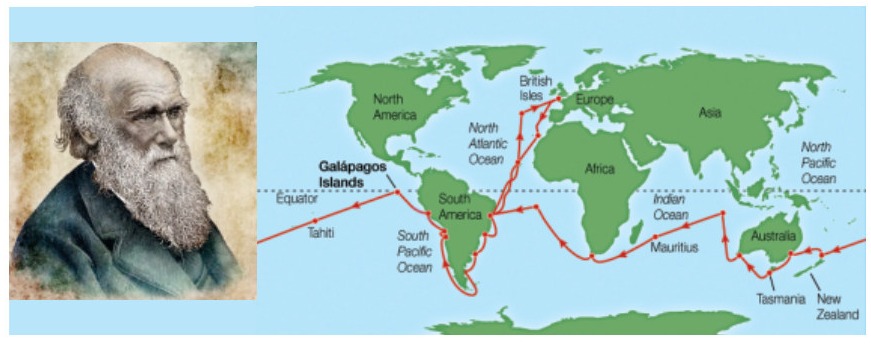
1. Introduction: English naturalist Charles Darwin (1809-1882) went on five-year trip around the world on a His Majesty's Ship (HMS) Beagle. During this voyage, Darwin made a lot of important observations that laid the foundations of his Theory of Evolution by Natural Selection.
2. Darwin's Observations
The following are some important observations made by Darwin:
a. Unique Species
i. He observed a variety of unique plant and animal species in different regions.
ii. He observed that different islands and environments had their own distinct sets of species.
b. Variations in Same Species:
i. Darwin observed variations among same species living in different environments.
ii. He noticed that-these were adaptations i.e., special variations in an organism's body or behaviour that help the organism to survive in its environment.
iii. He was convinced on the role of adaptations in the survival of species.
c. Beaks of Finches
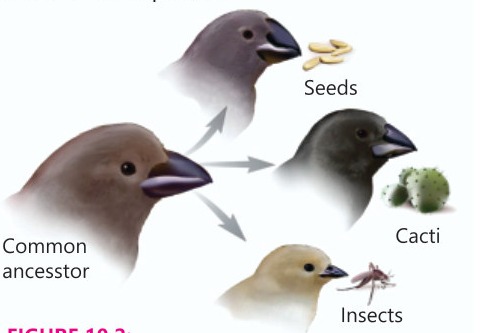
i. On the Galapagos Islands, he noticed that different species of finches had different sizes and shapes of beaks in different islands.
ii. He noticed that different foods e.g., seeds, cacti and insects were available at different islands. The beaks of finches were suited according to the food sources available on specific island.
d. Fossils of Extinct Animals
i. When he observed the fossils of extinct animals, he found their resemblance with modern species.
ii. This suggested that species could change over time.
3. Publishing of Darwin's work
a. After returning from his voyage, Darwin analysed his observations and gathered more evidence to support his ideas.
b. Eventually, in 1859, Darwin published his work in the form of a book, "On the Origin of Species". In this book, he presented his "theory of evolution by natural selection".
Key Points
Steps of Natural Selection | Variations | Struggle for Survival | Survival of the Fittest | Reproduction and Passing on Variation | Gradual Evolution Over Time | Giraffe's Long Neck
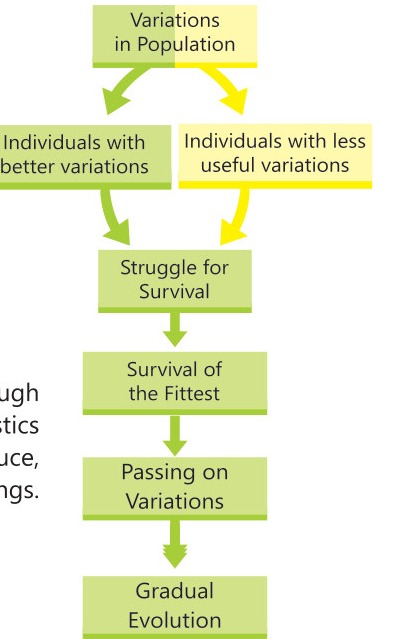
1. Introduction: The theory of evolution by natural selection states that "living things change over time. Those with helpful characteristics (variations) survive, reproduce, and pass those characteristics to their young. Over many generations, these favourable characteristics become more common in the population. It leads to the evolution of new species.
Natural Selection
a. Introduction: Natural selection is the process through which the individuals with better characteristics (variations) are more likely to live, reproduce, and pass those variations to their offspring.
b. Steps of Natural selection
Natural selection works as follow:
i Variations
• In every species, individuals are slightly different from one another
• These differences may be in colour, size, speed, strength, or ability to find food.
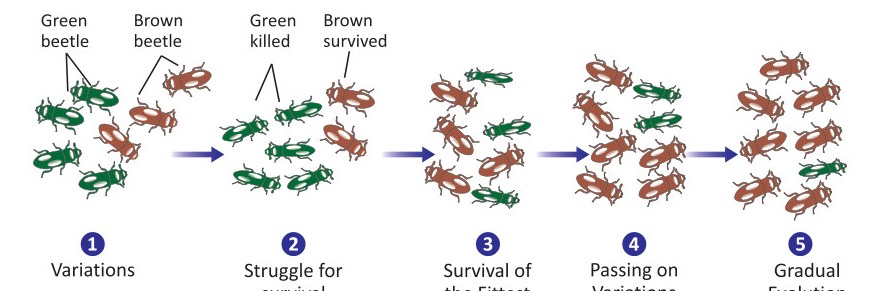
• For example: some beetles are green, and some are brown.
ii Struggle for Survival
• Living things compete for limited resources such as food, water, space, and mates.
• Also, they face threats from predators, diseases, and harsh environments.
• For example: Birds eat beetles, so beetles must survive by hiding or blending in.
iii Survival of the Fittest
• The individuals with better variations are more likely to live and reproduce.
• "Fittest" means best suited, not necessarily the strongest.
• For example: Brown beetles blend in with the soil better than green beetles. So, they will be difficult to be preyed upon by birds.
iv Reproduction and Passing on Variations
• The surviving individuals reproduce and pass their useful variations to their offspring.
• Over time, these helpful variations become more common in the population.
• For example: More brown beetles are born because the green ones were eaten more often.
v Gradual Evolution Over Time
• After many generations, small changes build up. The species slowly changes.
• If the environment continues to favour certain variations, new species may eventually form.
• For example: If only brown beetles survive and reproduce over many generations, the whole beetle population may become brown.
c. Examples of Natural Selection
i Giraffe's Long Neck
• Variations: Some giraffes had slightly longer necks than others.
• Struggle for Survival: Food (leaves on tall trees) was hard to reach, especially during dry seasons.
• Survival of the Fittest: Giraffes with longer necks could eat leaves from taller trees and survived better during harsh conditions.
• Reproduction and Passing on Traits: These long-necked giraffes reproduced and passed the long-neck trait to their babies.
• Gradual Evolution Over Time: Over many generations, most giraffes in the population had long necks.
ii Peppered Moth (During Industrial Revolution in England)
• Variations: Some moths were light-coloured, and some were dark coloured.
• Struggle for Survival: Birds hunted the moths during the day as they rested on tree bark.
• Survival of the Fittest: After pollution darkened the tree bark, dark coloured moths blended in and survived better than light ones.
• Reproduction and Passing on Variations: Dark moths reproduced more and passed on the dark colour trait.
• Gradual Evolution Over Time: Over time, the population had more dark-coloured moths than light ones.
Key Points
Species | Speciation | Types of Speciation
1. Species
a. Definition: A species is a group of organisms that can interbreed freely and produce fertile offspring under natural conditions. Members of the same species are similar and are reproductively isolated from other species.
b. Example: For example, Lions (Panthera leo) and Tigers (Panthera tigris) are distinct species. They do not naturally interbreed with each other
2. Speciation
a. Definition: Speciation is the process by which new species arise by evolution.
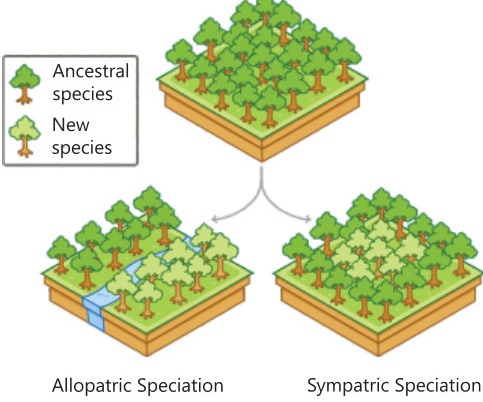
b. Types: There are two main types of speciation:
1. Allopatric Speciation
i Occurrence
• This speciation occurs when a population is geographically separated into two or more populations.
• The physical barrier (such as a mountain range, river, or ocean) prevents individuals from breeding between different groups.
• Over time, the isolated populations evolve differently and become distinct species.
ii Example: For example, in the case of the finches of Galapagos Islands, different islands provided unique environment. Over time, populations of finches adapted to each environment, eventually becoming separate species.
II. Sympatric Speciation
i Occurrence
• This speciation occurs when reproductive isolation happens within the same geographical area due to habitat preference or behaviour
• Example: For example, groups of fishes of same species live in the same lake. Both the groups are reproductively isolated due to dietary preferences or mate selection. Over time, the groups remain reproductively isolated, resulting in the emergence of new species.
Key Points
Sources of variations: Mutation | Genetic combination | Gene flow | Random pairing of Gametes
1. Introduction: Variations are the inheritable differences among individuals in a population on which natural selection can act.
2. Sources of Variations
The following are the main sources of variations.
a. Mutation
• Introduction: Mutation is a permanent change in the DNA of an organism that can pass on to the offspring.
• Occurrence: Mutations can occur spontaneously or by environmental factors such as radiations or chemicals.
• Result of Mutation
o Mutations result in new characteristics (variations) in organism.
o Most mutations are neutral or harmful.
o Some mutations can be beneficial and provide better variations to the organism.
• Example: In a population of bacteria, a mutation may produce antibiotic resistance in some individuals. These resistant bacteria have more chances to survive and reproduce in the presence of antibiotics. They can pass on this variation to future generations.
b. Genetic Recombination
• Introduction: In sexually reproducing organisms, genetic recombination occurs during the formation of gametes through meiosis.
• Result of Genetic Combination: The mixing of genetic material from two parents produces offspring with new combinations of genes. This results in variation by creating new combinations of characteristics.
• Example: Human siblings have different combinations of characteristics (e.g., hair colour, eye colour) because of the genetic recombination that occurs during the formation of gametes in parents.
c. Gene Flow (Migration)
• Introduction: Gene flow occurs when individuals from one population migrate to another and introduce new genes in that population.
• Result of Gene Flow
o This can introduce new variations within a population.
o If these new variations prove better in the new population, they can spread through the population.
• Example: When plants from one area cross-pollinate with plants from a different region, they introduce new characteristics into the population, such as improved drought resistance varieties.
d. Random Pairing of Gametes
• Introduction: During sexual reproduction, the pairing (fusion) of egg and sperm is random. It means that any sperm can fertilize any egg.
• Result of Random Pairing of Gametes: It increases variation by producing offspring with unique combinations of genes inherited from both parents.
• Example: In humans, the random pairing of an egg and one sperm from millions of possibilities leads to children in the same family having different characteristics, even though they share the same parents.
Key Points
Fossils of vertebrate classes | Homologous Structures | Vestigial Structures | Selective Breeding
There exists many evidences that species have changed and continue to change over time. The following are important evidences of evolution:
1. Palaeontology (Fossil Record) / Justify how fossil record provides an evidence of evolution.
a. Introduction
i. Fossils provide a visual record of evolution.
ii. Palaeontologists study fossils to observe sequence of evolutionary changes among organisms.
b. Example: Fossils of vertebrate classes
i. For example, the fossils of vertebrate classes showed that fishes are the earliest vertebrates, following amphibians, reptiles, and then birds and mammals.
ii. Fossils of organisms show characteristics of ancestors and their new generations.
iii. These fossils bridge the gaps in the evolutionary history of various species and provide evidence of gradual change over time.
iv. Fossils of Archaeopteryx: Fossils of Archaeopteryx (a bird-like dinosaur) provides evidence that birds evolved from a tetrapod dinosaur (a reptile).
2. Comparative Anatomy
Comparative anatomy involves the similarities and differences In the structures of different organisms.
a. Homologous Structures / Write a note on homologous structure as an evidence of evolution.
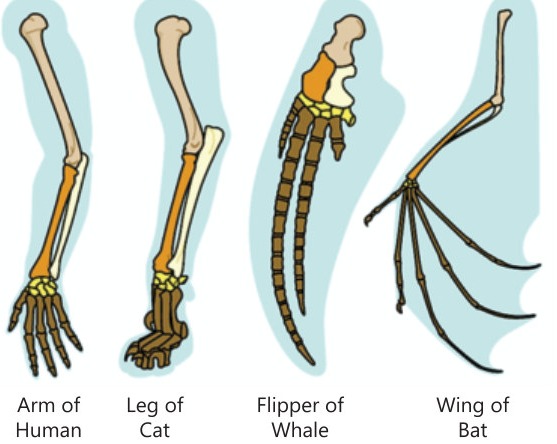
i. Definition: The similar structures in different species that perform different functions are called homologous structures. For example, the forelimbs of mammals (arms of human, legs of cat, flippers of whale, and wings of bat) all have the same structure but different functions. The basic similarity of structure of these forelimbs is the evidence that they evolve from a common ancestor
ii. Vestigial Structures / What are vestigial structures? / Explain how vestigial structures provide evidence of evolution.
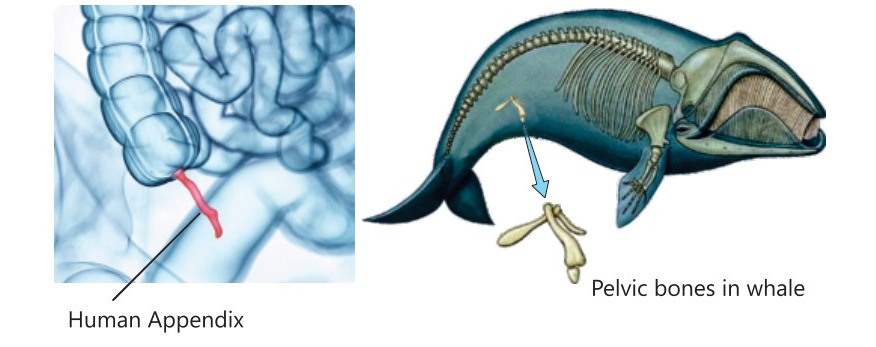
• Definition: Vestigial organs are body parts that have no apparent function but were fully functional in an organism's ancestors. It is believed that through evolution vestigial organs lost their original function overtime.
• Example of Vestigial Organs
o Human appendix: It is a small, tube-like structure attached to the cecum. In humans, it is a vestigial structure. It might have played a more important role in the digestive system of ancestors.
o Ear Muscles in Humans: In many animals, such as cats and dogs, ear muscles move their ears to detect sounds from different directions. However, in humans, these ear muscles are largely non-functional. So, these are vestigial structures in humans.
o Pelvic bones in whales: Modern whales have small, non-functional pelvic bones even though they do not have legs.
o Wings in flightless birds: Birds like ostriches have wings, but they do not use them for flight.
3. Selective Breeding (Artificial selection)
a. Introduction: Selective breeding means the process in which humans select varieties of plants or animals and breed them to produce offspring with required characteristics.
b. Effects: In this way, they can improve characteristics in plants such as grain production or disease resistance. Similarly, they can improve growth rate or milk production in animals.
c. Breeds: The varieties of animals which are selectively bred are called breeds.
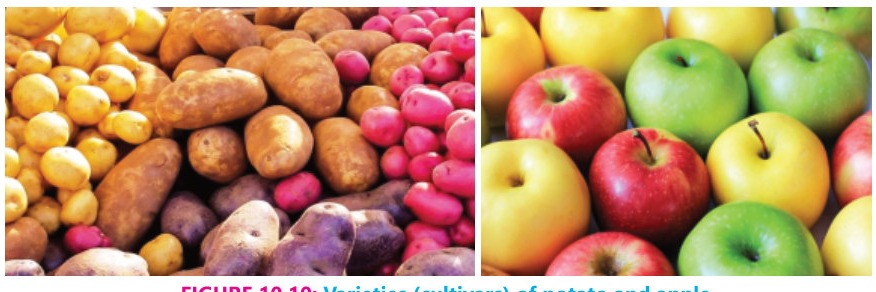
d. Varieties / Cultivars: The varieties of plants which are selectively bred are known as varieties or cultivars.
e. Examples
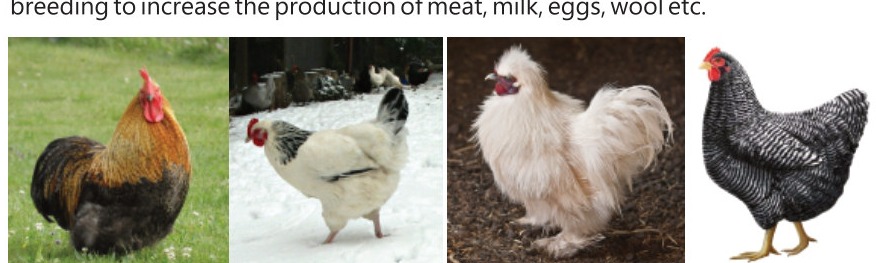
i. Many breeds of sheep, goat, cow, hen etc. have been produced by selective breeding to increase the production of meat, milk, eggs, wool etc.
ii. Similarly, many plant varieties (cultivars) have been produced for better quantity and quality of food. This process has proved very successful for the improvement of yields in economically important plants like wheat, rice, potato, and apple etc.
4. Conclusion: Selective breeding provides evidence of the naturally occurring variations among species and their natural selection (evolution).
More figures from this unit