StudentAid
Unit 4: Work, Energy and Power — Long Questions
11th Class Physics · Unit 4: Work, Energy and Power
Work
Definition "Work is said to be done, if a constant force is applied on body and body covers a distance in the direction of force."
Formula W = F.d = Fd cos θ
Explanation
Let F be a constant force acting on a body and making an angle 'θ' with the displacement d as shown in the Fig. Resolving F into its rectangular components
Fx = F cos θ
Fy = F sin θ
Work done along x-axis
The displacement of the body 'd' which is along the x-axis, therefore, work done due to x-component of force will be
Wx = (Fx) d
= (F cos θ) d
Work done along y-axis
Since there is no displacement of the body along y-axis, therefore, work done due to y-component of the force will be
Wy = (Fy) d
Wy = 0 ∴ d = 0
Total work done
W = Wx + Wy
W = (F cos θ) d + 0
W = (F cos θ) d
W = Fd cos θ
or W = F.d
Conclusion Hence work done is the dot product of force and displacement. Work is a scalar quantity.
Unit
Its S.I unit is joule.
1J = 1 N × 1m
1J = 1 N m
Definition of joule Joule is defined as "work done when a force of 1 N acts on a body and it displaces through a distance of 1 m along its direction".
Dimension of work
F = ma
N = 1kg × 1m/s²
⇒ [F] = [MLT⁻²]
∴ [W] = [MLT⁻²][L] = [ML²T⁻²]
Characteristics of work
(i) Work is a scalar quantity.
(ii) If θ < 90°, work is said to be positive.
(iii) If θ = 90°, no work is done.
(iv) If θ > 90°, the work done is said to be negative.
Graphical representation of work done by constant force:
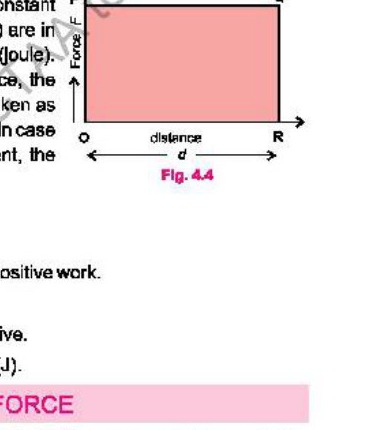
Area under a force displacement curve represents the work done by constant force.
Explanation Distance is taken along x-axis and the force which is constant along y-axis. When constant force 'F' and displacement 'd' are in the same direction, the work done is Fd. On the graph shaded area in the Fig. is OPQR which is also Fd. Hence area under force displacement curve measures the work done.
Work done by a variable force:
The force does not remain constant in many cases during the process of doing work. So work is said to be done by variable force.
Examples
(i) The force exerted by a spring increases with the amount of the stretch. Hence, work done in stretching a spring is a case of work done by variable force.
(ii) When a rocket moves away from the Earth, work is done against the force of gravity. The force of gravity does not remain constant because it is inversely proportional to the square of distance from the centre of Earth, (Fg α 1/r²). Therefore, it is case of work done by variable force.
Calculation of Work Done by a Variable Force:
Consider a body, which is moving from point 'P' to 'Q' under a variable force. The work done can be calculated by dividing the path in the small path elements Δd₁, Δd₂, Δd₃,-- ---------- Δdₙ. Let F₁ ,F₂, F₃ ------------ Fₙ are the forces acting during these intervals respectively.
By supposing the force during each interval to be constant, the work done for these displacements are:
ΔW₁ = F₁.Δd₁ = F₁Δd₁ cosθ₁
ΔW₂ = F₂.Δd₂ = F₂Δd₂ cosθ₂
ΔW₃ = F₃.Δd₃ = F₃Δd₃ cosθ₃
ΔW₄ = F₄.Δd₄ = F₄Δd₄ cosθ₄
The total work done in going point from 'P' to 'Q' is
W = Δ W₁ + ΔW₂ +------------------+ ΔWₙ
= F.Δd₁ + F.Δd₂ + -------------- +F.Δdₙ
= F₁Δd₁ cosθ + F₂Δd₂ cosθ₂ .... + Fₙ Δdₙ cosθₙ
Wtotal = Σ F₁Δd₁ cosθ₁
i=1
Graphically This can be examined graphically by plotting F cosθ versus d, F Cosθ has been plotted along Y-axis while displacement d has been subdivided into "n" equal intervals. The value of F cosθ at the beginning of each interval is indicated by the vertical line.
New area of it h shaded rectangles.
Accurate work If distance is subdivided into large number of intervals so that each Δd becomes very small such that each Δd approaches to zero then we obtain an accurate result written as below:
Wtotal = lim Σ F₁Δd₁ cosθ₁
Δd→0 i=1
Conclusion Work done by variable force in moving a particle from point 'P' to point 'Q' is equal to area under the graph of "F cosθ" versus d as shown in Fig.
Gravitational Field
Definition
"The space or region around the Earth within which the Earth exerts a force of attraction (gravitation) on other bodies is called gravitational field.
(OR)
"The space around the Earth in which its gravitational force acts on a body is called gravitational field."
Work done in gravitational field:
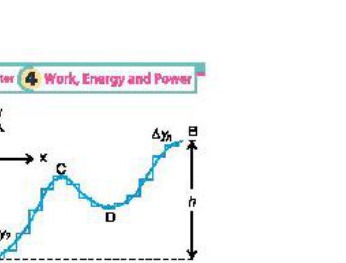
Consider a body of mass 'm' is displaced from point A to B in the Gravitational field along various paths. Consider three such paths which are ACB, AB and ADB.
The work done over these paths are:
Work done along the path ACB:
WACB = WAC + WCB
= Wd₁ + Wd₂
= Wd₁ cos180° + Wd₂ cos 90°
= Wd₁ (-1) + Wd₂ (0) [∵ cos180°=-1&cos90° = 0]
= -Wd₁
Let d₁ = h (From Fig.), As w = F = mg
So WACB = -wh
Or WACB = -mgh ----------- (1)
Work done along path ADB:
WADB = WAD + WDB
= Wd₁ + Wd₂
WACB = Wd₁ cos90° + Wd₁ cos180°
WACB = Wd₁(0) + Wd₁ (-1)
WACB = -Wd₁
WADB = -mgh ----------- (2)
Work done along the path AB
We divide the curved path (AB) into a series of horizontal and vertical steps as shown in Fig.
Work done along AB = (W work done along horizontal steps) + (work done along vertical steps)
WAB = (wΔx₁ + wΔx₂ ------- wΔxₙ) + (wΔy₁ + wΔy₂ ------- wΔyₙ)
WAB = (wΔx₁ cos90° + wΔx₂ cos90°------- +wΔxₙ cos90°) +(wΔy₁ cos180° + wΔy₂ cos180° -----+ wΔyₙ cos180°)
⇒ WAB = 0 + (-wΔy₁ - wΔy₂ - wΔy₃ ------- - wΔyₙ)
WAB = -w(Δy₁ + Δy₂ + Δy₃ ------- Δyₙ)
WAB = -wh
WAB = -mgh ----------- (3)
Comparing eq. (1), (2) and (3) it is concluded that work done along every path is same. Hence, work done in the gravitational field is independent of the path followed by the body.
Conservative field
Definition "The field in which the work done is independent of the path or work done around the closed path is zero is known as conservative field."
Examples
i. Gravitational field
ii. Electric field
Work done along a closed:
Consider a closed path ABDA. The body is moved from A to D, D to B and then from B to A. the total work done is equal to sum of work done along these paths. So,
WA→D = mg (AD) cos90°
= mg (AD) (0)
= 0
Now WD→B = mg (DB) cos180°
= mg (DB) (-1)
= -mgh
And for the curved path
WB→A = mg (Δy₁)cos0° + mg (Δy₂)cos0° + ...... + mg (Δyₙ) cose0°
= mg (Δy₁ + Δy₂ +.............. + Δyₙ) [∵ cos0° = 1]
= -mgh [∵ (Δy₁ + Δy₂ +..... + Δyₙ) = h]
So, WADBA = WA→D + WD→B + WB→A
0 + (-mgh) + (mgh)
WADBA = 0
Hence the work done along a closed path is zero.
Conservative force Non-Conservative force
A force is conservative if: A force is non-conservative if the:
i. Work done by force is independent of path followed. i. Work done by force depends upon the path followed.
ii. Work done by this force along a closed path is zero. ii. Work done by this force along a closed path is not zero.
iii. Examples of conservative force are gravitational force, elastic restoring force and electric force etc. iii. Examples of non-conservative force are frictional force, air resistance, tension in a string, normal force, propulsion force of a rocket, propulsion force of a motor.
Power
Data "Rate of doing work is known as power."
Formula
Power = Work/Time
P = W/t
Average power
Definition "It is defined as the ratio of total work done to total time taken."
Mathematically Pav = ΔW/Δt
Instantaneous Power
Definition "It is defined as power of an agency at any instant."
Mathematically
Pins = lim ΔW/Δt
Δt→0
Power in terms of velocity and force:
P = F.v
Proof
We know that
P = lim ΔW/Δt
Δt→0
P = lim F.Δd/Δt [∵ ΔW = F.Δd]
Δt→0
∴ lim Δd/Δt = v
Δt→0
P = F.v
Hence, power is dot product of force and velocity.
Unit SI unit of power is watt. It is scalar quantity.
Definition of Watt "Power delivered by the machine will be 1 watt if it performs one joule of work in 1 sec."
1 watt = 1J/1Sec
Dimension of power
[P] = [work]/[time]
[P] = [ML²T⁻²]/[T]
[P] = [ML² T⁻³]
Kilowatt-Hour
Data It is a commercial unit of electrical energy. "One kilowatt hour is the work done in one hour by an agency whose power is one kilowatt".
1kwh = 1000w × 3600s [∵ 1hrs 60× 60 = 3600 sec]
= 3600000 W s [∵ W = J/s, Ws = J]
= 36×10⁵ J
= 3.6×10⁶ J = 3.6 MJ
Definition "Kinetic energy is the energy possessed by a body due to its motion".
Derivation of an Expression Let us derive a formula for the kinetic energy of a moving body. Consider a body of mass m moving with a constant speed on a frictional road. It will still cover some distance before stopping. As long as it is moving, it is doing work against the force of friction of the road. In other words, during this interval, it will exert a force equal in magnitude to the force of friction f. Let the distance travelled before coming to rest be d, then the work done by the body would be fd. This work is done by the body due to its motion. The ability of a body to do work due to its motion is its kinetic energy. Therefore, kinetic energy of the body is equal to f d. The acceleration can be found by using Newton's second law of motion, i.e.,
F = ma
As the body slows down and finally stops, its acceleration a is negative-because it is produced by force of friction f acting opposite to the direction of motion. Thus, f = - ma
or a = -f/m
We can now determine the value of (fd) by using the third equation of motion, i.e;
2as = vf² - vi²
Here, Initial velocity vi = v
Final velocity vf = 0
Distance s = d
Acceleration a = -f/m
Putting values in the above equation of motion, we have
2 × (-f/m) d = 0 - v²
fd = 1/2 mv²
As f d is equal to the kinetic energy of body, therefore,
Kinetic energy = 1/2 mv²
Units Since, kinetic energy is equal to work which the body is capable of doing, so the unit of kinetic energy must be that of work, i.e. joule (J).
Expression K.E = p²/2m
As we know K.E = 1/2 mv²
Multiply and divide by m on right side
K.E = m²v²/2m ----------(1)
∴ p = mv
Taking square
p² = m²v²
Put in (1)
K.E = p²/2m
Absolute P.E.
"The amount of work done in lifting the body from the required point to the point at infinity against gravitational force is known as absolute P.E."
Expression of absolute P.E:
Consider two points 1 and N in the Earth's gravitational field. Divide the interval between point 1 and N into small segments, such that gravitational force remains constant during each segment. Consider two such points 1 and 2. Let the displacement of the body from point 1 to point 2 is Δr. From Fig.
Δr = r₂ - r₁
Where r₁ and r₂ are the distances of the point 1 to 2 from centre of the Earth.
Work done in lifting the body from point 1 to point 2 is:
W = F.Δr
1→2
W = FΔr cos 180°
1→2
= -F.Δr
[∵ cos 180° = -1]
= -F(r₂ - r₁)
From Newton's Law of Gravitation [F = GMm/r²], we have:
W = -GmM(r₂ - r₁) ----------(1)
1→2 r²
Where r = (r₁ + r₂)/2
(r)² = ((r₁ + r₂)/2)² ----------(2) (Squaring)
As r₂ - r₁ = Δr
r₂ = Δr + r₁
Putting the value of r₂ in Eq. (2)
r² = ((r₁ + Δr + r₁)/2)
r² = ((2r₁ + Δr)²)/4
r² = (4r₁² + Δr² + 4r₁Δr)/4
r² = r₁² + Δr²/4 + r₁Δr
When Δr is very small then Δr²/4 can be neglected.
r² = r₁² + r₁Δr
Putting the value of Δr:
r² = r₁² + r₁(r₂ - r₁)
r² = r₁² + r₁r₂ - r₁²
r² = r₁r₂
Putting the value of r² in Eq. (1)
W = -GmM(r₂/r₁r₂ - r₁/r₁r₂)
1→2
W = -GmM(1/r₁ - 1/r₂) ----------(3)
1→2
Similarly, the works done in lifting the body for other intervals are:
W = -GmM(1/r₂ - 1/r₃)
2→3
W = -GmM(1/r₃ - 1/r₄)
3→4
.
.
.
.
W = -GmM(1/r(N-1) - 1/rN)
(N-1)→N
W = W + W + W --------- + W
1→N 1→2 2→3 3→4 (N-1→N)
W = -GmM(1/r₁ - 1/r₂) - GmM(1/r₂ - 1/r₃) ------- -GmM(1/r(N-1) - 1/rN)
1→N
W = -GmM[(1/r₁ - 1/r₂) + (1/r₂ - 1/r₃) + (1/r₃ - 1/r₄) + ... + (1/r(N-1) - 1/rN)]
1→N
W = -GmM[1/r₁ - 1/rN]
1→N
By taking N at infinity we put rN = ∞ in above equation
W = -GmM(1/r₁ - 1/r∞)
1→∞
∴ 1/rN = 1/∞ = 0
Anything divided by infinity is zero
W = -GmM/r₁
1→∞
By definition this is the absolute P.E at point '1' is written as below:
U₁ = -GmM/r₁
Generally the absolute P.E at any point at a distance 'r' from the centre of Earth is written as:
U(r) = -GmM/r
The absolute P.E on the Earth surface can be determined by putting r equal to R.
∴ Ug = -GmM/R
Absolute P.E. = -GmM/R
Absolute P.E as negative quantity:
The absolute P.E is taken negative because displacement of the body is opposite to the gravitational force. This negative sign shows that the Earth's gravitational field is attractive for the body of mass m.
Escape Velocity
"The minimum velocity given to the body on the Earth's surface, due to which it escapes the Earth's gravitational field, is known as escape velocity". It is denoted by vesc.
Expression of Escape Velocity
The K.E of the body on the Earth surface when it is thrown vertically upward with escape velocity is written as:
K.E = 1/2 m v²esc ---------- (1)
Thrown with escape velocity body will just reach to point where a = 0 i.e. at infinity. At that point the absolute potential energy is zero and the body comes to rest. So,
Increase in P.E = U∞ - Ug
Increase in P.E = 0 - (-GmM/R)
Increase in P.E. = GmM/R ----------- (2)
Since
Loss of K.E = Increase in P.E.
1/2 mvesc² = G Mm/R
1/2 mvesc² = G Mm/R
v²esc = 2GM/R
vesc = √(2GM/R) ----------- (3)
As, we know that
F = GMm/R²
But on surface of Earth, F = w = mg
∴ mg = GMm/R²
g = GM/(R × R)
gR = GM/R
Put in (3).
vesc = √(2gR)
This is an expression for escape velocity. It depends upon the radius and acceleration due to gravity of the planet.
For Earth
vesc = √(2 × 9.8 × 6.4×10⁶)
vesc = 11×10³ m/sec
vesc = 11 km/s
The escape velocity for different planets is different.
Note (i) At a velocity of about 8 km/sec, a satellite can describe a circular orbit close to the Earth's surface.
(ii) A satellite having a velocity greater than 8 km/sec but less than 11 km/sec, can move in an elliptical orbit around the Earth.
(iii) The molecules of air at normal pressure and temperature have an average velocity of 48m/sec which is much less than the velocity of escape. Resultantly the gravitational attraction keeps the atmosphere around the Earth.
(iv) The gravitational attraction of moon is much less and the velocity of escape from moon is 2.3 km/sec so this accounts for the lack of atmosphere around the moon.
Work-Energy Principle
Statement "It states that when a force is applied on a body then work done on the body is equal to change in K.E of the body".
Explanation
Consider a body is moving on a smooth surface. Let a constant force F acts on a body over a displacement 'd' which changes its velocity from Vi to Vf.
Work done on the body from A to B is
F.d = Fd cos 0°
WAB = Fd ---------- (1)
The acceleration in the body by Newton's second law
a = F/m ---------- (2)
Using 3ʳᵈ Eq. of motion, in which S = d and a = F/m
2aS = v²f - v²i
2(F/m)d = v²f - v²i
Fd = m/2(v²f - v²i)
Fd = mv²f/2 - mv²i/2
Fd = 1/2 mv²f - 1/2 mv²i
W = (K.E)f - (K.E)i
W = Δ(K.E)
W = Change in Kinetic Energy.
The work energy principle can also be written in terms of P.E when body is lifted from one point to another in gravitational field without accelerating it.
WorKA→B = (P.E)B - (P.E)A
Interconversion of K.E. and P.E.
P.E may be converted into K.E and vice-versa but total energy remains constant in every circumstance.
Explanation
Case I When air friction is absent (f ≈ 0)
Consider a body moving from point A to B under gravity. During its free fall the body will lose P.E and gain K.E. Let the height of point A from Earth surface is h.
At position A Since at position A, body of mass m is at rest. So v = 0.
(PE)A = mgh
(KE)A = 0 ∴ v = 0
Total energy = (PE)A + (KE)A
= mgh + 0 = mgh
(TE)A = mgh
At position B
At position B, body has fallen through a distance of 'x', so
(PE)B = mg (h-x)
(KE)B = 1/2 mv²B ----------- (1)
To Calculate VB, put Vi = 0, a = g, S = x, Vf = VB = ?
Using third equation of motion
2aS = v²f - v²i
2gx = v²B - 0
v²B = 2gx
Putting v²B in equation. (1) we get
(KE)B = 1/2 m × 2gx = mgx
(TE)B = (PE)B + (KE)B = mg(h-x) + mgx
(TE)B = mgh - mgx + mgx
(TE)B = mgh
Thus (TE)B = mgh
At position C
At position C, just before when it strikes the Earth is
(P.E)c = 0
And
(K.E)c = 1/2 mv²c ----------- (2)
To calculate v²c
Vi = 0 , a = g, S = h, Vf = Vc = ?
Using 2aS = v²f - v²i we get
⇒ v²c = 2gh
Put in Eq. (2)
Hence: (K.E)c = 1/2 mv²c = 1/2 m × 2gh = mgh
∴ (T.E)c = (P.E)c + (K.E)c
= 0 + mgh
Thus (T.E)c = mgh
Conclusion
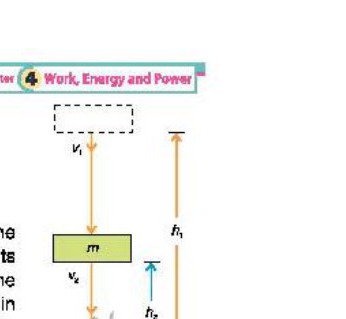
As a body falls under gravity its velocity increases and height decreases. Thus, in general, a body at height h₁ has velocity v₁ and at height h₂ , velocity is v₂ , then according to law of conservation of energy.
Loss in P.E = Gain in K.E
mg(h₁ - h₂) = 1/2 m(v₂² - v₁²)
Case II When friction is present (f ≠ 0)
In the Presence of friction, during the downward motion, a part of P.E is used in doing work against friction which is equal to fh.
Loss in P.E = gain in K.E + work done against friction.
mgh = 1/2 mv² + fh
More figures from this unit