StudentAid
Unit 7: Waves and Vibrations — Long Questions
11th Class Physics · Unit 7: Waves and Vibrations
Definition A wave is a regular disturbance or variation that carries energy, which spreads out from the source.
Examples
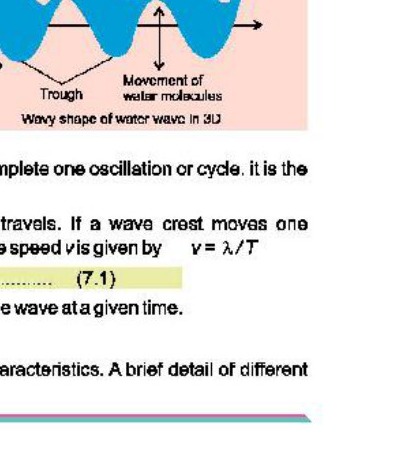
Energy is transferred from the Sun to the Earth in the form of light waves called electromagnetic waves. These waves can even travel through vacuum. However, in a medium, energy is transferred due to the regular and repeated disturbances that travel through the medium, making its particles to move up and down or back and forth (to and fro). Imagine a stone thrown into a pond of water Fig.
The stone produces a disturbance (ripple) that travels through the water (medium).
The water particles move up and down at their own places, creating a repeating pattern known as wave that spreads out.
The displacement of a particle of a wave is its distance in a specified direction from its rest / equilibrium position. If the displacement is plotted along the y-axis and the time in the direction of energy travel along the x-axis, we get a waveform as shown in Fig.
The waves can be described by the following parameters:
i. Amplitude (A): The maximum displacement of the wave (or particles of the medium) from its equilibrium position.
ii. Frequency (f): The number of oscillations/vibrations or cycles per second.
iii. Wavelength (λ): The distance between two consecutive similar points on the wave that are in phase.
iv. Period (T): The time taken by the wave to complete one oscillation or cycle, it is the reciprocal of the frequency T= 1/f.
v. Speed (v): The speed at which the wave travels.
If a wave crest moves one wavelength λ in one period of oscillation T, the speed v is
given by v = λ / T (Using v = s/t)
as 1/T = f, so v = f λ
vi. Phase (θ): The relative position of a point on the wave at a given time.
Types of Waves
Waves have various forms, each with unique characteristics. A brief detail of different types of waves is given below:
i. Mechanical Waves
These waves require a physical medium (solid, liquid, or gas) to propagate.
Examples Water waves (ocean, lake, or pond ripples), sound waves (audible vibrations in air, water, or solids), seismic waves (earth quakes), etc.
ii. Electromagnetic Waves
They do not require a medium to propagate and therefore, can travel through vacuum.
Examples Radio waves (wireless communication), Microwaves (cooking and heating), Infrared waves (IR or heat radiation), Visible light (sunlight, lamp light), Ultraviolet waves (UV radiation), X-rays (medical imaging), Gamma rays (high-energy radiation), etc.
iii. Quantum Waves
Quantum waves are associated with particles like electrons and photons.
Examples Matter waves/particle waves (electron waves in atoms) or de-Broglie waves, photon waves (light quanta), etc.
iv. Surface Waves
Surface waves propagate along surfaces or interfaces between two mediums.
Examples Ocean surface waves (wind-driven waves), seismic surface waves, etc.
Transverse and Longitudinal Waves
There are two main types of waves which are named as transverse waves and Transverse waves is one in which the vibrations of the particles are at right angle to the direction in which the energy of the wave is travelling e.g. waves on surface of water, waves in stretched string etc.
Longitudinal wave is one in which the direction of the vibration of the particles is along or parallel to the direction in which the energy of the wave is travelling e.g. sound waves etc.
The transverse wave and longitudinal wave are illustrated in Figs. (a) and (b) respectively.
Principle of Superposition of Waves
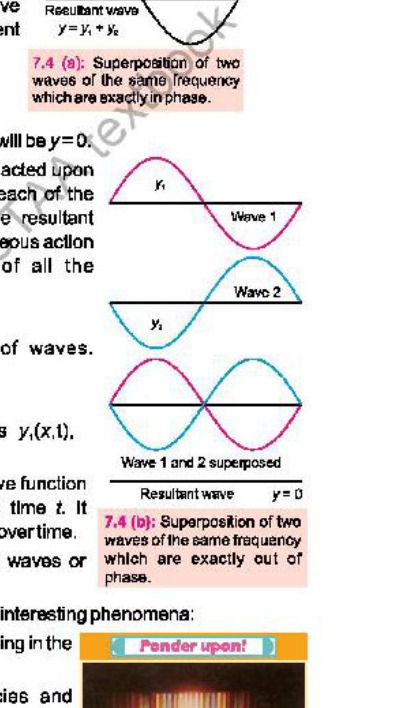
"If a particle of the medium is simultaneously acted upon by two waves, then the resultant displacement of the particle is the algebraic sum of their individual displacements. This is called principle of superposition."
In other words, the displacements of the individual waves are added together to form a new wave pattern as shown in Figs. (a) and (b) respectively.
Explanation
(i) If two waves, which overlap each other, have same phase, their resultant displacement will be:
y = y₁ + y₂
Where
y₁ = amplitude of wave 1
y₂ = amplitude of wave 2
And
y = resultant amplitude
Particularly, if y₁ = y₂ then resultant displacement will be:
y = 2 y₁, or y = 2 y₂
(ii) If two waves, which cross each other, have opposite phase, their resultant displacement will be:
y = y₁ + (- y₂)
y = y₁ - y₂
Particularly, if y₁ = y₂, then resultant displacement will be:
y = 0. Thus, if a particle of a medium is simultaneously acted upon by n waves such that its displacement due to each of the individual n waves be y₁, y₂ -------, yₙ, then the resultant displacement y of the particle, under the simultaneous action of these n waves is the algebraic sum of all the displacements, i.e.,
y = y₁ + y₂ + ----------+ yₙ
This is called principle of superposition of waves.
Mathematically, this can also be represented as:
y(x,t) = y₁(x,t) + y₂(x,t) + ------- + yₙ(x,t)
Where y(x,t) is the resultant wave, whereas y₁(x,t), y₂(x,t), ---------, yₙ(x,t) are the individual waves.
In the context of waves, y(x,t) represents the wave function or wave displacement at a given point x and time t. It describes the shape of the wave and its evolution overtime.
The principle of superposition applies to linear waves or small amplitude waves.
Application of superposition principle
Principle of superposition of waves leads to many interesting phenomena:
(i) Interference: Two waves having same frequency and travelling in the same direction (Interference).
(ii) Beats: Two waves of slightly different frequencies and travelling in the same direction (Beats).
(iii) Stationary waves: Two waves of equal frequency travelling in opposite direction (Stationary waves).
Applications of the Principle of Superposition
By applying the principle of superposition of waves, noise-cancelling headphones effectively eliminate unwanted noise, providing a more immersive and peaceful listening experience.
1. The headphones contain one or more microphones that capture ambient noise (like background chatter or engine rumble or any environmental noise).
2. The microphone sends the sound signals to an amplifier and a processing unit in the headphones.
3. The processing unit generates an "anti-noise" signal, which is the exact opposite of the ambient noise (in terms of amplitude and phase).
4. The anti-noise signal is then played through the headphones, along with the desired audio (like music or voice).
5. When the anti-noise signal meets the ambient noise, the two waves cancel each other out resulting in a much quieter listening experience.
Though the above example is an oversimplification of the situation, as noise-cancelling headphones use complex algorithms and multiple microphones to achieve optimal noise cancellation, the basic principle of superposition remains a fundamental concept in understanding how they work.
Interference and its types
Interference Superposition of two waves having the same frequency and travelling in the same direction results in phenomenon called interference.
Explanation An experimental setup to observe interference effect of sound waves is shown in Fig. two loud speakers S₁ and S₂ act as two sources of harmonic sound waves of a fixed frequency produced by an Audio Generator (AG). Since the two speakers are driven from the same generator, therefore, they vibrate in phase. Such sources of waves are called coherent sources. A microphone attached to a sensitive Cathode Ray Oscilloscope (CRO) acts as a detector of sound waves. The CRO is a device to display the input signal into waveform on its screen. The microphone is placed at various points, turn by turn, in front of the loud speakers as shown in Fig.
Condition for Constructive Interference
At points P₁, P₃ and P₅, we find that a compression meets a compression and a rarefaction meets a rarefaction. So, the displacement of two waves are added up at these points according to the principle of superposition and a large resultant displacement is seen on the CRO screen Fig.
From Fig., we find that the path difference ΔS between the waves at the point P₁, is,
ΔS = S₂P₁ - S₁P₁
ΔS = 4 1/2 λ - 3 1/2 λ = λ
Similarly, at points P₃ and P₅, path difference is zero and λ, respectively. Here, λ is the wavelength which is the distance between any two successive solid or dashed lines.
Whenever the path difference is an integral multiple of wavelength, the two waves are added up. This effect is called constructive interference.
Therefore, the condition for constructive interference can be written as:
ΔS = nλ where n = 0, ±1, ±2, ±3, ----------
Condition for Destructive Interference
At points P₂ and P₄, a compression meets a rarefaction, so that they cancel each other's effect according to the principle of superposition. The resultant displacement becomes zero, as shown in Fig.
The path difference ΔS between the waves at points P₂ and P₄ is:
ΔS = S₂P₂ - S₁P₂
ΔS = 4λ - 3 1/2 λ = 1/2 λ
Similarly, at P₄ the path difference is 1/2 λ.
So, at points where the displacements of two waves cancel each other's effect, the path difference is an odd integral multiple of half the wavelength. This effect is called destructive interference.
Therefore, the condition for destructive interference can be written as:
ΔS = (2n + 1) λ/2 where n = 0, ±1, ±2, ±3, ----------
Stationary Waves & Their Formation
Stationary waves, also known as standing waves, are the waves that oscillate in a fixed position, without moving or propagating. They are formed by the superposition of two waves with the same frequency and amplitude, travelling in opposite directions. The resulting wave pattern remains stationary, with nodes (points of zero amplitude) and antinodes (points of maximum amplitude) at fixed positions. Examples include waves on a string, and sound waves in a pipe. The term "standing wave" describes that the wave pattern remains fixed in space, oscillating between positive and negative values, without moving forward or backward.
Node In stationary waves, the points where the displacement is zero are called nodes. They are usually denoted by 'N'.
Antinodes In stationary waves, the points where the displacement is maximum are called antinodes. They are usually denoted by 'A'.
Characteristics Energy in a wave transfers because of the motion of the particles of the medium. The nodes always remain at rest, so energy cannot flow past these points. Hence, energy remains "standing" in the medium between nodes, although it alternates between potential and kinetic forms at the antinodes. When the antinodes are all at their extreme displacements, the energy stored is wholly potential and when they are simultaneously passing through their equilibrium positions, the energy is wholly kinetic.
Stationary Waves on a Stretched String
Consider a string of length 'ℓ' which is kept stretched by clamping its ends so that the tension in the string is F.
(a) String Plucked at its Middle Point
If the string is plucked at its middle point, two transverse waves will originate from this point. One of them will move towards the left end of the string and the other towards the right end. When these waves reach the two clamped ends, they are reflected back thus giving rise to stationary waves. As the two ends of the string are clamped, no motion will take place there. So, nodes will be formed at the two ends and one mode of vibration of the string will be as shown in Fig. with the two ends as nodes with one antinode in between. The distance between two nearest nodes is half the wave length. So if "λ₁" is the wave length in this mode of vibration then
ℓ = λ₁ / 2
λ₁ = 2ℓ ------ (1)
where λ₁, is the wavelength of the waves set up in this mode of vibration then. If "v" is the velocity of the waves along the string and f₁ is the frequency with which string vibrates then
v = f₁ λ₁
or
v = f₁ (2 ℓ)
or
f₁ = v / 2ℓ
Since the speed of the waves in the string depends upon the tension 'T' in the string and the linear mass density m of the string (mass per unit length)
∴ v = √(T / m)
Putting the value of 'v' in above Eq. (1) we have
f₁ = 1 / 2ℓ √(T / m)
Thus, in the first mode of vibration shown in Fig., waves of frequency f₁ only will be set up in the given string.
(b) String Plucked at Quarter Length
If the same string is plucked from one quarter of its length, again stationary waves will be set up with nodes and antinodes as shown in Fig. (b) Note that now the string vibrates in two loops. As the distance between two consecutive nodes is half the wavelength, so the length ℓ of string is equal to the wavelength of the waves set up in this mode. If λ₂ is the wavelength of these waves, then,
ℓ = λ₂ / 2 + λ₂ / 2
ℓ = 2 λ₂ / 2
λ₂ = ℓ ------ (2)
If f₂ is frequency of vibration of string in its second mode, then
f₂ = v / λ₂
from Fig. (b)
λ₂ = ℓ
Therefore
f₂ = v / ℓ
Multiplying and dividing by 2, we have
f₂ = 2 (v / 2ℓ)
Using Eq. (1)
So
f₂ = 2f₁
Thus, when the string vibrates in two loops, its frequency becomes double than when it vibrates in one loop.
(c) String Plucked at an Arbitrary Point
Let the string resonates in n number of loops with (n + 1) nodes and n antinodes. Thus, we can say that if the string is made to vibrate in n loops, the frequency of stationary waves set up on the string will be:
fₙ = n (v / 2ℓ)
Using Eq. (1)
fₙ = nf₁ ------ (3)
or
fₙ ∝ n
and the corresponding wavelength is,
λₙ = 2ℓ / n ------ (4)
where n = 1,2,3, ......
It is clear that as the string vibrates in more than one loop, its frequency f₁, 2f₁, 3f₁ ,...., nf₁ goes on increasing and the wavelength λ gets correspondingly shorter. However, the product of the frequency f and wavelength λ is always equal to v, the speed of waves.
The above discussion clearly establishes that;
i. The stationary waves have a discrete set of frequencies which is known as harmonic series. The lowest characteristic frequency of vibration is the fundamental frequency f₁, corresponds to the first harmonic. The frequency f₂ = 2 f₁, corresponds to the second harmonic and so on.
ii. In other words, quantum jumps in frequency exist between the resonance frequencies. This phenomenon is known as the Quantization of frequencies. It means fₙ = nf₁ where n = 1,2,3, ... (Integral multiples). The stationary waves can be set up on the string only with the frequencies of harmonic series determined by the tension, length and mass per unit length of the string. Waves which are not in harmonic series are quickly damped out.
iii. The frequency of a string on a musical instrument can be changed either by varying the tension or by changing the length. For example, the tension in guitar and violin strings is varied by tightening the pegs on the neck of the instrument. Once the instrument is tuned, the musicians vary the frequency by moving their fingers along the neck, thereby changing the length of the vibrating portion of the string.
Stationary Waves in Air Columns
Stationary waves can be set up in other media also, such as air column inside a pipe or tube. A common example of vibrating air column is in the organ pipe.
Organ pipe
An organ pipe is a wind instrument in which sound is produced, due to setting up of stationary waves in air column. It consists of a hollow long tube with both ends open or with one end open and the other closed. The relationship between the incident wave and the reflected wave depends upon whether the reflecting end of the pipe is open or closed.
(i) If the reflecting end is open, the air molecules have complete freedom of motion and this behaves as an antinode.
(ii) If the reflecting end is closed, then it behaves as a node because the movement of the molecules is restricted.
Modes of Vibrations
Stationary longitudinal waves occur in a pipe as discussed by the following two cases:
Case (1)
Modes of Vibrations in an organ pipe open at both ends
Consider an organ pipe of length 'ℓ' which is open at both ends. As at the open end, an air molecule has complete freedom of motion so it acts as antinode as shown in Fig. In this Fig., longitudinal waves set up inside the pipe have been represented by transverse curved lines which represent the displacement and amplitude of vibration of air particles at various points along the axis of pipe.
(a) Fundamental mode of vibration
In this case, as shown in Fig.(a), there is only one node N at the middle of the pipe. As both ends of pipe are open, there are two antinodes at both the ends. If λ₁ is the wavelength of sound, then
ℓ = λ₁/4 + λ₁/4
ℓ = λ₁/2
or
λ₁ = 2ℓ ------ (1)
If f₁ is the frequency of sound, then the velocity of sound is:
v = f₁λ₁
f₁ = v / λ₁
Putting the value of λ₁, we have
f₁ = v / 2ℓ ----- (2)
This frequency is called fundamental frequency or first harmonic.
(b) Second mode of vibration
If there are three antinodes and two nodes, frequency will be twice that of fundamental. Frequency. It is second mode of vibration as shown in Fig. (b) in this case, there are three antinodes and two nodes.
If λ₂ is the wavelength of wound, then
ℓ = λ₂/4 + λ₂/2 + λ₂/4
ℓ = (1 + 2 + 1) λ₂/4
or
λ₂ = ℓ
If f₂ is the frequency of sound, then speed v of sound becomes:
v = f₂λ₂
or
f₂ = v / λ₂
Putting the value of λ₂, we have
f₂ = v/ℓ = 2 × (v / 2ℓ)
or
f₂ = 2f₁ (∵ v/2ℓ = f₁)
The frequency f₁ is called fundamental frequency.
(c) nth mode of vibration
Similarly, frequency for air column vibrating in n loops is:
fₙ = n (v/2 ℓ),
fₙ = nf₁
And wavelength is
λₙ = 2ℓ / n --------- (3)
Where n = 1,2,3,4,5, -----
So, the longitudinal stationary waves have a discrete set of frequencies f₁, 2 f₁, 3 f₁,...., n f₁, which is known as harmonic series. The frequency f₁ is known as fundamental frequency and the others are called harmonics.
Case (2)
Modes of vibration in an organ pipe closed at one end
Let us consider an organ pipe of length ℓ which is closed at one end. Then at the closed end, we get a node while at the open end, we get an antinode as shown in the Fig.
(a) Fundamental mode of vibration:
Fundamental mode of vibration has one node and one antinode as shown in Fig. (a) If λ₁ is the wavelength of fundamental mode, then length of the pipe is:
ℓ = λ₁/4
or
λ₁ = 4ℓ --------- (4)
so, the speed v becomes:
v = f₁λ₁
f₁ = v / λ₁
f₁ = v / 4ℓ ----------(5), (∵ λ₁ = 4ℓ)
The frequency f₁ is called fundamental frequency.
(b) Second Mode of Vibration:
Second mode of vibration contains two nodes and two anti-nodes as shown in Fig. (b)
If λ₂ is the wavelength, then length of the pipe is:
ℓ = λ₂/4 + λ₂/2
ℓ = 3/4 λ₂
or
λ₂ = 4ℓ/3 --------- (6)
If f₂ is the frequency of sound, then speed v of sound becomes:
v = f₂λ₂
or
f₂ = v / λ₂
Putting the value of λ₂, we have
f₂ = v/ℓ = 2 × (v / 2ℓ)
or
f₂ = 2f₁
Harmonics
In the above example, the set of all the possible standing waves, having frequencies f₁, 2f₁, 3f₁, ..., nf₁, are called harmonics of the system. The lowest or fundamental frequency of all the harmonics is called the fundamental or first harmonic. Subsequent frequencies are called as second harmonic, third harmonic, etc.
Experiment demonstrating stationary Waves Using Microwaves
Microwaves are a form of electromagnetic radiations. They are called "micro" waves because their wavelengths are typically of the order of millimetres or centimetres, much shorter than radiowaves. Stationary waves, also known as standing waves, can be produced by microwaves when they are confined to a specific region or cavity such as wave guides or resonant chambers. In these structures, microwaves can bounce back and forth, creating a standing wave pattern with nodes and antinodes. It occurs when the microwave frequency matches the resonant frequency of the cavity.
The stationary waves can be created using microwaves by the following simple method as shown in Fig.
The experiment setup consists of a microwave source (transmitter), a probe detector and a metal reflector (a metallic plate for the reflection of microwave). Three of the mentioned are placed in line.
The waves coming out of microwave source are moving towards the metal plate and then reflected back. The reflected wave and incident wave superpose and create a stationary wave pattern. This can be detected by a probe detector placed between transmitter and metallic plate. The intensity of the signal can be observed by the detector. You can move the plate or detector to observe antinode and node. By finding the distance from one antinode to the next antinode, the wavelength of stationary wave can be found.
Diffraction of Waves
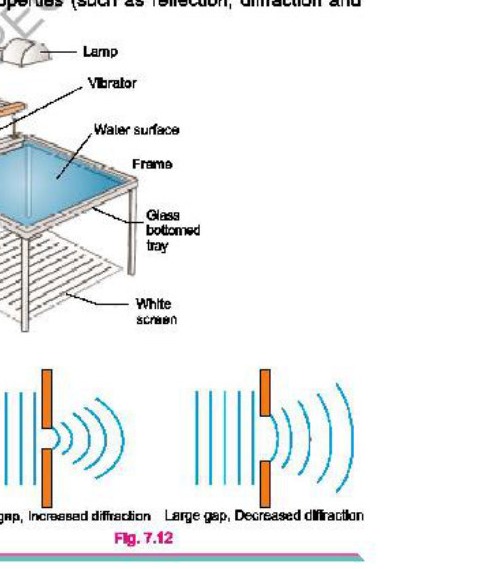
Diffraction of waves is the bending of waves around the sharp edges or corners of obstacles or the spreading of waves beyond a barrier. It occurs when a wave encounters a physical barrier or an opening (a slit) that is comparable in size to the wavelength of the wave. The longer the wavelength, the greater the spreading and vice versa.
Diffraction can be observed in various types of waves, including water waves, sound waves, light waves and electromagnetic waves.
Some examples of the phenomenon of diffraction include:
Hearing of sound waves around corners or through doorway from where they were generated as sound waves bend around the corners.
Diffraction of X-rays by crystals as the spacing between the regular arrays of atoms is of the order of X-rays wavelength.
Diffraction is a fundamental aspect of wave behaviour and has many practical applications in various fields.
The Ripple Tank
Fig. shows a ripple tank. It is very useful apparatus not only to generate water waves, but also to demonstrate wave properties (such as reflection, diffraction and refraction).
Ripple tank contains water, vibrator (e.g. a motorized oscillating needle), obstacles (e.g. a small rectangular block or a semicircular barrier) and gap widths of different sizes. It creates a series of concentric circles or parallel waves using the vibrator. An obstacle is placed for creating a gap with a specific width. The experiment can be repeated with different gap widths.
It is observed that when the gap width is small compared to the wavelength, diffraction is significant and the waves bend around the obstacle, creating a semicircular pattern. As the gap width increases relative to wavelength, diffraction decreases and the waves pass through the gap with less bending.
This experiment demonstrates the qualitative effect of gap width on diffraction in a ripple tank, illustrating how the relationship between gap width and wavelength affects wave behaviour
When two waves of slightly different frequencies, travelling in the same direction overlap each other then there is a periodic variation of sound between maximum and minimum loudness which is called as beats.
Explanation
Tuning forks give out pure notes (single frequency). If two tuning forks A and B of the same frequency say 32 Hz are sounded separately, they will give out pure notes. If they are sounded simultaneously, it will be difficult to differentiate the notes of one tuning fork from that of the other. The sound waves of the two will be superposed on each other and will be heard by the human ear as a single pure note.
If the tuning fork B is loaded with some wax or plasticine, its frequency will be lowered slightly, say it becomes 28 Hz. If now the two tuning forks are sounded together, a note of alternately increasing and decreasing intensity will be heard. This note is called beat note or a beat which is due to interference between the sound waves from tuning forks A and B.
Fig.(a) shows the waveform of the note emitted from a tuning fork A. Similarly, Fig. (b) shows the waveform of the note emitted by tuning fork B. When both the tuning forks A and B are sounded together, the resultant waveform is shown in Fig. (c) It shows how do the beat occur. At some instant X, the displacement of the two waves is in the same direction. The resultant displacement is large and a loud sound is heard.
After 1/4 s the displacement of the wave due to one tuning fork is opposite to the displacement of the wave due to the other tuning fork resulting in minimum displacement at Y, hence, faint sound or no sound is heard.
Another 1/4 s later, the displacements are again in the same direction and a loud sound is heard again at Z.
As the difference of the frequency of the two tuning forks is also 4 Hz so, we find that the number of beats per second is equal to the difference between the frequencies of the tuning forks.
fA = 32 Hz, fB = 28 Hz fA > fB
No. of beats = fA - fB = 32 Hz - 28 Hz = 4
Limitation
However, when the difference between the frequencies of the two sounds is more than 10 Hz, it becomes difficult to recognize the beats.
The difference between the frequencies of the two waves is termed as beat frequency fbeat or
fbeat = fA - fB
Tuning Musical Instruments
Here are some examples of how beats are generated in musical instruments:
i. Guitar: When playing two strings with slightly different tunings, beats are created. For example, playing a standard tuned string and a string tuned a few cents higher or lower.
ii. Piano: Playing two keys white and black, adjacent to each other, creates beats.
iii. Violin: When playing two strings with slightly different bow pressures or speeds, beats are generated.
iv. Drums: When two drums with slightly different tunings are played simultaneously, beats are created.
v. Flute: When playing two notes with slightly different embouchure (lip and facial muscles) positions, beats are generated.
vi. Organ: When playing two pipes with slightly different tunings, beats are created.
vii. Synthesizer: Generating two oscillators with slightly different frequencies creates beats.
In each of these examples, the slight difference in frequency between the two sound sources creates a periodic increase and decrease in amplitude, resulting in a "beat" or pulsation effect. Musicians often use beats intentionally to create interesting rhythmic effects, add texture, or produce a sense of tension and release. However, in some cases, beats can be unwanted and may require adjustments to tuning, pitch, or playing technique to minimize their impact.
The sound produced by most of string and wind musical instruments is due to the formation of stationary waves or standing waves in these instruments.
Intensity
Definition "Intensity is defined as the amount of energy transmitted per unit area per unit time in the direction of propagation of progressive wave."
Explanation
It is a measure of the power of a wave and is usually denoted by the symbol "I". It is measured in units of watts per square metre (W m-2).
A progressive wave or travelling wave is one that travels through a medium in a consistent direction and transferring energy from one point to another. It is a wave that propagates or moves forward, as opposed to a stationary or standing wave. Examples of progressive waves include water waves, sound waves, light waves, etc.
Mathematically
By definition, the intensity of a wave is
I = E / (A x t)
I = (E/t) / A
I = P / A ( E/t = P)
Here
I = intensity of wave in (W m-2)
E = Energy in-joules (J)
t = Time in seconds (s)
P = Power in watts (W)
We know that in mechanical waves, such as sound waves, water waves, or waves on a vibrating string, energy is stored as kinetic energy and potential energy of the medium's particles. How much energy is stored depends upon the displacement (amplitude) of the particles from the mean position. Therefore, the intensity I of waves is proportional to the square of the amplitude A, i.e.,
I ∝ A2
or
I = k A2 ---------- (1)
Here k is the constant of proportionality and depends upon the physical properties of the wave and the medium.
Doppler Effect
Definition
The apparent change in the frequency (or pitch) of waves due to the relative motion between the source and observer (listener) is called Doppler Effect.
Explanation
This effect was first observed by John Doppler while he was observing the frequency of light emitted from a star. In some cases, the frequency of emitted light was found to be slightly different from that emitted from a similar source on the Earth. He found that the change of frequency of light depends upon motion of star relative to Earth.
Example
This effect can be observed with sound waves also. For example, when an observer is standing on a railway platform, the pitch of whistle of an engine coming towards the platform appears to become higher to an observer standing on the platform. However, the pitch of whistle of an engine going away from the platform appears to become lower to an observer standing on the platform.
Derivation of different cases
Consider a source of sound S at rest which emits sound waves having wavelength A.. Let speed of the sound for a stationary observer (i.e., listener) is v then the number of waves received by observer in one second i.e., frequency f is:
f = v / λ ----------(1)
(a) When source of sound moves towards the stationary observer
When the source moves towards the stationary observer C with velocity us, then waves are compressed and their wavelength is decreased as shown in Fig. In this case, the waves are compressed by an amount given as
Δλ = us / f
The compression of the waves is due to the fact that same number of waves are contained in a shorter space depending upon the velocity of the source. The wavelength observed by the observer C is then,
λc = λ - Δλ
or
λc = v/f - us/f
λc = (v - us) / f
Here Δλ is the decrease in wavelength in one second and is called Doppler shift.
Thus, the number of waves received by observer C in one second (i.e., changed or apparent frequency) is
fc = v / λc
Putting the value of λc, we have
fc = [v / ((v - us) / f)]
fc = [v / (v - us)] f
v / (v - us) > 1
Therefore
fc > f
Thus, the apparent frequency of sound heard by the observer increases which in turn will increase the pitch of sound.
(b) When source of sound moves away from the stationary observer
When the source moves away from the stationary observer D with velocity us, then waves are expanded and their wavelength is increased.
In this case, the waves expanded by an amount
λD = us / f
The expansion of the waves is due to the fact that same number of waves are now contained in a large distance. The wavelength observed by the observed D is then,
λD = λ + Δλ
Where Δλ is the increase in wavelength in one second and is called Doppler shift.
Thus, the number of waves received by observer D in one second (i.e., changed or apparent frequency) is:
fD = v / λD
Putting the value of λD, we have
fD = [v / ((v + us) / f)]
fD = [v / (v + us)] f
v / (v + us) < 1
Therefore
fD < f
Thus, the apparent frequency of sound heard by the observer decreases which in turn will decrease the pitch of sound.
Applications of Doppler Effect
Doppler effect is also applicable to electromagnetic waves.
(i) Radar System:
One of its important applications is the radar system, which uses radio waves to determine the elevation and speed of an aeroplane. RADAR (Radio Detection and Ranging) is a device, which transmits and receives radio waves. If an aeroplane approaches towards the radar, then the wavelength of the wave reflected from aeroplane would be shorter and if it moves away, then the wavelength would be larger as shown in Fig., respectively. Similarly, speed of satellites moving around the Earth can also be determined by the same principle.
(ii) SONAR:
SONAR is an acronym derived from "Sound Navigation and Ranging". It is the general name for sonic or ultrasonic underwater echo-ranging and echo-sounding system. Sonar is the name of a technique for detecting the presence of objects under water by acoustical echo. In Sonar, "Doppler detection" relies upon the relative speed of the target and the detector to provide an indication of the target speed. It employs the Doppler effect, in which an apparent change in frequency occurs when the source and the observer are in relative motion to one another. Its known military applications include the detection and location of submarines, control of antisubmarine weapons, mine hunting, and depth measurement of sea.
(iii) Astronomy:
In Astronomy, astronomers use the Doppler effect to calculate the speeds of distant stars and galaxies. By comparing the line spectrum of light from the star with light from a laboratory source, the Doppler shift of the star's light can be measured. Then, the speed of the star can be calculated.
(a) Stars moving away from the Earth show a red shift as shown in Fig. The emitted waves have a longer wavelength than if the star had been at rest. So, the spectrum is shifted towards longer wavelength, i.e., towards the red end of the spectrum. Astronomers have also discovered that all the distant galaxies are moving away from us and by measuring their red shifts, they have estimated their speeds.
(b) Stars moving towards the Earth show a blue shift as shown in Fig. This is because the wavelength of light emitted by the star are shorter than if the star had been at rest. So, the spectrum is shifted towards shorter wavelength, i.e., to the blue end of the spectrum.
(iv) Radar Speed Trap:
Another important application of the Doppler shift using electromagnetic waves is the radar speed trap. Microwaves are emitted from a transmitter in short bursts. Each burst is reflected off by any car in the path of microwaves in between sending out bursts. The transmitter is open to detect reflected microwaves. If the reflection is caused by a moving obstacle, the reflected microwaves are Doppler shifted. By measuring the Doppler shift, the speed at which the car moves is calculated by computer programme.
(v) Satellite Navigation uses Doppler shift to determine satellite velocity and position, enabling accurate location tracking.
(vi) Satellite Communication also uses Doppler shift compensation ensuring stable communication signals.
Doppler radar detects wind velocity and precipitation patterns. Doppler shift helps measure Earth's surface velocity and deformation.
(vii) Doppler echocardiography measures blood flow velocity and detects cardiac abnormalities, such as valve stenosis or regurgitation. Doppler echocardiography optimizes pacemaker settings.
(viii) Doppler ultrasound measures blood flow and calculates cardiac output. Doppler ultrasound detects vascular stenosis or occlusion.
(ix) [Entry continues from (viii)]
More figures from this unit