StudentAid
Unit 11: Special Theory of Relativity — Long Questions
11th Class Physics · Unit 11: Special Theory of Relativity
Relative Motion
Definition "The change in position of a body with respect to a second body is called relative motion"
Explanation Consider throwing a ball to your right. For someone facing you, this direction appears to his left. This illustrates that direction is a relative concept. Similarly, the state of rest or motion of an object depends on the observer.
Examples (i) The walls of a moving train seem stationary to passengers inside the train but appear to be moving to someone standing on the ground. Thus, we cannot definitively say whether an object is absolutely at rest or in motion; all motions are relative to the observer or to the reference frame being used.
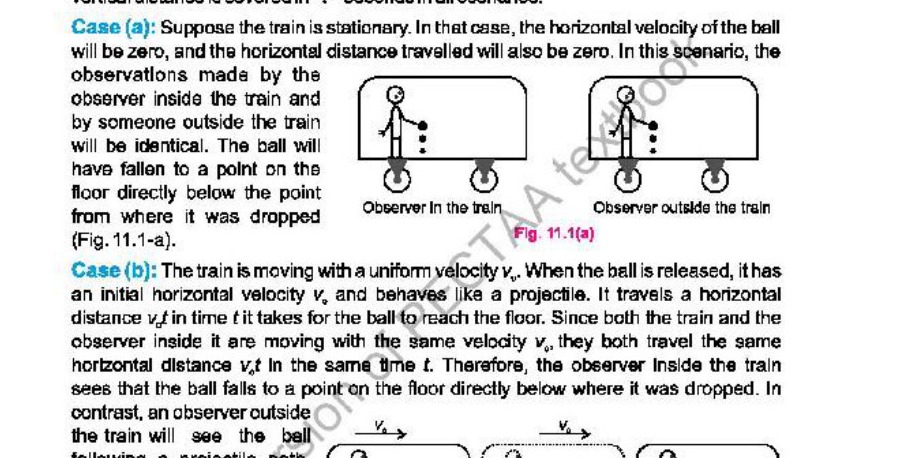
(ii) An observer in a closed train compartment uses the compartment as his frame of reference. To determine the train's motion, the observer drops a ball and measures the horizontal distance travelled by the ball, keeping the vertical distance the same in each case. It is assumed that the vertical distance is covered in "t" seconds in all scenarios.
Case (a) Suppose the train is stationary. In that case, the horizontal velocity of the ball will be zero, and the horizontal distance travelled will also be zero. In this scenario, the observations made by the observer inside the train and by someone outside the train will be identical. The ball will have fallen to a point on the floor directly below the point from where it was dropped.
Case (b) The train is moving with a uniform velocity v0. When the ball is released, it has an initial horizontal velocity v0 and behaves like a projectile. It travels a horizontal distance v0t in time t it takes for the ball to reach the floor. Since both the train and the observer inside it are moving with the same velocity v0, they both travel the same horizontal distance v0t in the same time t. Therefore, the observer inside the train sees that the ball falls to a point on the floor directly below where it was dropped. In contrast, an observer outside the train will see the ball following a projectile path, as shown in Fig. Thus, observers in different frames of reference, moving with uniform velocity relative to each other, will perceive motion differently.
Frames of Reference
Definition "The space bounded by three mutually perpendicular co-ordinate Axes are made is called frame of reference."
Examples (i) The position of a table in a room can be described relative to the walls of the room, making the room the frame of reference.
(ii) The laboratory is the reference frame for measurements taken there. If the same experiment is performed in a moving train, the train becomes the frame of reference.
(iii) The position of a spaceship can be described relative to the positions of distant stars, making a coordinate system based on these stars from the frame of reference.
Inertial and Non-Inertial Frame of Reference
Inertial Frame of Reference
Definition An inertial frame of reference is defined as a coordinate system in which the law of inertia is valid. This means a body at rest remains at rest unless acted upon by an unbalanced force that produces acceleration. Other laws of nature also apply in such a system.
Examples (a) For instance, a body placed on the Earth remains at rest unless an unbalanced force acts upon it, indicating that the Earth can be considered an inertial frame of reference.
(b) A body in a car moving with uniform velocity relative to the Earth also remains at rest, so the car is also an inertial frame of reference. Thus, any frame of reference moving with uniform velocity relative to an inertial frame is also an inertial frame.
Non-Inertial Frame of Reference
Definition
A non-inertial frame of reference is defined as a coordinate system in which the law of inertia is not valid.
(OR)
It is a frame of reference which is accelerated.
Examples (a) If the moving car is suddenly stopped or accelerated, the body inside no longer remains at rest. In such cases, the car is not an inertial frame of reference. Therefore, an accelerated frame of reference is a non-inertial frame.
(b) While Earth is rotating and revolving, making it strictly speaking a non-inertial frame, it is often treated as an inertial frame due to its relatively small acceleration.
Theory of Relativity The theory of relativity deals with how observers in different states of relative motion describes physical phenomena.
Special Theory of Relativity The special theory of relativity addresses problems involving inertial (non-accelerating) frames of reference.
General Theory of Relativity There is another theory, called the general theory of relativity, that deals with problems involving frames of reference that are accelerating relative to one another.
Postulates of Special Theory of Relativity
The special theory of relativity is based on two postulates, which can be stated as follows:
i. The laws of physics are the same in all inertial frames (Principle of Relativity).
ii. The speed of light in free space has the same value for all observers, regardless of the state of motion of the source or the observer (Principle of Constancy of Light).
Explanation:
Fact of Postulate -I: The first postulate generalizes the fact that all physical laws are the same in frames of reference moving with uniform velocity relative to one another. If the laws of Physics differed for observers in relative motion, those observers could determine which was stationary and which was moving. However, such a distinction does not exist, implying that there is no way to detect absolute uniform motion.
Fact of Postulate -II: The second postulate states the experimental fact that the speed of light in free space is a universal constant, denoted as c (c = 3 x 10⁸ m s⁻¹). Since c is constant, space and time become relative. For example, if you are sitting in a train moving at the speed of light and you hold up a mirror in front of you at arm's length, you will still see your reflection in the mirror. This is because, according to the principle of relativity, no experiment can detect the constant motion of the train relative to the person inside it.
Consequences of Special Theory of Relativity
These simple postulates have far-reaching consequences. They include phenomena such as the slowing down of clocks and the contraction of lengths in moving reference frames as observed by a stationary observer. Some interesting results of the special theory of relativity can be summarized as follows, without going into their mathematical details.
i. The Relativity of Simultaneity
Definition: If two events in different locations are observed by one observer to be simultaneous, they will generally not be observed as simultaneous by another observer in a different frame of reference moving relative to the first observer. In other words, whether two events are seen as simultaneous depends on the observer's frame of reference.
Explanation: Consider a train equipped with light-operated doors. The light switch is located in the centre of the roof and is operated by a traveler standing in the middle of the compartment. When the train is travelling at half the speed of light, the traveler turns on the light. The light travels forward and backward at equal speed and reaches both doors at the same time. Consequently, the traveler sees both doors opening simultaneously. However, an observer outside the train will see the back door open before the front door. This is because the back door is moving towards the light waves, while the front door is moving away from the light waves.
ii. Time Dilation
According to the special theory of relativity, time is not an absolute quantity; it depends on the motion of the frame of reference.
Proper Time: Suppose an observer is stationary in an inertial frame and measures the time interval between two events in this frame. Let this time interval be t₀. This is known as proper time.
Relativistic Time: If the observer is moving with respect to the frame of events with relativistic velocity v, or if the frame of events is moving with respect to the observer with a uniform relativistic velocity v, the time measured by the observer will not be t₀, but rather t, given by
t = t₀ / √(1 - v²/c²) ----------- (1)
As the quantity √(1 - v²/c²) is always less than one, so t is greater than t₀ i.e., time has dilated or stretched due to the relative motion of the observer and the frame of reference of the events.
Applications: This astonishing result applies to all timing processes—physical, chemical, and biological. Even the aging process of the human body is slowed by motion at very high speeds or relativistic speeds.
Example: For example, if a traveler on a plane moving at 0.8 c picks up and opens a book, the event takes one second as measured by the traveler. However, to a person standing outside the plane, the same event takes 1.7 seconds.
iii. Length Contraction
Proper Length: If you are in motion relative to two points that are a fixed distance apart, the distance between the two points appears shorter than if you were at rest relative to them. This effect is known as length contraction. Length contraction occurs only along the direction of motion; no such contraction is observed perpendicular to the direction of motion. The length of an object or the distance between two points measured by an observer who is at rest relative to them is called the proper length ℓ₀.
Relativistic Length: If an object and an observer are in relative motion with speed v, then the contracted length ℓ is given by
ℓ = ℓ₀√(1 - v²/c²) ----------- (2)
Example: Let a train that is measured to be 100 metres long when at rest travel at 80% of the speed of light (0.8 c). A person inside the train will measure its length as 100 metres. However, a person standing by the side of the track will observe the train to be only 60 metres long. This effect of relativity, which is the shortening of length in the direction of motion, is due to length contraction.
Application: The distance from Earth to a star measured by an observer in a moving spaceship would appear smaller than the distance measured by an observer on the Earth.
iv. Mass Variation
According to the special theory of relativity, the mass of an object is a variable quantity that depends on the object's speed.
Proper Mass: An object whose mass is measured at rest is called its rest mass m₀, will have an increased mass m when observed to be moving at speed v.
Relativistic Mass: when an object of mass m₀ moves with velocity v its mass increases m and is given by
m = m₀ / √(1 - v²/c²) ----------- (3)
The increase in mass indicates the increase in inertia that an object has at high speeds. As approaches c, it requires a greater force to change the object's speed.
As v → c, v/c → 1, Therefore, √(1 - v²/c²) → 0
Thus m → ∞
An infinite mass would require an infinite force to accelerate it. Since infinite forces are not available, an object cannot be accelerated to the speed of light c in free space.
Limitations: In our everyday life, we deal with speeds that are extremely small compared to the speed of light. Even Earth's orbital speed is only 30 km s⁻¹, while the speed of light in free space is 300,000 km s⁻¹. This is why Newton's laws are valid in everyday situations. However, when dealing with subatomic particles moving at velocities approaching the speed of light, relativistic effects become very prominent, and experimental results cannot be explained without considering Einstein's equations.
v. The Equivalence Between Mass and Energy
According to the special theory of relativity, mass and energy are distinct entities but are interconvertible. The total energy E and mass m of an object are related by the expression:
E = mc² ----------- (4)
where m depends on the speed of the object. At rest, the energy equivalent of an object's mass m₀ is called its rest mass energy E₀. Thus,
E₀ = m₀c²
As mc² is greater than m₀c², the difference of energy (mc² - m₀c²) is due to the motion, and it represents the kinetic energy of the mass. Hence,
K.E. = (m - m₀)c²
From Eq. 4, the change in mass m due to change in energy ΔE is given by
Δm = ΔE / c²
Because c² is a very large quantity, this implies that small changes in mass require very large changes in energy. In our everyday world, energy changes are too small to provide measurable mass changes.
Applications: The energy and mass changes in nuclear reactions are found to be exactly in accordance with the above mentioned equations.
Space-Time in Relativity
Space is said to be a three-dimensional extent in which all objects and events occur. It provides a framework to define the position and motion of various objects under the influence of some force.
(i) Time is not absolute
Time measures the sequence and duration of events. In the theory of relativity, time is not absolute; it is considered the fourth dimension.
Examples (i) Oscillatory motion, such as that of a swinging pendulum, relies on time to determine the frequency of oscillations.
(ii) Another example is time dilation, a phenomenon discussed earlier in this chapter, where time passes more slowly for an observer moving at extremely high speeds compared to one at rest.
Space and Time
The special theory of relativity explains that space and time are related to each other. It describes how space and time are influenced by gravity and speed, such as the bending of light around massive objects like stars.
(ii) Space-time is a mathematical model
Space-time is, in fact, a mathematical model that unifies space-time into a single continuum. It is a concept used to describe all points of space and time and their relation to each other.
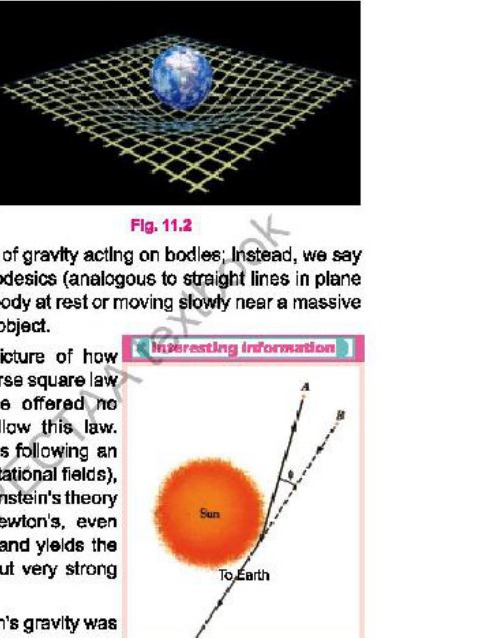
• According to Einstein's theory, space-time is curved especially near massive bodies and for speeds approaching the speed of light. We can hypothetically visualize this as a fabric sheet. If a heavy ball is placed over this sheet, it curves as shown in Fig.
• Objects such as stars and planets cause space-time to curve around themselves, much like an elastic fabric deforms when holding a ball. The more massive the object, the deeper the curve.
• Consequently, we do not speak of a force of gravity acting on bodies; instead, we say that bodies and light rays move along geodesics (analogous to straight lines in plane geometry) in curved space-time. Thus, a body at rest or moving slowly near a massive object would follow a geodesic toward that object.
(iii) Einstein's View About Gravitation
Einstein's theory provides a physical picture of how gravity works. Newton discovered the inverse square law of gravity but explicitly stated that he offered no explanation for why gravity should follow this law. Einstein's theory also describes gravity as following an inverse square law (except in strong gravitational fields), but it explains why this is so. This is why Einstein's theory is considered an advancement over Newton's, even though it encompasses Newton's theory and yields the same results as Newton's theory in all but very strong gravitational fields.
(iv) Example Based on Einstein's View
The bending of starlight caused by the Sun's gravity was measured during a solar eclipse in 1919. The results matched Einstein's theory rather than Newton's, leading to Einstein's theory being hailed as a scientific triumph. Another success of Einstein's theory was the detection of gravitational waves, produced by some celestial events causing disturbances (squeezes and stretches) in the curvature of space-time. These waves were detected in 2015 and announced in 2016.
(v) Hypothetical Example of Space Time
Let a spaceship be travelling to a star with half of the speed of light. Let it takes eight years to reach to the star, from the point of view of the observer on the Earth. From the Earth's point of view, the clocks on the spaceship are moving slowly, so that less time passes on the spaceship compared to the Earth. For the spaceship occupants, the length of the journey has contracted which they cover in less time. The occupants of the spaceship record 7 years to reach their destination, rather than 8 years.
More figures from this unit