StudentAid
Unit 3: Circular and Rotational Motion — Long Questions
11th Class Physics · Unit 3: Circular and Rotational Motion
Angular Displacement
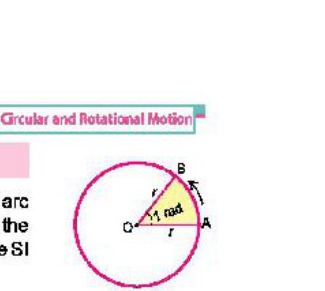
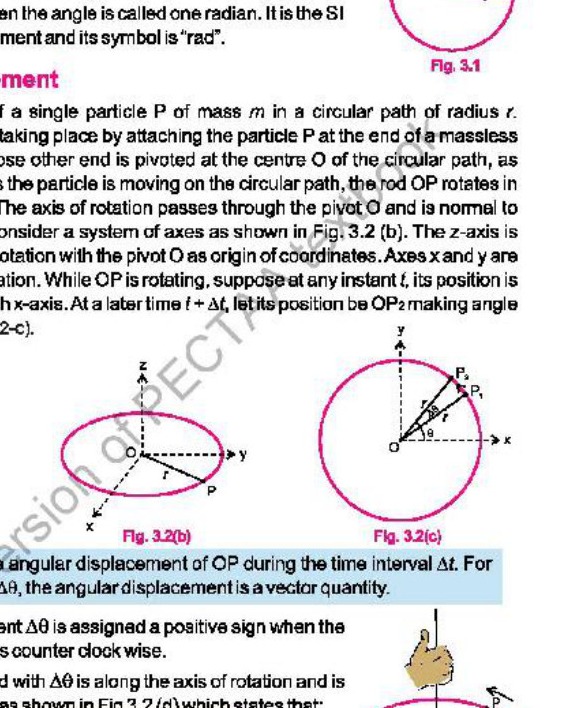
"It is the angle subtended by an arc at the centre of the circle". It is denoted by the symbol θ (Fig. 1). For its small values, θ is a vector quantity and for large values is not a vector quantity.
Its direction is determined by right hand rule.
Right Hand Rule "Grasp the axis of rotation in the right hand such that the fingers are curled along the direction of rotation. The extended thumb along the axis indicates the direction of angular displacement" as shown in Fig. (2).
Unit The units for angular displacement may be degree, revolution or radian, where radian is SI unit.
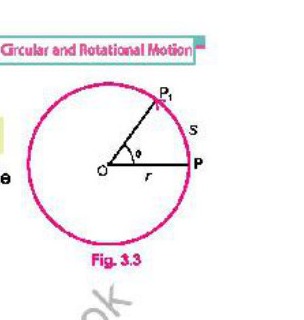
Radian Radian is the SI unit of angular displacement and it is defined as; "One radian is the angle subtended at the centre of a circle by an arc whose length is equal to radius of the circle" as shown in Fig. (3).
Relation between radian and degree:
Consider an arc of length 'S' along a circular path of a circle of radius 'r' which subtends an angle 'θ' at the centre of the circle, as shown in Fig. (3). It has been observed that at constant radius, the length of the arc is directly proportional to the subtended angle.
S ∝ θ.
S = rθ
θ = S/r (rad) -------(1)
Now for one complete revolution.
S = 2πr (Circumference) and θ = 360°
Thus Eq. (1) becomes
360° = (2πr)/r (rad) = 2π(rad)
Hence, 1 revolution = 2π(rad) = 360°
1 rad = 360°/(2π)
1 rad = 180°/π
1 rad = 57.3°
Or
1° = 0.01745 rad
Angular Velocity
"Time rate of change of angular displacement is known as angular velocity".
Average Angular Velocity
Average angular velocity is defined as:
"The ratio of total change in angular displacement to the total time taken."
Mathematically ω̄av = Δθ/Δt
Here Δθ is the angular displacement and Δt is total time taken.
Instantaneous angular velocity
Definition "The angular velocity of the body at any instant of time is known 'as its instantaneous angular velocity."
Mathematically ω̄inst = lim(Δt→0) Δθ/Δt
It is a vector quantity. Its direction is determined by right hand rule:
Units The SI units for angular velocity are radian per second i.e. rad. s-1 sometimes it is also given in terms of revolution per minute. (rpm)
Relation between linear and angular velocities:
Consider a body moving along a circular path of radius 'r'. Let A is the initial position, and after time Δt seconds the body moves to the position B. The distance covered by the body is equal to length of the arc ΔS, and its angular displacement is Δθ as shown in Fig.
ΔS = rΔθ
Divide both sides by Δt
ΔS/Δt = r × Δθ/Δt
Apply limit Δt → 0 in above equation, we get
lim(Δt→0) ΔS/Δt = lim(Δt→0) r × Δθ/Δt
⇒ lim(Δt→0) ΔS/Δt = r(lim(Δt→0) Δθ/Δt)
By definition we know that lim(Δt→0) ΔS/Δt = v = tangential velocity and lim(Δt→0) Δθ/Δt = ω = angular velocity.
Therefore, |v = rω|
It is the relation between linear(or tangential) velocity and angular velocity for circular motion.
In vector form this relation can be expressed as:
V⃗ = ω⃗ × r⃗
Angular Acceleration
Definition "The rate of change of angular velocity with time is known as angular acceleration". It is denoted by the symbol 'α'.
Average Angular Acceleration
Definition
Average angular acceleration is defined as:
"The ratio of total change in angular velocity to the total time taken."
Mathematically ᾱav = Δω/Δt
Here Δω is the change in angular velocity that occurs in time Δt seconds.
Where Δω = ωf - ωi and time interval Δt = tf - ti, hence the above equation can also be written as:
Formula ᾱav = (ω̄f - ω̄i)/(tf - ti)
Units Average angular acceleration is a vector pointing along the direction of Δω. Its units are degs-2, rev s-2 or rad s-2, where rad s-2 is the S.I unit of angular acceleration.
Instantaneous Angular Acceleration
Definition
Average angular velocity is defined as:
"The rate of change of angular velocity at any instant"
Mathematically ᾱins = lim(Δt→0) Δω/Δt
For circular motion in fixed plane the direction of instantaneous angular acceleration is along the axis of rotation as shown below:
Relation Between Tangential and Angular Accelerations:
Consider a rigid body moving in a circular path of radius 'r' with variable angular velocity ω as shown in Fig.
Let ωi is the angular velocity at point A and ωf is the angular velocity after time Δt at the point B. The linear velocities at these points are vi and vf respectively.
Using the relation v = rω we have the following equations:
vi = r ωi --------- (1)
vf = r ωf --------- (2)
Subtracting equation (1) from equation (2)
⇒ vf - vi = rωf - rωi
⇒ Δv = r (ωf - ωi)
⇒ Δv = r Δω
Divide both sides by Δt
Δv/Δt = Δω/Δt
Apply limit Δt → 0 on both sides
lim(Δt→0) Δv/Δt = lim(Δt→0) Δω/Δt
⇒ lim(Δt→0) Δv/Δt = r lim(Δt→0) Δω/Δt
By definition we know that lim(Δt→0) Δv/Δt = a = tangential acceleration, and lim(Δt→0) Δω/Δt = α = angular acceleration.
Therefore, |a = rα|
It is the relation between tangential and angular acceleration for circular motion. In vector form it can be written as below:
ā = ᾱ × r⃗
Equations of Angular Motion
When the body is moving with constant angular acceleration 'a' then we can write the following equations for circular motion like we have for linear motion, by replacing the linear quantities by their angular counter parts that is vi by ωi, s by θ, vf by ωf and a by α.
The equations of angular motion are:
ωf = ωi + αt ----------- (1)
θ = ωi t + (1/2)αt2 --------- (2)
2αθ = ωf2 - ωi2 ----------- (3)
The equation of linear motion are:
vf = vi + at ----------- (1)
s = vi t + (1/2)at2 ---------- (2)
2as = vf2 - vi2 ----------- (3)
The angular equations (1), (2), (3) hold true only in the case when the axis of rotation is fixed.
Centripetal Force
Definition "The force needed to bend the straight path of the particle into a circular path is called the centripetal force."
Expression for centripetal force
For a body of mass m moving with velocity v in a circular path of radius r, centripetal force Fc is given by
Fc = mac = (mv2)/r --------- (1)
Where ac = v2/r is the centripetal acceleration and its direction is towards the centre of the circle. As v = r ω, so the above equation becomes:
Fc = mrω2 --------------- (2)
Explanation
Newton's second law of motion states that when a force acts on a body, it produces acceleration in the same direction. A force acting on a moving body along the direction of its velocity will change magnitude of the velocity (speed) keeping the direction unchanged. On the other hand, a constant force acting perpendicular to the velocity of a body moving in a circular path will change the direction but magnitude of velocity (speed) will remain the same. Such force makes the body move in a circle by producing a radial (or centripetal) acceleration and is called centripetal force (centre seeking)
Examples of Centripetal Force
In every circular or orbital motion, centripetal force is needed which is provided by some agency.
i. When a ball is whirled in a horizontal circle with the help of a string, then tension in the string provides necessary centripetal force.
ii. For an object placed on a turntable, the friction is the centripetal force.
iii. The gravitational force is the cause of the Earth orbiting around the Sun, Moon and artificial satellites revolving around the Earth.
iv. A normal or perpendicular magnetic force compels a charge particle moving along a straight path into a circular path.
v. When a vehicle takes turn on a road, it also needs centripetal force which is provided by the friction between the tyres and the road. If the road is slippery, then at high speed, the friction may not be sufficient enough to provide necessary centripetal force.
Hence, vehicle will not be able to take turn and may skid or may even be toppled. To overcome this difficulty, the highway road is banked on turns. That is, the outer edge of the track is kept slightly higher than that of the inner edge.
Applications of Centripetal Force
We know that an object moves in a circle because of centripetal force. If the magnitude of applied force falls short of required centripetal force then the object will move away from the centre of the circle. The centrifuge Fig. (a) functions on this basic principle.
(i) Centrifuge: It is one of the most useful laboratory device. It helps to separate out denser and lighter particles from a mixture. The mixture is rotated at high speed for a specific time. In a laboratory setup, sample tubes are used where the denser particles will settle at the bottom and lighter particles will rise to the top of the sample tubes Fig. (b).
(ii) The dryer of the washing machine also functions on the principle of centrifuge. The dryer consists of a long cylinder with hundreds of small holes on its wall. Wet clothes are piled up in this cylinder, which is then rotated rapidly about its axis Fig. (c). Water moves outward to the walls of the cylinder and thus, drained out through the holes. In this way, clothes become dry quickly.
(iii) Cream separator is another practical device which is used to separate cream from the milk. In this machine, milk is whirled rapidly. Since milk is a mixture of light and heavy particles, when it is rotated, the light particles gather near the axis of rotation whereas the heavy particles will go outwards and hence, cream can easily be separated from milk Fig. (d).
Artificial Satellite
Definition "The man-made objects orbiting around the Earth are known as artificial satellites ".
Explanation
They are put in the orbit by rockets and gravity of the Earth help the satellites to orbit around the Earth. Once the satellite is placed in the orbit it will continue to move in that orbit under the gravitational force. The gravitational force between Earth and satellite provide the necessary centripetal force, which is given by:
Fc = (mv2)/r
Where m = mass of the satellite
v = orbital speed
r = radius of the orbit
Calculation of the minimum velocity of satellite:
Let the satellite is orbiting around the Earth and its height 'h' above the Earth is very small as compared to the radius of Earth 'R'. The radius of the orbit of low flying satellite is almost equal to the radius of the Earth because r = R + h ⇒ r = R, ∴ h << R.
Since
Fc = Fg
mv2/R = mg
v2 = gR
v = √(gR)
Substituting g = 9.8 ms-2 and R = 6.4 × 10⁶ m, we get
v = √(6.4×106 × 9.8)
v = 7.9×10³ ms-1
v = 7.9 kms-1
This is minimum velocity required to put the satellite into orbit near the Earth and is called critical velocity.
Time Period
"Time taken by the satellite to complete one revolution is known as period of revolution".
As satellite is moving with constant speed. So, for one revolution s = 2πR
Time 't' is given by;
t = s/v
⇒ T = (2πR)/v
T = (2 × 3.14 × 6.4 × 106 m)/(7.9×103 ms-1) = 5060s
T = 84 min (approximately)
The higher the satellite, the slower will be the required speed and longer it will take to complete one revolution around the Earth.
Orbital Velocity
Definition "The tangential velocity of satellite orbiting around the Earth is called its orbital velocity".
The artificial satellites when launched, will adopt nearly a circular path around Earth. This type of motion is called orbital motion.
General Expression for orbital velocity:
Consider a satellite is moving around the Earth in an orbit of radius 'r' with orbital speed v. The centripetal force required for keeping satellite in circular orbit is written as:
Fc = (mv2)/r
The gravitational force between satellite and Earth will furnish the required centripetal force.
i.e Fc = Fg
or (m.v2)/r = (Gm.M)/r2
Where "M" is the mass of the Earth and " ms " is the mass of satellite.
∴ v2 = (GM)/r
v = √((GM)/r) ----------(1)
since
√(GM) = constant
∴ v = constant × 1/√r
v ∝ 1/√r
Hence orbital velocity of the satellite is inversely proportional to the square root of the radius of the orbit. When the velocity of satellite is less then as given by equation (1), it will not revolve around the Earth and will fall back on Earth in the gravitational field.
Weightlessness
Definition "The state in which apparent weight of an object experiences zero weight is called weightlessness. "
Explanation
When a satellite is launched by a rocket in its desired orbit around the Earth, then it has been observed practically that everything inside the satellite experiences weightlessness because the satellite is accelerating towards the centre of the Earth as a freely falling body.
Weightlessness in Satellites
Consider a satellite of mass M revolving in its orbit of radius around the Earth. A body of mass m inside the satellite suspended by a spring balance from the ceiling of the satellite is under the action of two forces. That is, its weight mg acting downward, while the supporting force, called normal force FN or tension in the spring acting upward, as shown in Fig. (1) Their resultant force is equal to the centripetal force required by the mass m which is acting towards the centre of the Earth, and is expressed as:
Fc = mg - FN ----------- (1)
Where Fc = (mv2)/r
Hence (mv2)/r = mg - FN ------- (2)
It may be noted that the centripetal force responsible for the revolution of the satellite of mass M around the Earth is provided by the gravitational force of attraction between the Earth and the satellite.
Fg = Fc
Mg = (Mv2)/r
g = (v2)/r
Hence, Eq. (2) becomes
mg = mg - FN
FN = 0
This shows that the supporting force which is acting on a body inside the satellite is zero. Therefore, the bodies as well as the astronauts in a satellite find themselves in a state of apparent weightlessness.
Artificial Gravity
In space the weightlessness is a serious handicap for astronauts to perform their research work. In overcoming this difficulty a new situation is created in the spaceship so that the astronauts may perform experiments in normal manner as they do in Earth's gravity.
How artificial gravity is produced?
The artificial gravity is produced by spinning the spaceship around its own axis. The objects and astronauts are pressed against the outer surface of the space station and exert a force on the floor of the spaceship in the same way as our feet on Earth.
Expression for the Frequency of Spin:
Space station is a hollow circular tube of large diameter revolving about a vertical axis. Let 'v' is its spinning speed, then the centripetal acceleration of astronaut in it is given by:
ac = v2/R
R is average radius of space station
as v = ωR
∴ ac = (ωR)2/R
ac = (ω2R2)/R
ac = ω2R
ac/R = ω2
ω = √(ac/R) ----------(1)
But ω = θ/t ⇒ ω = 2π/T
Where "T" is time for one revolution of the satellite or spaceship about its own axis.
Putting the value of ω in equation (1) we get
2π/T = √(ac/R)
⇒ 1/T = 1/(2π)√(ac/R)
If "f" frequency of spin then 1/T = f
So above equation becomes
f = 1/(2π)√(ac/R)
This is the general formula for spin frequency to produce artificial gravity.
To produce Earth like gravity in space station we put ac = g in the above formula
f = 1/(2π)√(g/R)
It is the required frequency at which artificial gravity becomes equal to the true gravity of the Earth. The astronauts and other objects inside the spaceship will be have apparent weight equal to their real weight.
Moment of Inertia
Definition "It is defined as resistance in a body against any change in its state of rest or state of uniform circular motion".
Explanation
The term inertia is applied when the body is moving in a straight line whereas the term moment of inertia is related with the circular motion. In circular motion moment of inertia plays the same role as mass in linear motion as shown in Fig.
Mathematically, the moment of inertia is defined as the product of mass of the particle and square of distance from the axis of rotation.
Units
I = mr2
S.I units are kg m2 and its dimensions are [ML2].
The moment of inertia depends upon
(i) The mass of body.
(ii) Distribution of mass of a body from axis of rotation.
Moment of inertia of a particle:
Consider a body of mass 'm' connected with the massless rod of length 'r'. the other end of the rod is pivoted at point O. Let the force of magnitude F is applied to the perpendicular of rod. By Newton's second law of motion.
F = mat -----------(1)
at is tangential acceleration.
Let α is the angular acceleration of the body.
at = rα
Put in Eq. (1)
∴ F = mrα ----------(2)
Multiply 'r' on both sides
rF = mr2 α
Where rF = τ = torque
τ = mr2 α
As mr2 = I
∴ |τ = Iα|
Moment of Inertia of Rigid body:
Definition of Rigid body
"A body whose each particle is rotating with the same angular velocity 'ω' and same angular acceleration α is known as rigid body."
Calculation of Moment of inertia of moment body:
The moment of inertia of rigid body can be determined by dividing the rigid body which is rotating about the point 'O' in number of small particles of masses m1, m2, m3 --- mn at the distances are r1, r2, ----- rn from axis of rotation 'O' as shown in Fig. Let the body be rotating with the angular acceleration α. So, the magnitude of torque is:
τ = mr2α
Torque on m1 is
τ1 = m1r12α1
The force on the first particle is given by:
F1 = m1a1
Where a1 = r1α1
Therefore F1 = m1r1α1
Multiply by r1 on both sides of above equation.
r1 F1 = m1r12α1
⇒ τ = m1r12α1
Similarly, the torques on other particles are written as:
τ2 = m2r22α2
τ3 = m3r32α3
. . .
. . .
. . .
τn = mnrn2αn
The resultant torque on the rigid body is:
τ = τ1 + τ2 + τ3 + -------------------- τn
τ = m1r12α1 + m2r22α2 + m3r32α3 + ------------- mnrn2αn ----------(3)
For rigid body, all the masses ar moving with same angular acceleration α
α1 = α2 = α3 = -------= αn = α
Put in Eq. (3)
τ = m1r12α + m2r22α + m3r32α + -------------- mnrn2α
τ = (m1r12 + m2r22 + ---------+mnrn2)α
τ = (∑i=1i=n miri2) α
Where ∑i=1i=n miri2 = I
I is moment of inertia of the rigid body.
∴ |τ = Iα|
Hence torque on the rigid body is always equal to the product of the moment of inertia I and angular acceleration α.
Angular Momentum
Definition "A particle is said to possess an angular momentum about a reference axis if it moves so that its angular position changes relative to that reference axis".
The angular momentum L⃗ of a particle of mass 'm' moving with velocity v⃗ and momentum p⃗ with respect to 'O' is defined as:
L⃗ = r⃗ × p⃗
Where r⃗ is position vector of particle with respect to point of rotation.
i. Spin angular momentum is due to spin motion.
ii. Orbital angular momentum is due to orbital motion.
Angular Momentum of a Particle:
For a particle performing circular motion as shown Fig. The angular momentum is calculated as below:
L = r p sinθ
Where p = mv
For circular motion θ = 90°
L = mv sin90°
But sin 90° = 1
∴ L = mvr
as v = rω
∴ L = mr2 ω
Where quantity mr2 is a moment of inertia of the particle and is represented by I, therefore, the above equation is written as:
|L = Iω|
Hence angular momentum of the particle is equal to the product of moment of inertia and angular velocity. S.I unit of angular momentum are kg m2s-1 or J-s and its dimensions are [ML2T-1].
Direction of Angular Momentum
The direction of angular momentum is perpendicular to the plane containing the vectors r⃗ and p⃗ determined by right hand rule.
Angular Momentum of Rigid Body consisting of n-particles:
Consider a rigid body rotating about a fixed axis. The rigid body can be imagined to be made up of 'n' small particles of masses m1, m2 ---------- mn at perpendicular distances r1, r2 ---------- rn from the axis of rotation respectively. Each particle of the rigid body rotates with same angular velocity 'ω' as that of the rigid body itself. The angular momentum of the particle of mass ' m1 ' is.
L1 = m1r12ω1
The angular momentum of particle of mass m2 is:
L2 = m2r22ω2
The angular momentum of particle of mass mn is:
Ln = mnrn2ωn
Total Angular momentum of rigid body 'L' is given by
L = L1 + L2 + -----+LN
Put values in right hand side
L = m1r12ω1 + m2r22ω2 + -------- +mnrn2ωn
As the body is rigid so all particles are moving with same angular velocity
∴ ω1 = ω2 = -------- = ωn = ω
So L = (m1r12 + m2r22 + -------- +mnrn2)ω
Where (m1r12 + m2r22 + -------- +mnrn2) = ∑i=1i=n miri2 = I is the moment of inertia of the rigid body.
Hence, |L = Iω|
Law of conservation of Angular Momentum:
Statement
"In the absence of an external torque the total angular momentum of system remains constant".
L⃗total = L⃗1 + L⃗2 + ---------+L⃗n = constant
For the case of circular motion the law of conservation of angular momentum can also be written as:
Iω = Constant or I1ω1 = I2ω2
Where I and ω are respectively the moment of inertia and angular velocity of the system. The absence of external torque the axis of rotation remain fixed.
Explanation
The law of conservation of angular moment is one of the fundamental principles of physics. The effect of the law can be seen if a single isolated system changes it moment of inertia. This is explained by somersaults performed by the diver during his motion.
It should be noted that angular momentum is a vector quantity with direction along the axis of rotation. The direction of angular momentum along the axis of rotation also remain the same if no external torque acts on the body.
Application of Law of Conservation of Angular Momentum:
Law of conservation of angular momentum has many applications such as acrobatics performed by acrobat conserving angular momentum by adjusting his body. Similarly diver, ballet dancer and ice skater conserve angular momentum by changing their body position in the absence of external torque the axis of rotation remain fixed.
The angular momentum is a vector quantity with direction along the axis of rotation. Hence, the direction of angular momentum along the axis of rotation also remains fixed. This is illustrated by the fact given below:
The axis of rotation of an object will not change its orientation unless an external torque causes it to do so.
This fact is of great importance for the Earth as it moves around the Sun. No other sizeable torque is experienced by the Earth, because the major force acting on it is the pull of the Sun. The Earth's axis of rotation, therefore, remains fixed in one direction with reference to the universe around us.
Examples of conservation of angular momentum
i. A man diving from a diving board
A diver jumping from a springboard has to take a few somersaults in air before touching the water surface, as shown in Fig. (1). After leaving the springboard, he curls his body by rolling arms and legs in. Due to this, his moment of inertia decreases, and he spins in midair with a large angular velocity. When he is about to touch the water surface, he stretches out his arms and legs. He enters the water at a gentle speed and gets a smooth dive. This is an example of the law of conservation of angular momentum.
ii. The spinning ice skater
An ice skater as shown in Fig. can increase his angular velocity by folding arms and bringing the stretched leg close to the other leg. By doing so, he decreases his moment of inertia. As a result, angular speed increases. When he stretches his hands and a leg outward, the moment of inertia increases and hence angular velocity decreases Fig. (2).
iii. A person holding some weight in his hands standing on a turntable.
A person is standing on a turntable with heavy mass (dumb-bell) in his hands stretched out on both sides as shown in Fig. (3). As he draws his hands inward, his angular speed at once, inertia decreases on drawing the hands inwards, while the speed with which the person is rotating around the turntable increases.
iv. Flywheel
Flywheel is a mechanical device which consists of a heavy wheel with an axle Fig. (4). It is used to store rotational energy, smooth out output fluctuations and provides stability in a wide range of applications such as bicycles and other vehicles, industrial machinery, gyroscopes, ships and spacecrafts.
When a fly wheel spins, its angular momentum resists changes to its orientations, maintaining stability. This is useful in systems that need precise control over their orientation without external interference.
v. The Gyroscope
A gyroscope is a device which is used to maintain its orientation relative to the Earth's axis or resists changes in its orientation. It consists of a mounted flywheel pivoted in supporting rings as shown in Fig.(5). It works on the basis of law of conservation of angular momentum due to its large moment of inertia. When the gyroscope spins at a large angular speed, it gains large angular momentum. It is then difficult to change the orientation of the gyroscope's rotational axis due to its large moment of inertia. A change in orientation requires a change in its angular momentum. To change the direction of a large angular momentum, a corresponding large torque is required. Even if gyroscope is tilted Fig. (5). It still keeps rotated without falling. Hence, it is a reason why a gyroscope can be used to maintain orientation. The main applications of gyroscope are in the guiding system of aeroplanes, submarines and space vehicles in order to maintain a specific direction in space to keep steady course.
More figures from this unit