StudentAid
Unit 16: Lab Safety and Practical Skills — Long Questions
11th Class Chemistry · Unit 16: Lab Safety and Practical Skills
Working in chemical laboratory
• A chemistry laboratory is a chemist workshop.
• It is a place where a student is trained to observe the physical and chemical characteristics of substances.
• A student should get himself familiarized with the layout of the laboratory and various fittings provided on the laboratory table as well as the side shelves.
General instructions to the students
(i) Students are expected to conduct themselves in a responsible manner at all times in the lab.
(ii) They are advised not to work alone in the lab. Experiments should be performed in the presence of lab instructor and other laboratory staff.
(iii) Students should always wear lab coat and safety goggles while working in the lab. Girls must tie up their scarves and hair before start working in the lab.
(iv) Determine the potential hazards related to any equipment or the experiment before starting any work. Appropriate safety precautions must be observed.
(v) There must not be any crowding in the lab and students should stick to their work places at a safe distance from each other.
(vi) Don't bring any food items in the lab. Never taste or smell any compound or a gas.
(vii) Any accident or breakage of glassware must be reported to the incharge of the laboratory immediately.
(viii) If you cannot handle an instrument or an equipment properly then you must seek help from the instructor.
(ix) Do not pour chemicals down the drains and do not utilize the sewer for chemical waste disposal.
(x) Follow the warning sign displayed in the lab.
While working in a laboratory, we may face various hazards. These hazards are generally divided into three main categories: physical hazards, chemical hazards, and biological hazards.
(i) Physical hazards
Slips and falls
• The most common physical hazards are slips and falls, especially on wet floors.
• Workers should take precautions to prevent slipping, tripping, or falling.
Handling broken glassware
• Cut-resistant gloves should be worn when handling broken glass to prevent cuts, abrasions, and skin injuries.
• It is important to dispose of broken glassware in a designated container to avoid injury.
(ii) Chemical hazards
Safe use of chemicals
• Chemicals should always be used according to standard procedures.
• Workers must be aware of each chemical's hazards and the necessary safety precautions to use them safely.
(iii) Biological hazards
• Common biological hazards include allergens, infectious diseases from animals (zoonotic diseases), and viral infections.
• These are transferred from animals plants water and air to human.
• Proper safety measures should be followed to prevent the spread of these diseases.
Waste disposal system for chemical
Chemical waste cannot be disposed off in bins or sewer system. Most chemical wastes must be disposed off keeping in view the following rules and regulation of Environmental Protection Agency (EPA):
(i) Store chemical wastes in proper containers.
(ii) Label the chemical waste containers with the types of wastes, the date of waste and place of origin.
(iii) These containers are then transferred to the allocated site where these are appropriately treated to dispose them off.
(iv) Chemical treatment of wastes involves neutralization, precipitation, ion exchange, oxidation or reduction.
First aid in laboratory
Every laboratory must have a first aid box. Common accidents and their first aid treatments are given as:
Table 16.1 Accidents and their first aid treatment.
Cuts
(i) Minor cuts: (i) Remove the glass piece if any, apply a little methylated spirit or tincture iodine with a piece of cotton. Both act as disinfectant.
(ii) Serious cuts: (ii) Apply pressure on the cut for about 10 minutes to stop bleeding. Consult a doctor.
Eye Injuries
(i) Acid in the eye: (i) Wash thoroughly with water and then with 1% sodium bicarbonate solution.
(ii) Alkali in the eye: (ii) Wash with water followed by 1% boric acid solution.
(iii) Foreign particle in the eye: (iii) Do not rub the eyes. Remove the particle carefully with soft handkerchief then wash with water.
(iv) Soreness in the eye: (iv) Put a drop of olive oil in the eyes and keep them closed form some time.
Burns
(i) Burns with dry heat (flame, hot object): (i) Apply burnol mustard oil
(ii) Acid burns: (ii) Wash freely with ice cold water. Then wash with a saturated solution of sodium bicarbonate and again with water.
(iii) Alkali burns: (iii) Wash freely with water and then with 1% acetic acid solution and again with water, dry the skin and apply the burnol.
(iv) Bromine burns: (iv) Wash fully with 2% ammonia solution and apply glycerine.
(v) Bromine burns: Wipe off glycerine after sometime and apply brunol.
Poisons
(i) Poisons swallowed: (i) Spit immediately wash mouth with water repeatedly
(ii) Acid swallowed: (ii) Drink a lot of water or lime water or milk of magnesia.
(iii) Caustic alkalies swallowed: (iii) Drink a lot of water; drink a glass of lemon or orange juice.
(iv) Salt of heavy metals swallowed: (iv) Take milk or white part of the egg.
Fire
(i) Clothes catch fire: (i) Do not run. Wrap with blanket or with dry cotton cloth. Lie down on the floor.
(ii) Beaker containing inflammable liquid, catches fire.: (ii) Cover the beaker with a duster or damp cloth. This will cut off the supply of oxygen.
(iii) Spirit or oil catches fire.: (iii) Throw a mixture of sand and sodium bicarbonate. Do not throw water. It will simply spread the fire.
(iv) Electric parts catch fire.: (iv) Switch off the electric supply immediately and throw sand. Do not throw water in such cases to extinguish fire.
Acid-Baes titration
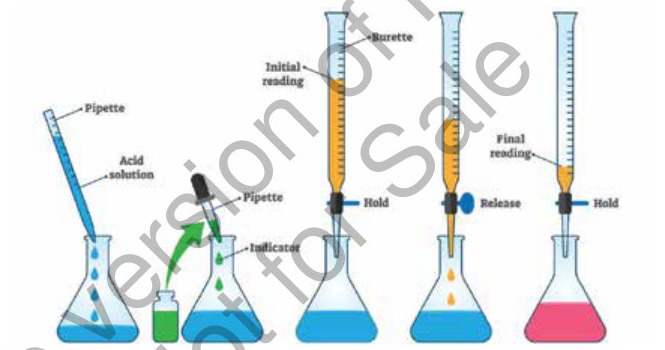
Volumetric analysis is used to find the concentrations of solutions by means of a technique known as titration. In this technique a solution of unknown concentration is combined slowly and carefully with a known volume of a standard solution until a colour change shows the completion of the reaction. The substance which indicates the completion of reaction by the change in its colour is called an indicator. The moment at which the indicator changes colour is called the end point. Either acidic or basic solution can be taken in a burette with the other solution taken in a conical or a titration flask.
Materials required
Burette, pipette, funnel, conical flask, HCl solution, NaOH solution, phenolphthalein.
Procedure of titration
• Rinse the pipette with distilled water and NaOH solution.
• Rinse the conical flask with distilled water.
• Pipette 10cm³ of NaOH into the conical flask and add 1-2 drops of phenolphthalein. The solution turns pink.
• Rinse the burette with distilled water and then HCl solution.
• Fill the burette with HCl using a funnel, then remove the funnel.
• Release some acid to remove air bubbles and note the initial burette reading.
• Place the conical flask on white paper under the burette and perform a rough titration by adding acid dropwise while swirling the flask.
• When the pink color just disappears and the solution becomes colorless, note the final reading.
• Repeat the titration to get accurate and concordant readings. Take at least three concordant readings which agree with one another within 0.1 cm³.
(i) Identification of carbonate CO₃²⁻ radical
Experiment Take about 2g of solid carbonate sample in a clean test tube and then add about 5 cm³ of dilute HCl solution. Pass the gas evolved in the above step through a solution of lime water.
Observation Effervescence takes place during which a gas evolves briskly, that turns lime water turns milky.
Inference Carbonate CO₃²⁻ are indicated ions.
Reactions involved in the above steps
CO₃²⁻ + 2H⁺(aq) → H₂O(l) + CO₂
Ca(OH)₂ + CO₂ → CaCO₃ + H₂O(l)
Lime water (white ppt)
(ii) Identification of chloride (Cl⁻), bromide (Br⁻) and iodide (I⁻) radicals.
Experiment Take 2g of solid sample in a test tube and 5cm³ of distilled water to make the aqueous solution. Add a few drops of dil. HNO₃ solution to acidify the solution of the salt, finally add about 5cm³ of aqueous Ag NO₃.
Observation A thick white precipitate is formed which dissolves in aq. NH₃. A thick cream-yellow precipitate is formed. A bright yellow precipitate is formed.
Inference Cl⁻ ions are indicated. Br⁻ ions are indicated. I⁻ ions are indicated.
Reactions involved in the above tests
Ag(aq) + Cl⁻(aq) → AgCl(s) white ppt
Ag(aq) + Br⁻(aq) → AgBr(s) cream yellow ppt
Ag(aq) + I⁻(aq) → AgI(s) bright yellow ppt
(iii) Identification of Nitrate NO₃⁻ radical
Experiment Take 2g of solid sample in a clean test tube and dissolve it in 5cm³ distilled water. Add to it 5cm³ of sodium hydroxide solution. Finally add 3g of powdered aluminium metal.
Observation A characteristic smell of NH₃ gas is felt near the mouth of test tube. This gas turns red litmus paper blue.
Inference NO₃⁻ indicated.
Aluminium metal reduces nitrate ions to ammonium ions which then react with aqueous NaOH to evolve ammonia gas.
3NO₃⁻(aq) + 8Al(s) + 5OH⁻(aq) + 18H₂O(l) → 3NH₃(g) + 8[Al(OH)₄]⁻(aq)
(iv) Identification of Sulphate SO₄²⁻ radical
Experiment Take 3g of solid sample in a clean test tube. Dissolve it in 5cm³ of distilled water. Acidify the solution with a few drops of dil. HNO₃ and then add 5cm³ barium nitrate solution.
Observation A heavy white precipitate of BaSO₄ is formed.
Inference SO₄²⁻ ions are indicated.
SO₄²⁻(aq) + Ba²⁺(aq) → BaSO₄(s)
(white ppt.)
(i) Identification of Aluminium (Al³⁺) radical
Take 4g of solid sample in a clean test tube. Dissolve it in about 10cm³ distilled water. Divide this solution into two parts for further tests.
Experiment To one part, add about 5 cm³ NaOH solution. To the second part of the above solution, add a few drops of aqueous ammonia.
Observation A white gelatinous precipitate is formed. A white precipitate is formed.
Inference Al³⁺ ions are indicated. Al³⁺ ions are indicated.
Al³⁺(aq) + 3OH⁻(aq) → Al(OH)₃(s)
white ppt.
(ii) Identification of Ammonium (NH₄⁺) radical
Take 4 g of sample in a clean test tube. Dissolve it in 10 cm³ distilled water. Add NaOH solution and gently heat it.
Experiment Ammonia gas is evolved with a distinct smell. Ammonia gas turns moist red litmus blue.
Observation NH₄⁺ indicated.
NH₄⁺(aq) + OH⁻(aq) → NH₃(g) + H₂O(l)
(iii) Identification of Calcium (Ca²⁺) radical
Take 4 g solid sample in a clean test tube. Dissolve it in 10 cm³ distilled water. Make two parts of this solution for further tests.
Experiment To one part, add NaOH solution. To the second part of the above solution, add aqueous ammonia.
Observation White precipitate is formed which does not dissolve in excess of NaOH solution. Only a slight turbidity appears or no precipitate is formed.
Inference Ca²⁺ indicated. Ca²⁺ indicated.
Ca²⁺(aq) + 2OH⁻(aq) → Ca(OH)₂(s)
white ppt.
(iv) Identification of Chromium radial (Cr³⁺)
Add 4 g sample in a clean test tube. Dissolve it in 10 cm³ distilled water. Make two parts of the above solution for further tests.
Experiment To one part, add NaOH solution. To the second part of the above solution, add aqueous ammonia.
Observation a green precipitate appears which turns into green solution when excess of NaOH is added. Green precipitate appears which is insoluble in excess of aqueous ammonia.
Inference Cr³⁺ indicated. Cr³⁺ indicated.
Cr³⁺(aq) + 3OH⁻(aq) → Cr(OH)₃(s)
Green ppt.
(v) Identification of copper radical (Cu²⁺)
Add 4g solid sample in a clean test tube. Dissolve it in 10cm³ of distilled water. Make two parts of the above solution for further tests.
Experiment To first part, add NaOH solution. To the second part of the above solution, add aqueous ammonia.
Observation Light-blue precipitate is formed. Deep blue solution is formed.
Inference Cu²⁺ indicated. Cu²⁺ indicated.
Cu²⁺(aq) + 2OH⁻(aq) → Cu(OH)₂(s)
Blue ppt.
(vi) Identification of ferrous radical (Fe²⁺)
Add 4g solid sample in a clean test tube. Dissolve it in 10cm³ of distilled water. Make two parts of the above solution for further tests.
Experiment To one portion, add NaOH solution. To the second potion of the above solution, add aqueous ammonia.
Observation Green precipitate is formed which is turned into orange brown precipitate after some time. White gelatinous precipitate of Fe(OH)₂ is formed which quickly oxidizes to form red brown precipitate of Fe(OH)₃.
Inference Fe²⁺ indicated. Fe²⁺ indicated.
Fe²⁺(aq) + 2OH⁻(aq) → Fe(OH)₂(s)
Green ppt.
(vii) Identification of Fe(III) radical (Fe³⁺)
Take 2g FeCl₃ in a clean test tube. Dissolve it in 10cm³ of distilled water. Make two portions of the solutions for further tests.
Experiment To one portion, add NaOH solution. To the second portion of the above solution, add aqueous ammonia.
Observation Orange brown precipitate is formed. Orange brown precipitate is formed.
Inference Fe³⁺ ions are indicated. Fe³⁺ ions are indicated.
Fe³⁺(aq) + 3OH⁻(aq) → Fe(OH)₃(s)
Orange brown ppt.
(viii) Identification of Zinc radical (Zn²⁺)
Take 4g solid sample in a clean test tube. Dissolve it in 10cm³ of distilled water. Make two portions of the above solution for further tests.
Experiment To one portion, add NaOH solution. To the second portion of the above solution, add aqueous ammonia.
Observation White precipitate is formed which is soluble in excess of NaOH solution. White precipitate is formed which dissolves in excess of ammonia.
Inference Zn²⁺ ions are indicated. Zn²⁺ ions are indicated.
Zn²⁺(aq) + 2OH⁻(aq) → Zn(OH)₂(s)
White ppt.
More figures from this unit