 StudentAid
Unit 4: Biomolecules — Short Questions
11th Class Biology · Unit 4: Biomolecules
[Diagram showing Maltose breaking down into Glucose and Glucose with water added]
[Structural diagrams of Glucose and Fructose shown in ring form]
Isomers
The molecules which have the same number of atoms (same molecular formula) but differ in how the atoms are arranged (different structural formula) are called isomers of each other. For example, glucose is not the only monosaccharide with the formula C6H12O6. Fructose and galactose also have the same molecular formula but their structural formulas are different.
Stereoisomers: Stereoisomers are compounds with the same molecule formula but differ in the arrangement of atoms in three-dimensional space e.g., glucose and galactoses are stereoisomers at C-4.
[Diagram showing amino acid structure with H2N-C-COOH groups and R group attached to central carbon]
A covalent bond that links two amino acids is known as a peptide bond. Each amino acid has an amino group at one end and a carboxyl group at the other end. When two amino acids are brought closer, dehydration synthesis occurs between the amino group of one and the carboxyl group of second amino acid. It results in the release of a molecule of water and formation of a peptide bond between "N" and "C" of adjacent amino acids.
[Diagrams showing structures of acylglycerol (three fatty acids attached to glycerol), phospholipid (showing glycerol, fatty acids, phosphate, and nitrogenous base, plus isoprene units), and terpene structures]
A nucleotide is made up of a nucleoside and phosphoric acid. A nucleoside is made of a nitrogen base and a pentose sugar
In one nucleotide, phosphoric acid has an ester linkage at C-5of pentose sugar. This phosphoric acid develops another ester linkage at C-3 of pentose sugar of another nucleotide. In this way, each phosphoric acid has two ester linkages with two pentose sugars (one at C-5 and other at C-3). The two ester linkages developed by phosphoric acid with two pentose sugars are known as phosphodiester linkage. This linkage joins two nucleotides.
All organisms use the same basic mechanism of reading and expressing genes, which is often referred to as central dogma.
• The first step of central dogma is the transfer of information in DNA to RNA, which occurs when an RNA copy of the gene is produced. The process is called transcription.
• The second step of the central dogma is the transfer of information from RNA to proteins, which occurs when the information contained in the RNA is used to direct the synthesis of proteins. This process is called translation. In this way, DNA controls the properties and activities of a cell.
SLO BASED SHORT QUESTION ANSWERS
Biochemistry is the study of chemical components and chemical process, occurring in living organisms. As all structures of living organisms have biochemical organization and all functions occurring in them are due to biochemical processes, taking place in this organization. Therefore, the basic knowledge of biochemistry is helpful to understand anatomy and physiology of living organisms.
Example: For example, photosynthesis, respiration, digestion, contraction etc can be described in biochemical terms.
All the chemical reactions taking place within a cell are collectively called metabolism. The processes in metabolism may be either anabolism or catabolism.
• In anabolism, simpler substances are combined to form complex substances.
• In catabolism complex molecules are broken down into simpler ones.
Biological Molecules
Percentage of major organic molecules in the dry mass of living organisms:
Proteins: 50%
Nucleic Acids: 18%
Carbohydrates: 15%
Lipids: 10%
A polymer is a molecule consisting of many identical molecular units, called monomers. Many macromolecules are in the form of polymers. Most of the organic molecules are large in size and biologists call them macromolecules. Important macromolecules like carbohydrates, proteins, and nucleic acids are the polymers of simple monomers i.e., sugars, amino acids and nucleotides respectively.
Types of Bond in Biology
Carbon is the basic element of organic molecules. It is tetravalent and can react with many other known elements like H, O, N, P and S.
• Carbon and hydrogen bond (C-H bond) is the potential source of chemical energy for cellular activities.
• Carbon-oxygen association in glycosidic linkages provides stability to the complex carbohydrate molecules.
• C-N bond: Carbon combines with nitrogen in amino acid linkages to form peptide bonds and proteins which are very important due to their diversity in structure and functions.
Covalent Bonds
• Covalent bonds form when two atoms share electrons.
• These are less strong than ionic bond.
• These bonds are often found in organic molecules like proteins and nucleic acids, providing stability to the molecules.
Ionic Bonds
• Ionic bonds are formed when one atom donates an electron (becomes a positive ion, or cation) and another atom accepts the electron (becomes a negative ion, or anion). The electrostatic attraction between these oppositely charged ions forms the ionic bond.
• Ionic bonds are relatively strong in the solid state.
• They are formed mostly in inorganic molecules like sodium chloride.
Hydrogen bonds are weak attractions that occur between a hydrogen atom and an electronegative atom (such as oxygen or nitrogen).
• These bonds are important in maintaining the structure of large molecules like proteins and nucleic acids, as well as in various biological processes like DNA replication.
Hydrophobic interactions occur between nonpolar molecules and polar molecules (like water). Nonpolar molecules (like water) tend to cluster together in aqueous environments to minimize contact with water molecules.
• This phenomenon is crucial for the folding of proteins and the formation of lipid bilayers in cell membranes.
Hydrophilic interactions occur between polar molecules and water molecules. These interactions are essential for the dissolution of polar and ionic compounds in water.
• These interactions help in various biological processes such as nutrient transport and chemical reactions within cells.
Condensation and Hydrolysis
During condensation, an -OH group is removed from one monomer and a-H atom is removed from another monomer. It is also known as dehydration synthesis because the removal of OH and H groups means the removal of a water molecule.
The formation of maltose by two glucose monomers is an example of a condensation reaction.
Proteins, nucleic acids, carbohydrates, and lipids are assembled from different kinds of monomers. All these biomolecules join their monomers by condensation or dehydration process.
Importance of Water
Solvent Properties
1. The ability of water to dissolve a wide variety of substances is due to its two properties, the polarity of water molecules and the ability of water molecules to form hydrogen bonds.
2. The water molecule has distinct ends, each with a partial charge. Hydrogen atom is partially positive and oxygen atom is partially negative. Such molecules are called polar molecules.
3. Partial negative charge at one end of a water molecule is attracted to partial positive of another water molecule. This weak attraction is called a hydrogen bond. Water forms a network of such bonds. Many of the properties of water are due to hydrogen bonds in water.
4. If water lacked H-bonds, it would have existed as a gas, and the properties like high boiling point, surface tension, and other properties would disappear and it will be difficult for life to exist.
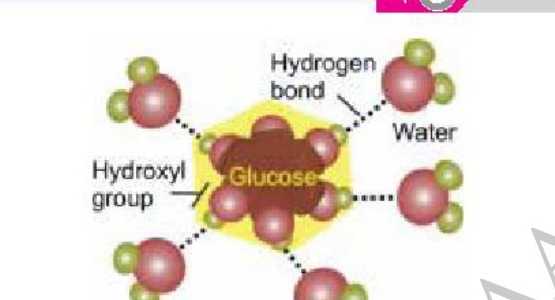
Due to the polar nature of water molecules, they gather around any other molecule that has an electrical charge, whether in the form of full charge (ions) or partial charge (polar molecules).
• For example, when sodium chloride (a salt) is placed in water. It breaks into positive (Na+) and negative (Cl-) ions. These ions are surrounded by opposite polar ends of water molecules.
• Similarly, when a glucose is placed in water, the molecules of water form hydrogen bonds with polar hydroxyl groups of glucose molecules. In this way, glucose dissolves in water (Figure 4.8). It means that charged or polar molecules are soluble in water. In the state of solution, ions and molecules can react with each other easily. So, water provides a medium for chemical reactions i.e., metabolism of cells.
Hydrophilic
Polar molecules such as salts, sugars, and amino acids dissolve readily in water and are called hydrophilic (water-loving).
Hydrophobic: Uncharged or non- polar molecules such as lipids do not dissolve in water and are called hydrophobic (water-hating).
Non-polar or uncharged molecules are insoluble in water because water molecules do not make hydrogen bonds with them. When they are placed in water, water molecules move them out. The insoluble molecules make hydrophobic associations with one another.
For example, lipid molecules are insoluble in water. When they are excluded from water, they make strong associations among themselves.
Definition
Specific heat capacity is defined as the number of calories (amount of heat) required to raise the temperature of 1 gram of a substance from 15°C to 16°C (i.e.,1°C).
Heat capacity of water: Water has a high specific heat capacity i.e., 4.184 Joules. It means that water has great ability to absorb and releasing heat with minimum change in its own temperature.
Water as temperature stabilizer: Most of the heat energy absorbed by water is used to break hydrogen bonds between its molecules. Due to this breakage of hydrogen bonds, individual water molecules start moving more freely and temperature of water rises.
• Due to high specific heat capacity, water heats up more slowly. Similarly, when it is given a cooler environment, it holds its temperature longer. Water thus works as temperature stabilizer not only for organisms' internal environment but also for their external environment.
Definition
It is the amount of heat required to change a liquid to gas.
Heat of vaporization of water: Water has high heat of vaporization. It absorbs much heat while changing from liquid state to gas. Its heat of vaporization is 574 Kcal/kg which means a considerable amount of heat energy (574 Kcal) is required to change 1kg of liquid water into vapours.
Cooling Effect: Due to this property, Earth's temperature is kept moderate. It also provides cooling effects to plants and animals when they transpire and perspire (sweat).
• Every gram of water that evaporates from plant or animals' body surface removes 574 calories of heat from the body.
Hydrogen bonds among water molecules enable them to "stick together". This type of attraction between same type of molecules is called cohesion.
• Inside water, molecules have high cohesion. The cohesion of water is important for living world.
• Plants depend on cohesion among water molecules for the transport of water and nutrients from roots to leaves. The evaporation of water from a leaf exerts a pulling force on water within xylem vessels of the leaf. As a result, water rises against the force of gravity.
• High surface tension: Hydrogen bonds also give water high surface tension. Water behaves as if it were coated with some invisible film. The insect water-strider walks on water without breaking surface.
Ionization of water
When the covalent bonds among the atoms of water molecule break, water is ionized to form hydrogen ion (H+) and hydroxyl ions (OH-).
At normal conditions, this reaction is reversible and equilibrium is maintained. At room temperature (25°C), in a litre of water one molecule out of each 550 million is ionized and thus the concentration of each of H+ and OH- in pure water remains at 10-7 moles/litre.
Significance: H+ and OH- ions take part in many chemical reactions in the cells e.g., hydrolysis of macromolecules. Relative concentrations of H+ and OH- ions determine the acidity and alkalinity of medium i.e., pH of medium. The pH affects the biochemical reactions. Enzymes work best at specific pH.
Carbohydrates
Carbohydrate are naturally occurring organic compounds. The word "carbohydrate" literally means "hydrated carbon" Carbohydrates are synthesized as the primary products of photosynthesis. During photosynthesis, when reduction of CO2 occurs, the resulting carbohydrate molecule contains carbon, hydrogen and oxygen in the molar ratio of 1:2:1.
Empirical formula: Their empirical formula is C(H2O)n where 'n' is the number of carbon atoms.
Classification of Carbohydrates
Carbohydrates are classified into three groups:
1. Monosaccharides
2. Disaccharides
3. Polysaccharides.
Monosaccharides Monosaccharides (simple sugars) are made of single sugar molecule. They are easily soluble in water. They may have 3 – 7 carbon atoms. They are further classified into subgroups on the basis of number of carbon atoms.
Monosaccharides table
Trioses (3 carbon atoms): C3H6O3, Examples: Glyceraldehyde, Dihydroxyacetone
Tetroses (4 carbon atoms): C4H8O4, Examples: Erythrose, Erythul ose (intermediate in photosynthesis in bacteria)
Pentoses (5 carbon atoms): C5H10O5, Examples: Ribose, Deoxyribose (C5H10O4), Ribulose
Hexoses (6 carbon atoms): C6H12O6, Examples: Glucose, Fructose, Galactose
Heptoses (7 carbon atoms): C7H14O7, Examples: Rare in nature (intermediate in photosynthesis)
[Fischer projections showing:
Glucose (aldose): H-C(=O) with aldose and ketose structures
Fructose (ketose): H-C(=O) and H-C-OH chains
Galactose (aldose): Similar structure to glucose
Ribose (aldose with 5 carbons): Pentose sugar structure]
There are two forms of D-glucose i.e., alpha D-glucose and beta D-glucose. They differ only in the direction of OH groups on carbon 1
α-D-glucose: The α-D-glucose has OH group on the lower side.
β-D-glucose: The β-D-glucose has OH on above side.
When many alpha D-glucose molecules join together, they form a polymer called starch.
When many beta D-glucose molecules join together, they form a polymer called cellulose.
Fischer and Haworth projections are two ways to represent the structure of sugar molecules.
Fischer projection: The Fischer projection was devised by German chemist Emil Fischer in 1891. In a Fischer projection the carbohydrate is shown in its open chain form, rather than a cyclical one.
Haworth projection: The Haworth projection is named after British Chemist Sir Norman Haworth. It shows sugars in their cyclic forms.
Disaccharides
They are made from two monosaccharides by the process of dehydration synthesis.
Glycosidic bond: The covalent bond between two monosaccharides is called glycosidic bond.
Hydrolysis: On hydrolysis, they yield monosaccharide monomers, of which they are made.
Solubility: As compared to monosaccharides, they are less soluble in water. Physiologically important disaccharides are:
i. Maltose (Malt Sugar)
ii. Lactose (Milk Sugar)
iii. Sucrose (Cane Sugar)
Maltose
• It is made up of two glucose monomers.
• The glucose molecules are attached by 1,4-glycosidic bond between carbon 1 of one and carbon 4 of the other glucose.
• It is found in many cereals (wheat, corn etc.) and is also formed (as an intermediate product) during the digestion of starch.
[Diagram showing maltose structure with 1,4-glycosidic linkage]
Lactose
• It is made up of one glucose and one galactose subunit.
• It is galactose 1-4 glucose.
• It is found only in mammalian milk, and is the main source of energy for infant mammals.
Composition
It is made up of one glucose and one fructose subunits i.e., it is glucose 1, 2-fructose.
Structure: It is the most familiar disaccharide and is also known as table sugar. It acts as a sweetener in our food.
[Diagram showing glucose subunit and fructose subunit joined by 1,2-glycosidic linkage]
Formula: Its molecular formula is (C11H22O11).
Importance: It is found in phloem vessels. It acts as a transport disaccharide. Important for higher plants where it acts as a transport product for the conduction of glucose to and from different parts of plant. That is why it is also known as transport disaccharide.
High fructose corn syrup is better than sucrose extract because it is cheaper and sweeter. In 1980's a method was developed to convert the glucose of corn starch into fructose which is sweeter than sucrose. Now this syrup is widely being used in food and soft-drinks.
The type of polysaccharides which upon hydrolysis yield many (more than 10) monosaccharide subunits are called polysaccharides.
Characteristics
They are most complex and most abundant carbohydrates.
Tasteless and sparingly soluble in water.
Important polysaccharides: Important polysaccharides include starch, glycogen, cellulose, pectin, lignin, chitin, agar and murein.
Amylose
• Amylose is a chain made of glucose monomers (with 1,4-glycosidic linkages).
• It is straight and unbranched. However, it tends to coil up into a helix.
Amylopectin
• Amylopectin is also a chain of glucose monomers (with 1,4-glycosidic linkages).
• It has branches (with 1,6-glycosidic linkages).
Both amylase and amylopectin are broken down by amylase at different rates because of their structure. Amylopectin being is branched having more ends, that's why it is broken more quickly by amylases as compared to unbranched amylose.
Similarity with amylopectin
It is similar in structure to amylopectin. It is a chain of glucose monomers (with 1,4-glycosidic linkages) with branches (with 1,6-glycosidic linkages).
Occurrence: It is made by animals as their primary storage polysaccharide, and is found mainly in muscles and liver.
Breakdown: Because it is so highly branched, it can be broken down to glucose very quickly.
[Diagram showing branched structure of glycogen]
[Diagrams showing:
Starch: Hexose rings connected by Alpha 1-4 glycosidic bonds
Cellulose: Hexose rings connected by Beta 1-4 glycosidic bonds]
The alpha 1-4 glucose polymer in starch coils up to form granules. On the other hand, the beta 1-4 glucose polymer in cellulose forms straight chains. Hundreds of these chains are linked together by hydrogen bonds to form cellulose microfibrils. These microfibrils make cellulose fibrils.
Significance: They are very strong and rigid, and give strength to plant cells, and therefore to young plants and also to materials such as paper, cotton etc.
The beta-glycosidic bond cannot be broken by amylase. It requires a specific cellulase enzyme. Some beta bacteria and some protozoan are only organisms that possess cellulase enzyme. Herbivore animals, like cows and termites whose diet is mainly cellulose, have mutualistic bacteria in their guts. These bacteria digest their cellullose. Humans cannot digest cellulose, and it is referred to as dietary fibre.
Like cellulose, chitin is also a polymer of glucose. The linkage between glucose monomers is also like that found in cellulose. However, in chitin each glucose molecule has been modified by the addition of a nitrogen-containing group. Only few organisms can digest it.
[Diagram showing part of chitin molecule with glucose and nitrogen-containing group]
Proteins
Proteins are the most abundant organic compounds in cell, which are defined as the polymers of amino acids.
J. Berzelious (in 1938) coined the term "protein" (Greek "Proteios"- molecules of the first rank) to emphasize the importance of this group.
Glycine
[Diagram showing H2N-C-COOH with H on the R group]
Alanine: [Diagram showing H2N-C-COOH with CH3 on the R group]
Essential Amino acids
The amino acids which are not synthesized by our body are essential amino acids. The nine amino acids cannot make our bodies are:
metionine, valine, tryptophan, isoleucine, leucine, lysine, threonine, histidine (necessary only for babies).
Non-essential Amino acids Out of 20 amino acids, our bodies can make eleven amino acids. These are called non-essential amino acids alanine, arginine, asparagine, aspartic acid, cysteine, glutamic acid, glutamine, glycine, proline, serine, and tyrosine.
Non-Essential amino acids Alanine, arginine, asparagine, aspartic acid, cysteine, glutamic acid, glutamine, glycine, proline, serine and tyrosine.
Essential amino acids Methionine, valine, tryptophan, isoleucine, leucine, lysine, threonine, histidine and phenylalanine.
The amino acids, which are linked by peptide bond, are called peptides. A dipeptide is formed by the linkage of two amino acids. For example, glycylalanine (a dipeptide) is formed by the linking of glycine and alanine.
[Diagram showing Glycine + Alanine with water being removed → Glycylalanine + Peptide bond formed]
Peptide
The amino acids which are linked by peptide bond are called peptides.
Dipeptide: When two amino acids are linked by peptide bond, its is called a dipeptide e.g. glycylalanine.
Polypeptide: Addition of aminoacids in a dipeptide (because both ends of dipeptide are reactive) ultimately leads to the formation of a chain, is called polypeptide chain.
Protein: When one or more polypeptide chains assume different shapes on the basis of number, types and sequence of amino acids, forms protein molecule.
The primary structure of a protein molecule is formed by the linear arrangement of amino acids. It represents the number and sequence of amino acid molecules in a polypeptide chain.
• All protein molecules (whether simple or complex) have specific primary structures.
• Crucial role: The number, sequence and types of amino acids is highly specific in the primary structure of a protein, for its proper functioning. This specificity in primary structure is determined by the order of nucleotides in DNA. Any change results in abnormal protein that fails to carry out its normal function. e.g., in sickle cell anemia occurs due to problem in primary structure of β-chain of hemoglobin.
Sickle cell haemoglobin is formed by a mistake in the arrangement of only one amino acid in position six in each beta chain. In sickle cell haemoglobin, amino acid valine is present in the place of glutamic acid. Due to sickle cell haemoglobin, red blood cell get sickle shapes and abnormal haemoglobin cannot transport sufficient oxygen. This disease is known as sickle cell anaemia.
In many proteins, folding or coiling patterns occur within a polypeptide chain. This structure is called secondary structure.
Coiling of a polypeptide chain results in alpha helix while folding makes a pleated sheet. Both these structures are maintained by hydrogen bonds between amino and carboxyl groups of nearby amino acids in the chain.
When the secondary structure further folds up and gets a complicated globular shape, it is called the tertiary structure of protein. These are more complex proteins. The globular shape is maintained by ionic, hydrogen and disulfide bonds.
Amino acids in a polypeptide chain interact with water to give the most stable tertiary structure in the form of a globular shape. These are hydrophilic and hydrophobic interactions. The hydrophobic (non-polar) amino acids aggregate in such a way that they disrupt hydrogen bonding of water molecules and so are buried inside. At the same time the hydrophilic (polar) amino acids turn out, towards the surface of water.
When two or more polypeptide chains with tertiary structures are held together by hydrophobic interactions, hydrogen bonds and ionic bonds, they form most complex proteins. This aggregation of tertiary structures makes the quaternary structure of protein.
Fibrous Proteins
Shape: In the form of fibrils
Structure: Primary or secondary
Role: Structural
Examples: Silk fibre-form the webs of silk worm and spider, Actin in muscle cells, Fibrin – in blood clots, Keratin – in nails, hairs, beak, skin etc, Collagen – in matrix of connective tissues
Globular Proteins
Shape: Spherical or ellipsoidal
Structure: Tertiary or quaternary
Role: Functional
Examples: Enzymes – biocatalyst, Antibodies – active against invading antigens, Hormones – regulate body's activities, Haemoglobin – oxygen carrying protein
Lipids
An ester is the compound produced as the result of a chemical reaction of an alcohol with an acid and a water molecule is released.
Classification of lipids: Acylglycerols, waxes, phospholipids, terpenes, steroids and prostaglandins.
Fats
• The acylglycerols which are solid at room temperature, are called fats.
• In animals, most acylglycerols are fats e.g., butter, meat and fat.
Oils
• The acylglycerols which are liquid at room temperature, are called oils.
• In plants, most acylglycerols are oil, for example, peanut oil, corn oil, castor oil.
Animals fats have more energy than plant oils because, they have more number of saturated fatty acids, so more the number of CH-bonds, hence more energy than unsaturated fatty acid oils with lower number of CH-bonds in plant oils.
Chemically, acylglycerols are the esters of fatty acids and alcohol. They are synthesized through dehydration synthesis (H is released from alcohol and OH from an acid) as shown below.
C3H5OH+ HOOCCH3 -----> C3H5OCOCH3 + H2O
alcohol acetic acid an ester
(ethylacetate)
The most widely found acylglycerols are triacylglycerol (triglycerides), also called neutral lipids. In triacylglycerols, three molecules of fatty acid (same or different) are joined to a single glycerol backbone.
Glycerol
It is a 3C alcohol and each of its carbon bears a hydroxyl group. The 3 carbons of glycerol form the backbone of acylglycerol molecule, to which three fatty acids are attached.
Fatty acids: These are responsible for all the characteristics of acylglycerols. Fatty acids are long hydrocarbon chains (with carbon in even number 4 – 30), ending in a carboxyl (-COOH) group. They vary in length and may be as straight chains (in animals) or branched or ringed (in plants).
Saturated fatty acids
• Saturated fatty acids contain no double bond in their hydrocarbon chain.
• In saturated fatty acids, all internal carbon atoms possess hydrogen side- groups.
• These fatty acids make straight chains, and have a high melting point e.g., butyric acid, palmitic acid.
Unsaturated fatty acids
• Unsaturated fatty acids have double bonds (6 maximum) between one or more pairs of carbon atoms.
• The double bonds replace some of the hydrogen atoms. Therefore, unsaturated fatty acids contain fewer number of hydrogen atoms.
• These fatty acids form bent chains, and have a low melting point.
Fibrous Proteins
Silk fibre-form the webs of silk and spider
Actin in muscle cells
Fibrin – in skin etc.
Collagen – in matrix of connective tissues
Globular Proteins
Enzymes – biocatalyst
Antibodies – active against invading antigens
Hormones – regulate body's activities.
Haemoglobin – oxygen carrying protein
Channel proteins in the membranes of cells control the movement of materials in and out of cells. For example, proteins make sodium– potassium pump in the cell membrane of neurons. This pump controls the movement of Na+ and K+ ions in and out of nerve cell.
Some globular proteins work to transport different materials throughout the body. For example; haemoglobin and myoglobin transport O2 and some CO2, and cytochromes work in electron transport chain as electron carriers.
Blood ferritin levels are measured in patients as a diagnostic tool of anaemia. If ferritin is high, there is iron in excess. If ferritin is low, there is a risk for lack of iron which sooner or later could lead to anaemia.
(i) Repressors are the proteins that regulate gene action by preventing the synthesis of RNA. These proteins allow genes to work where and when required.
(ii) Antibodies are important proteins. They recognize and combine with foreign substances (antigens) and convert them into harmless products.
(iii) Ion-binding proteins store ions in different parts of body. For example, ferritin is the main intracellular iron storage protein. Similarly, casein is a milk protein that stores potassium and calcium ions.
(iv) Blood clotting is important to prevent the loss of blood after an injury. Fibrinogen protein is present in blood. When an injury occurs, fibrinogen is activated into fibrin. The fibrin makes fibres and a clot is formed.
If a fatty acid has one double bond it is called mono-unsaturated e.g., oleic acid. If there are more than one double bond, it is called poly-unsaturated e.g., linoleic acid.
Dehydration synthesis of a triacylglycerol
[Diagram showing 3 Fatty acids + Glycerol → Triacylglycerol + 3H2O]
They are mixtures of
• Long chain alkanes (with carbon atoms in odd number; 25-35),
• Alcohols (other than glycerol), ketones
• Long chain fatty acids.
Waxes are chemically inert. Like other lipids, waxes are strongly hydrophobic. They act as protective coverings and water barriers for living organisms. Waxes are widespread as protective coatings on fruits and leaves. Some animals like insects, birds, sheep etc. also secrete waxes over their skin.
Waxes are used to waterproof paper and cards. Waxes are also used in wax polishes for furniture, footwear and vehicles. Waxes are also used to make candles. Waxes with coloured pigments are used in making crayons and coloured pencils.
[Diagram showing phosphatidylcholine structure with glycerol, fatty acids, phosphate, and choline groups]
Chemically they are the derivatives of phosphatidic acid. Phosphatidic acid is composed of one glycerol, two fatty acids and one phosphoric acid (phosphate). Any nitrogenous base e.g., choline, ethanolamine or serine attaches with its phosphoric acid and makes phospholipid.
Examples: Common examples are phosphatidyl choline (lecithin), phosphatidyl ethanolamine and phosphatidyl serine. Phosphatidyl choline forms lipid bilayer in plasma membranes.
It is a very large and diverse group of lipids. All terpenes are made of isoprene units. An isoprene unit is a branched unsaturated hydrocarbon chain with the formula CH2=C(CH3)-CH=CH2.
Importance: Terpenes form many biologically important pigments, such as chlorophyll in plants and retinal pigments in eyes. Vitamin A and rubber are also terpenes.
[Diagram of isoprene unit showing:
CH3
|
C = CH2
|
CH2 C
|
CH2]
Steroids Steroids are lipids whose carbon skeleton is bent to form four fused rings. All steroids have the same ring pattern i.e., three 6-cornered rings and one 5-cornered ring. Cholesterol is a common steroid in animal cell membranes. Animal cells also use it for making other steroids e.g., male and female sex hormones (androgens, estrogens), adrenal hormones and corticosteroids.
In 1950s some pharmaceutical companies produced anabolic steroids for the treatment of general anaemia. Some athletes began using anabolic steroids to build-up their muscles quickly and enhance their performance. Today, anabolic steroids are banned. Anabolic steroids can cause serious physical and mental problems e.g., deep depression, liver damage sweating, insomnia rest less.
Prostaglandins are a group of lipids that are modified fatty acids, with non-polar tails attached to a five-carbon ring.
Importance: They occur in many tissues of vertebrates, where they act as local chemical messengers. Some of them stimulate smooth muscles to contract and relax, others constrict or expand the diameter of blood vessels. They are also involved in inflammatory response to infection.
Lipids are important sources of energy (ATP).
In fact, lipids are the most energy rich of all nutrients. One gram of lipids provides 9.5 kilocalories of energy. The same amount of protein provides 5.6 kilocalories while that of carbohydrate provides 4.1 kilocalories.
• Lipids are essential components of all cellular and subcellular membranes. They serve as biological carriers for the absorption of fat-soluble vitamins A, D, E and K.
• Lipids are a source of fatty acids, which are essential for various metabolisms. Lipids play a role as a mechanical cushion/support for vital body organs.
• The lipids (fats) present beneath skin, insulate the body from extreme temperatures.
Steroids perform a wide range of important biological functions. For example, cholesterol is involved in the maintenance of membranes. It also helps in lipid transport. It as a precursor of vitamin D, bile acids and steroid hormones (androgens, estrogens), adrenal hormones and corticosteroids.
Nucleic Acids
DNA is found mainly in chromosomes, with small amounts in mitochondria and chloroplasts.
RNA is found in nucleolus, ribosomes and cytosol.
Pyrimidine Pyrimidine is a single ringed nitrogenous base. There are three pyrimidine bases in nucleic acids. Cytosine (C) is present in both DNA and RNA, thymine (T) is present only in DNA, and uracil (U) is present only in RNA.
Purines Purine is a double ring nitrogenous base. Both DNA & RNA contain two purine bases i.e., adenine (A) and guanine (G)
[Diagrams showing adenine purine structure and uracil nucleotide structure with phosphorus, ribose sugar, and nitrogenous base]
[Diagram showing Nicotinamide Adenine Dinucleotide with Nicotinamide, Ribose, and Adenine components]
[Diagram of Adenosine Triphosphate showing Adenine, Ribose, and three Phosphate groups]
Nicotinamide Adenine Dinucleotide (NAD) is a co-enzyme. It acts as a hydrogen acceptor in oxidation–reduction reactions in cell.
Watson and Crick's Model of DNA suggests the following points:
DNA is made of two polynucleotide chains or strands.
• The two strands are coiled around each other and make a double helix.
• The double helix is like a ladder. Its poles are made of sugars and phosphate groups. Its rungs are made of nitrogenous base pairs.
• Each base pair (rung) is made of one purine (A or G) and one pyrimidine (C or T) base.
• Two strands are held together by weak hydrogen bonds between their bases.
In 1951 Erwin Chargaff provided an informative data and it was found that adenine and thymine are equal in ratio in DNA and so are guanine and cytosine.
A gene is a sequence of nucleotides of DNA which codes for the formation of a particular polypeptide.
Messenger RNA (mRNA)
• It consists of a single strand of ribonucleotides.
• Its sequence of nucleotides is complementary to the sequence of nucleotides of one of the strands of DNA.
• mRNA is about 3-4% of the total amount of RNA in cell.
• It carries the genetic message of DNA to ribosomes to form particular protein.
Transfer RNA (tRNA)
• It is comparatively small.
• It is a helical structure and its molecule resembles a clover leaf.
• It consists of 10-15% of the total amount of RNA in cell.
• tRNAs transport amino acids to ribosome and mRNA, in the process of protein synthesis.
It is synthesized by the DNA of nucleoli. After its synthesis, ribosomal RNA is joined with ribosomal protein and ribosomes are formed. It comprises about 80% of the total RNA in cell. rRNA acts as the machinery for synthesis of proteins in ribosomes.
Transcription
The transfer of information from DNA to RNA, which occurs when an RNA copy of the gene is produced. The process is called transcription.
Translation: The second step of the central dogma is the transfer of information form RNA to proteins, which occurs when the information contained in the RNA is DNA controls the properties and activities of a cell.
Conjugated Molecules
Conjugated molecules are formed by the combination of two or more molecules belonging to different categories. Some important conjugated molecules are as follows.
• Glycoproteins (e.g., They are formed by covalent linkage between a protein and a carbohydrate polymer.)
• Glycolipids (e.g., They are formed by a covalent linkage between a lipid and a carbohydrate.)
• Lipoproteins
• Nucleoproteins
Glycoproteins
They are formed by covalent linkage between a protein and a carbohydrate polymer. They occur widely in nature as integral structural component of membranes; in blood serum; as cellular secretions; and in cartilage, eyes, skin etc.
Glycolipids
They are formed by a covalent linkage between a lipid and a carbohydrate. They are an integral structural component of membranes.
They are a class of biomolecules which are formed by hydrophobic interactions (not covalent or ionic bonds) between lipids and proteins.
Importance: Lipoproteins are the basic structural framework of all types of plasma membranes. Lipids are transported in blood as very low-density lipoproteins.
They are formed by ionic bonds between chromosomal DNA and proteins.
• For example, histone proteins are bound to DNA to form nucleosomes.
• Role: They stabilize chromosomal structure in eukaryotes and also play an important role in the regulation of gene expression.