StudentAid
Unit 10: Thermal Physics — Long Questions
10th Class Physics · Unit 10: Thermal Physics
Key points Thermal expansion (Definition, Cause of expansion and contraction, Thermal expansion in solids)
Thermal Expansion
Definition "Thermal expansion is the change in length, area, or volume of a substance when it is heated."
1. Cause of expansion and contraction
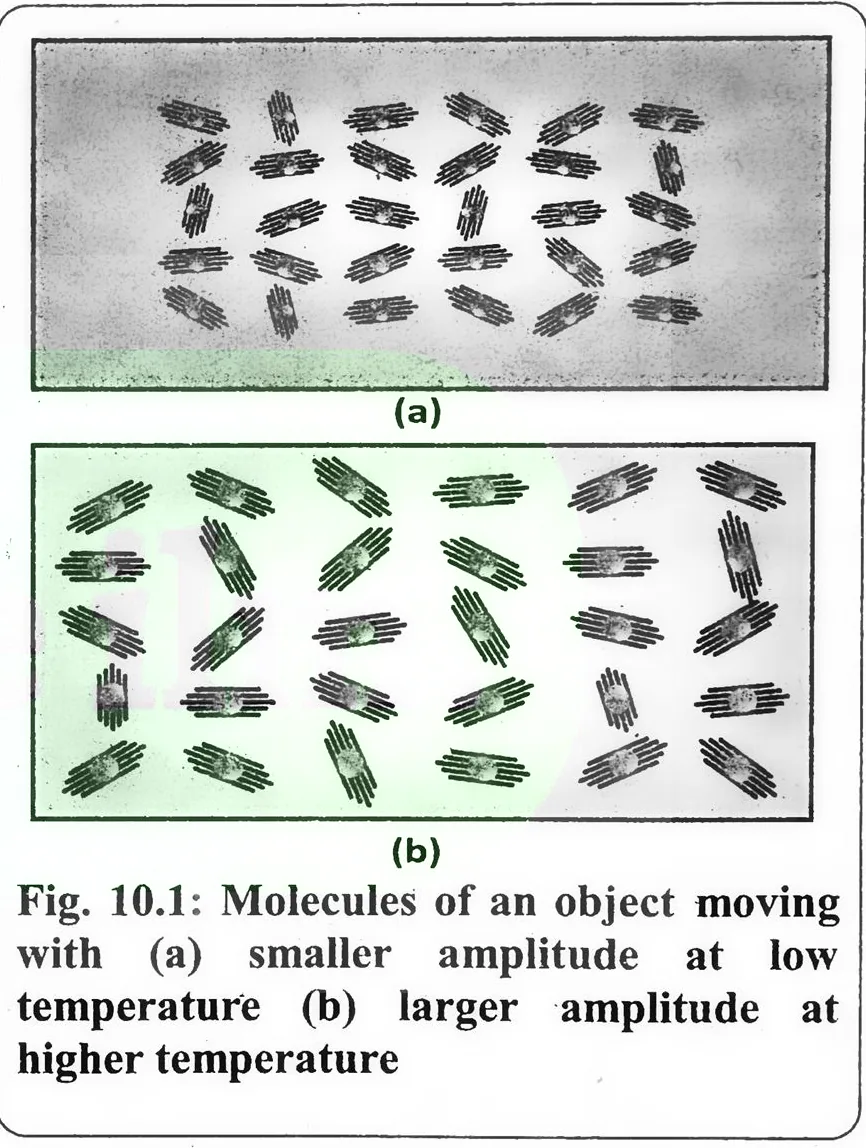
- As the temperature rises, the particles within a substance gain more kinetic energy. This causes them to move faster and spread out, leading to expansion of the material (Fig. 10.1-b).
- Conversely, when a substance is cooled, its particles lose energy and move closer together, causing the material to contract (Fig. 10.1-a). This phenomenon is known as thermal contraction.
2. Thermal expansion in solids
When solids are heated, they expand, and this expansion remains almost consistent over a broad temperature range. Change in temperature may cause respective change in length or volume of the solids.
3. Linear Thermal Expansion
Definition "If length of a solid changes upon heating, then it is called linear thermal expansion."
Derivation of expression
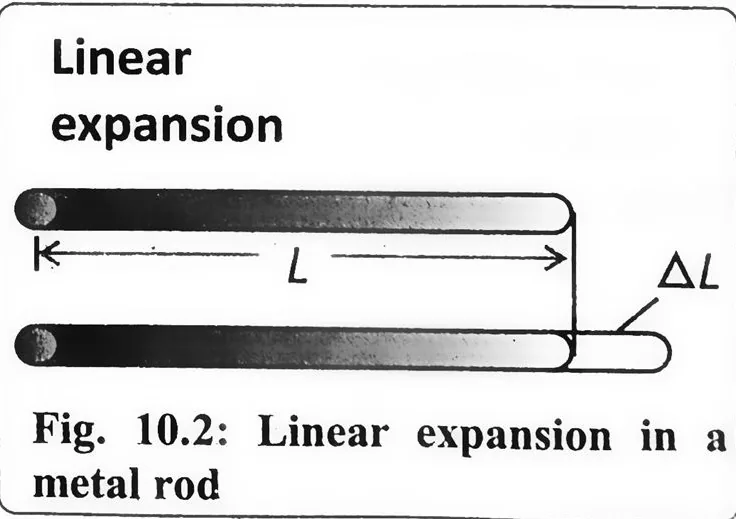
Consider a metal rod as shown in Fig. 10.2 with an initial length L₀ at a temperature T₀. When heated to a temperature T, its new length become L. Thus, the increase in length of the rod is:
ΔL = L - L₀
And the rise in temperature is: ΔT = T - T₀
It has been observed that the change in length ΔL of a solid is directly proportional to its original length L₀ and the temperature change ΔT. Thus,
ΔL ∝ L₀ ΔT
Or ΔL = α L₀ ΔT
α = ΔL / L₀ ΔT
Or L - L₀ = α L₀ΔT
Or L = L₀(1 + α ΔT) ........................(10.1)
- Here α is called the coefficient of linear thermal expansion of the material.
- The value of 'α' of different solid materials is different.
Key points Volume Thermal Expansion. (Definition, Derivation)
Volume Thermal Expansion
Definition "The volume of a solid increases when its temperature rises. This is known as volume thermal expansion."
Derivation of expression
Suppose a solid has an initial volume V₀ at a temperature T₀.
When heated to a temperature T, its new volume becomes; ΔV = V - V₀ and the rise in temperature is: ΔT = T - T₀
It has been observed that, the increase in volume ΔV is directly proportional to its original volume V₀ and the temperature change ΔT, thus
ΔV ∝ V₀ ΔT
Or ΔV = β V₀ ΔT
Or V - V₀ = β V₀ ΔT
Or V = V₀(1 + β ΔT) ........................(10.2)
- Here β is called coefficient of volume expansion which determines how much a material expands with temperature.
- Different solids have different values of β, meaning some expand more than others when heated.
Mathematically,
β = ΔV / V₀ΔT
- In solids, atoms are arranged in a tight, regular pattern. As the temperature rises, each atom pushes slightly harder against its neighbours due to increased vibration. Since there is no room to move inwards, the structure expands outward instead.
Key points Thermal expansion in liquids, (Explanation, Example)
Thermal expansion in liquids
Definition "When a liquid is heated, its volume increases. this is called thermal expansion in liquid. This happens because the heat energy makes the liquid molecules move faster, causing them to spread apart and take up more space."
1. Explanation
- Unlike solids, which have a fixed shape and expand in a limited way, liquids do not have a definite shape, so they expand freely in all directions when their temperature rises.
- The degree to which a liquid expands depends on its specific coefficient of volumetric expansion, a property unique to each substance. This expansion is quantified by the formula:
ΔV = β V₀ΔT ........................(10.3)
where ΔV is the change in volume, β is the volume expansion coefficient, V₀ is the original volume, and ΔT is the temperature change.
2. Explanation with example
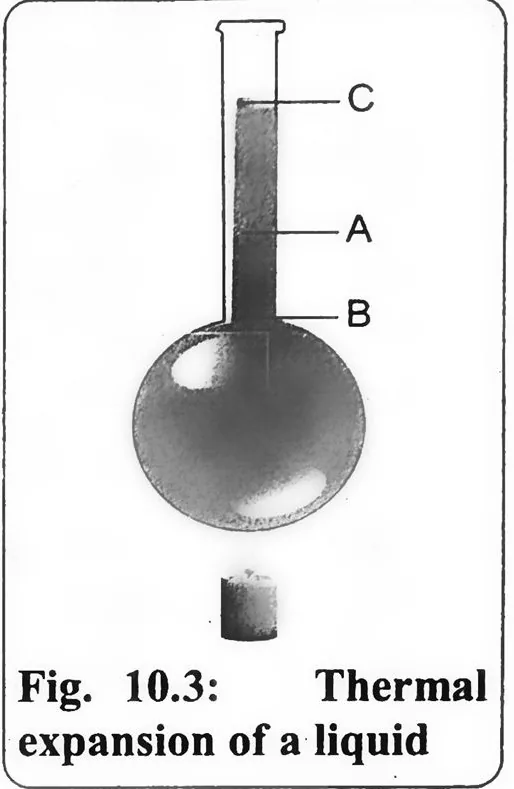
- A common example of thermal expansion in liquid as seen in flask (Fig. 10.3). When the flask is heated, the glass expands leading to decrease in liquid level from A to B which is known as expansion of flask (AB).
- As the liquid heats up, it expands and the level rises from B to C which is known as real expansion (BC). Where AC is an apparent expansion. Remember that real expansion is always greater than apparent expansion.
BC = AC + AB
Key points Thermal expansion in gases, (Definition, Explanation, Behaviour of a gas, Importance, Dangers of uncontrolled expansion)
Thermal expansion in gases
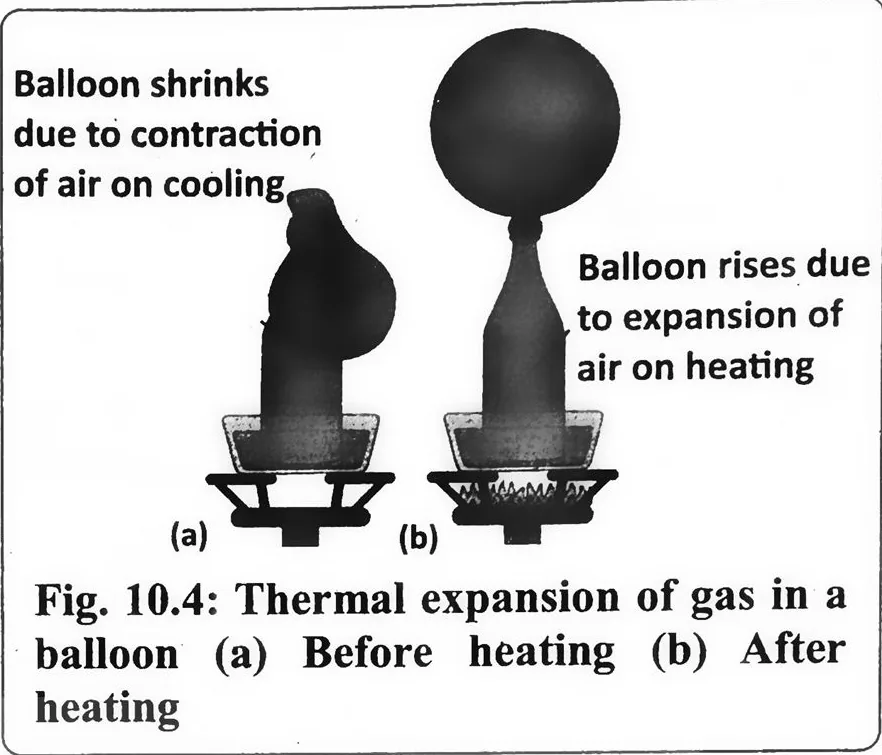
Definition "When temperature of a gas increases, its volume increases as long as the pressure remains same. This is called thermal expansion of the gas."
1. Explanation
- As the temperature of a gas increases, the kinetic energy of its particles also increases. This causes the gas molecules to move faster and collide more frequently and forcefully with the walls of the container.
- Thus, collisions exert pressure, on the container walls.
2. Behaviour of a Gas in Flexible and non-flexible Container
- If a gas is in a non-flexible container, the increased collisions lead to a rise in pressure.
- However, in a flexible container, the volume can expand instead, allowing pressure to remain constant.
- This behaviour aligns with Charles' law, which states that the volume of a gas is directly proportional to its temperature at constant pressure.
3. Importance
- The expansion of gases plays an important role in daily life and various industries. For example, in a hot air balloon, the air inside is heated, causing it to expand and become lighter than the cooler air outside. This makes the balloon to rise (Fig. 10.4).
- Similarly, in car engines, fuel burns and produces hot gases that expand quickly, pushing the pistons and making the vehicle move.
- In weather patterns, warm air expands and rises, affecting air pressure and causing winds and weather changes.
4. Dangers of uncontrolled expansion
The uncontrolled expansion of gases can be dangerous. For instance, aerosol cans and gas cylinders can explode if exposed to high temperatures because the gas inside expands beyond what the container can withstand.
Key points Practical applications and consequences of thermal expansion
Practical applications and consequences of thermal expansion
When materials expand or contract due to temperature changes, it can lead to structural, mechanical, and functional consequences. Thermal expansion is commonly used in our daily life such as:
1. Applications
a. Thermometers: In thermometers, thermal expansion in a narrow tube helps in the measurement of temperature.
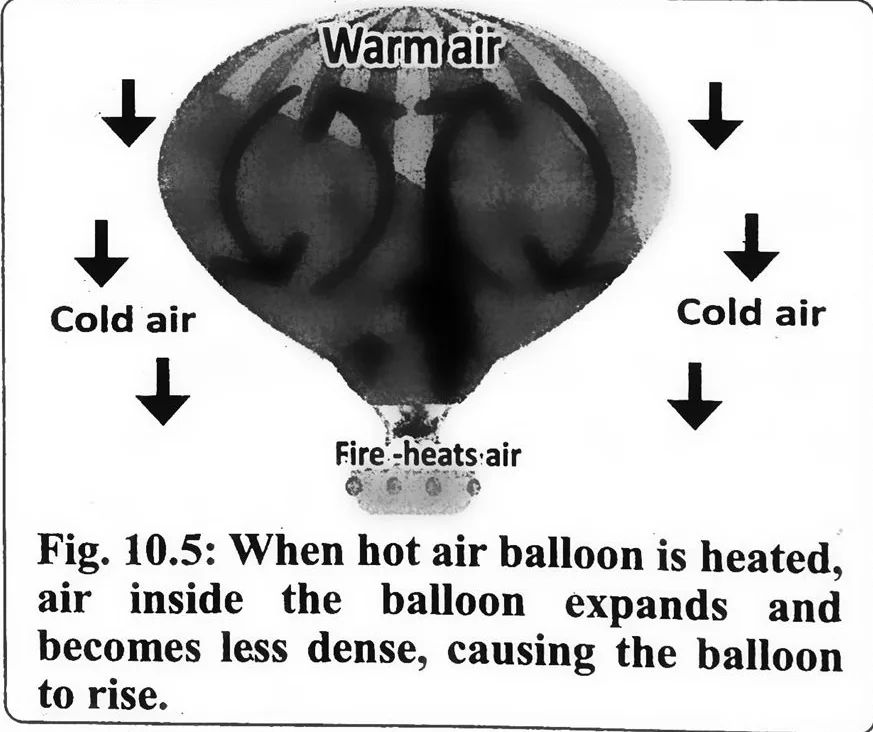
b. Hot Air Balloon: The expansion of heated air is intentionally used to make the balloon rise. Heating the air inside causes it to expand, reducing its density so it lifts the balloon (Fig. 10.5).
2. Consequences
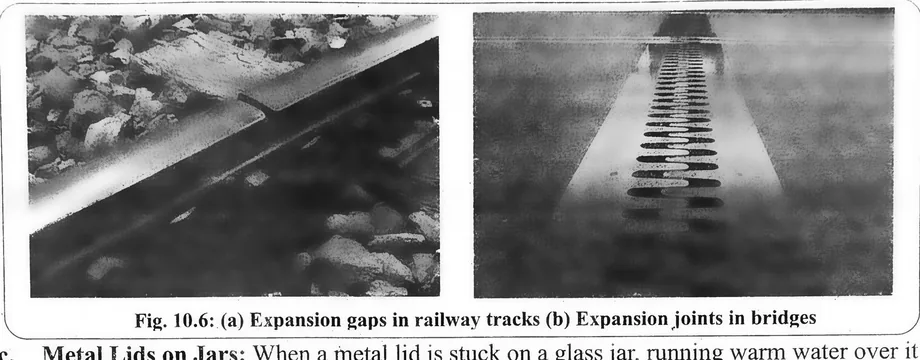
a. Gaps in Railway Tracks: Steel tracks of the rails expand on hot days. Without room to expand, the tracks may bend or twist a phenomenon called "sun kinks" which can cause train derailments. Small gaps are left between railway tracks to allow them to expand in summer, preventing them from bending (Fig. 10.6-a).
b. Bridges: Bridges have small gaps called expansion joints that allow them to expand in hot weather and contract in cold weather without breaking (Fig. 10.6-b).
c. Metal Lids on Jars: When a metal lid is stuck on a glass jar, running warm water over it makes the lid expand slightly, making it easier to open.
d. Gas Containers (like aerosols or propane tanks): Gases expand significantly when heated. If containers are exposed to heat (like being left in the Sun), pressure can build up inside and causes explosions. Warning labels advise users to store these containers away from heat, and pressure relief valves are often included.
e. Pipes and Plumbing: Water pipes can expand and contract, especially with hot water. This may lead to pipe bursts or joint leaks if not properly accounted for. Flexible joints and loops are used in piping systems to absorb movement.
Key points Specific heat, (Definition, Units, Formula, Explanation, Specific heat capacity of solids)
Specific heat of a substance
Definition "Specific heat capacity (c) is the amount of heat energy needed to increase the temperature of 1 kg of a substance by 1 °C (or 1 K)."
Units
The SI units of specific heat capacity are J kg⁻¹ K⁻¹.
Formula
Q = m c ΔT ........................(10.4)
Where
Q = heat energy
m = mass of the substance
ΔT = change in temperature
c = specific heat capacity
Explanation
The energy required to heat a material depends on three factors:
a. Mass of the substance b. Change of temperature c. Nature of the material
Some substances absorb heat more easily than others. For example, heating 1 kg of water by 1 °C requires more energy than heating 1 kg of alcohol by the same amount. This relationship is expressed using the formula: Q = m c ΔT
Specific heat capacity of solids
- The specific heat capacity of solids is the heat energy needed to raise the temperature of 1 kg of a solid by 1 °C.
- Materials with a high specific heat capacity, such as wood and rubber require more heat to increase their temperature, making them useful in applications like cooking utensils and thermal insulation.
- On the other hand, metals like steel and copper have low specific heat capacities, i.e they heat up and cool down quickly, so they are used in making cooking items, kettles, radiators, and heat engines.
Key points Specific heat of liquids. (Definition, Explanation, Effects of large specific heat capacity of water specific heat capacity of water)
Specific heat of liquids
Definition "The specific heat capacity of a liquid is the amount of heat energy needed to raise the temperature of 1 kg of the liquid by 1°C or 1 K."
1. Explanation
- Different liquids have different specific heat capacities based on their molecular structure and ability to store heat.
- One of the most important liquids in this regard is water, which has a high specific heat capacity of 4200 J kg⁻¹ K⁻¹. This means water can absorb and store a large amount of heat with only a small temperature increase. Because of this property, water is widely used in cooling systems, heating systems, and as a natural temperature stabilizer.
- Other liquids, such as alcohol and mercury, have lower specific heat capacities, meaning they heat up and cool down more quickly than water.
2. Effects of Large Specific Heat Capacity of Water
- Large water bodies like oceans and lakes absorb heat during the day and release it slowly at night, preventing drastic temperature changes. This is why coastal areas have milder climates compared to inland regions. Since water has a specific heat capacity of 4200 J kg⁻¹ K⁻¹, while dry soil has only 810 J kg⁻¹ K⁻¹ :
- Soil heats up five times faster than the same mass of water under the same heat. As a result, land temperatures rise and fall more quickly than sea temperatures, making seasonal temperature changes less extreme in coastal areas.
- Water's high specific heat capacity also makes it useful for storing and transferring heat.
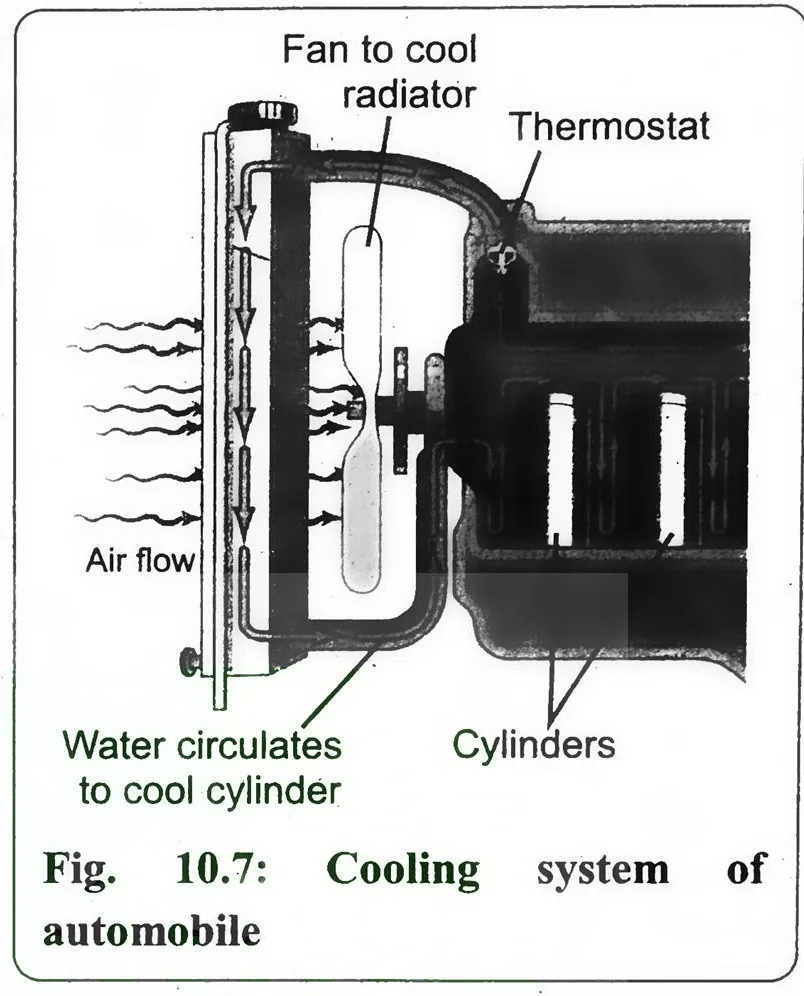
- In an automobile engine, the cooling system uses water to absorb and carry away the heat produced during the engine operation.
- The pump circulates water through jackets around the engine cylinders, where it absorbs heat (Fig. 10.7). This heated water then flows through the thermostat, which regulates its movement based on temperature. If the water is too hot, the thermostat opens, allowing it to enter the radiator.
- In the radiator, a fan draws in outside air, which cools the water passing through it. The cooled water then returns to the engine to absorb more heat, and this cycle is repeated.
- A pressure release cap ensures that the system remains safe by releasing excess pressure.
- This property helps water to carry away engine heat efficiently, preventing overheating and ensuring smooth engine performance.
Key points Change in state, Role of intermolecular force and order of thermal expansion
Change in State
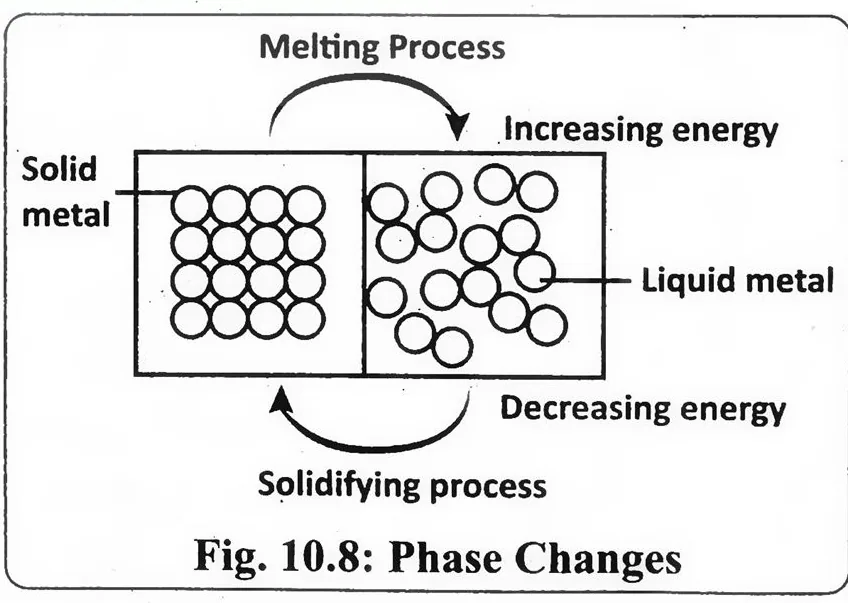
1. Melting
Definition "Converting from a solid to liquid is called melting."
When a substance absorbs energy, the atoms and molecules move more rapidly and hence need more space and separation between atoms or molecules. It may lead to turn from a solid to liquid, called melting.
2. Boiling
Converting the liquid to gas is known as boiling.
3. Condensation
Definition "Converting from a gas to liquid is called condensation."
The atoms and molecules will slow down by losing energy and hence there is less space and separation between them. It may lead to turn a gas to liquid, called condensation.
4. Solidification
Converting a liquid to solid is known as solidification.
Role of intermolecular force and order of thermal expansion
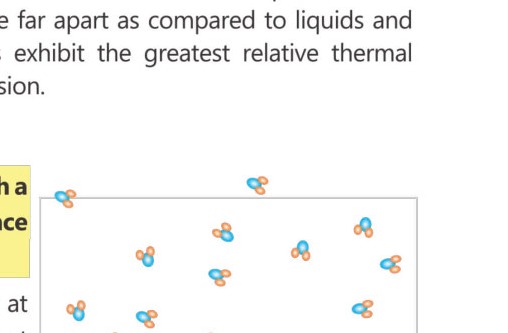
- Keep in mind that intermolecular forces are the strongest in solids due to least separation and weakest in the gases, as the molecules are far apart as compared to liquids and solids.
- This is the reason that the gases exhibit the greatest relative thermal expansion while solids have the least expansion.
Evaporation
Definition "Evaporation is a natural process by which a liquid changes into a gas at its surface without boiling."
1. Explanation
- It occurs at all temperatures but is faster at higher temperatures. This change occurs at the surface of the liquid, where some of the particles have enough energy to escape into the air as vapour.
- Evaporation does not require the entire liquid to be heated, it can occur at room temperature.
- For instance, when water is spilled on the floor, it gradually disappears as it turns into water vapour.
- This process plays a key role in everyday life and in nature. It helps in drying wet clothes, and cooling our bodies through sweating.
2. Factors affecting evaporation
Several key factors influence how quickly or slowly evaporation takes place:
a. Temperature: The higher the temperature, the faster evaporation occurs. When heat is added, the molecules in the liquid move more energetically, increasing the chances of them escaping into the air as vapour e.g. water evaporates faster on hot summer day than on a cold winter day.
b. Surface Area: A larger surface area allows more liquid to be exposed to the air, which speeds up evaporation. For example, water in a wide, shallow dish will evaporate quicker than the same amount in a tall, narrow container.
c. Air Movement (Wind Speed): Wind or air movement helps to carry away the vapour molecules from the surface of the liquid. This prevents saturation of the air above the liquid and allows more molecules to evaporate (Fig. 10.9) e.g. clothes dry faster on a windy day.
d. Humidity of the Surrounding Air: If the air is already full of moisture (high humidity) evaporation slows down. But in dry air, the process occurs more rapidly because the air can absorb more water vapour e.g. clothes take longer time to dry in humid weather.
e. Nature of the Liquid: Different liquids evaporate at different rates based on their molecular structure. For instance, alcohol evaporates faster than water because its molecules require less energy to escape into the air.
f. Pressure: Lower atmospheric pressure can enhance evaporation since there is less force pushing down on the liquid surface, making it easier for molecules to escape e.g. water evaporates faster at the top of mountain than at sea level.
Cooling Caused by Evaporation
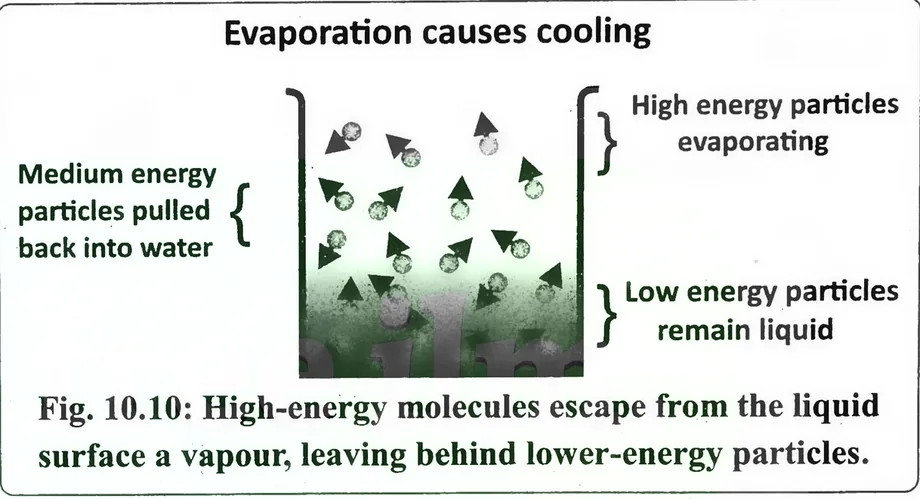
- During evaporation, the molecules that evaporate take away heat from the remaining liquid. This process cools the liquid down because the higher-energy molecules leave, leaving behind cooler molecules.
- For example, when we sweat, the sweat on our skin evaporates, taking heat away from our body and making us feel cooler.
- Similarly, wet clothes dry faster on a hot day because water evaporates quickly, cooling the clothes as it evaporates.
- This cooling effect due to evaporation is important in everyday life and in nature, helping to regulate temperatures and keep things cool (Fig. 10.10).
Brain Teaser
Q. If evaporation produces cooling, why does not boiling water feel cold?
Ans. While evaporation causes cooling by allowing high-energy particles to escape from the surface, boiling is a different process that requires a continuous supply of external heat. To boil water, it must be heated to its boiling point (100°C), meaning the liquid absorbs a large amount of thermal energy. Because the entire body of water is at a very high temperature, it feels hot despite the phase change occurring.
1. Refrigeration without Chlorofluorocarbons (CFCs)
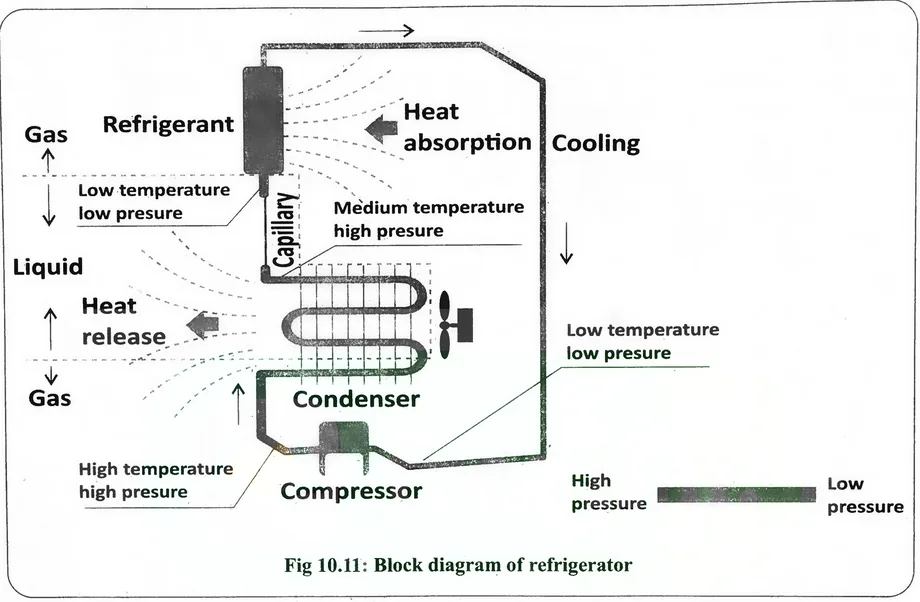
- In modern refrigeration systems, the cooling effect caused by evaporation plays an important role in lowering temperatures without relying on harmful CFCs (chlorofluorocarbons).
- These systems use environmentally friendly refrigerants that evaporate at low temperatures inside the cooling coils.
- As the refrigerant evaporates, it absorbs a large amount of heat from the surrounding area (such as inside a refrigerator), causing the temperature to drop.
- This absorbed heat is then carried away as the vapour is compressed and condensed back into a liquid outside the cooling compartment (Fig. 10.11).
- This cycle of evaporation and condensation enables continuous cooling, while avoiding the environmental damage once caused by ozone-depleting CFCs.
2. Difference between evaporation and boiling
Properties | Evaporation | Boiling
--- | --- | ---
Occur | At the surface of liquid | Throughout the liquid
Temperature | At any temperature | Only at boiling point of liquid
Energy source | Uses surrounding energy | Uses continuous external heat source
Rate/speed | Generally slower and depends on many factors | Fast process (after reaching boiling point)
Process Completion Time | It takes longer to be completed | It is quick process than evaporation
Effect of pressure | Less effected by external pressure | Highly effected by external pressure
Formation of Bubble | No bubble formation | Bubbles are formed throughout the liquid and rise from the surface
Dependence on surface area | Depends on surface area | Does not depend on surface area
Effect on temperature of surrounding | Causes cooling in surrounding | Increases temperature of surrounding
Latent Heat
Definition "Latent heat is the heat energy required to change the state of a substance without changing its temperature."
Importance
This heat is used to break or form bonds between particles instead of increasing their movement.
1. Latent Heat of Fusion
Definition "Latent heat of fusion is the heat energy required to convert 1 kg of a solid into a liquid at its melting point while keeping the temperature constant."
a. Explanation
- When a solid melts into a liquid, it absorbs heat without rise in temperature.
- This heat is used to break the strong bonds between solid particles, allowing them to move more freely as a liquid.
- The temperature remains constant until the entire solid has melted.
- The latent heat of fusion is calculated using the formula:
b. Formula
Q = m Lf ...................(10.5)
Where
Lf = Latent heat of fusion
Q = Heat energy
m = Mass of the substance
c. Example
Ice at 0 °C absorbs heat but remains at 0 °C until it completely melts into water. The latent heat of fusion of ice is 3.36 × 10⁵ J kg⁻¹, meaning 3.36 × 10⁵ joules of heat is needed to melt 1 kg of ice into water at 0 °C.
d. Experiment 1
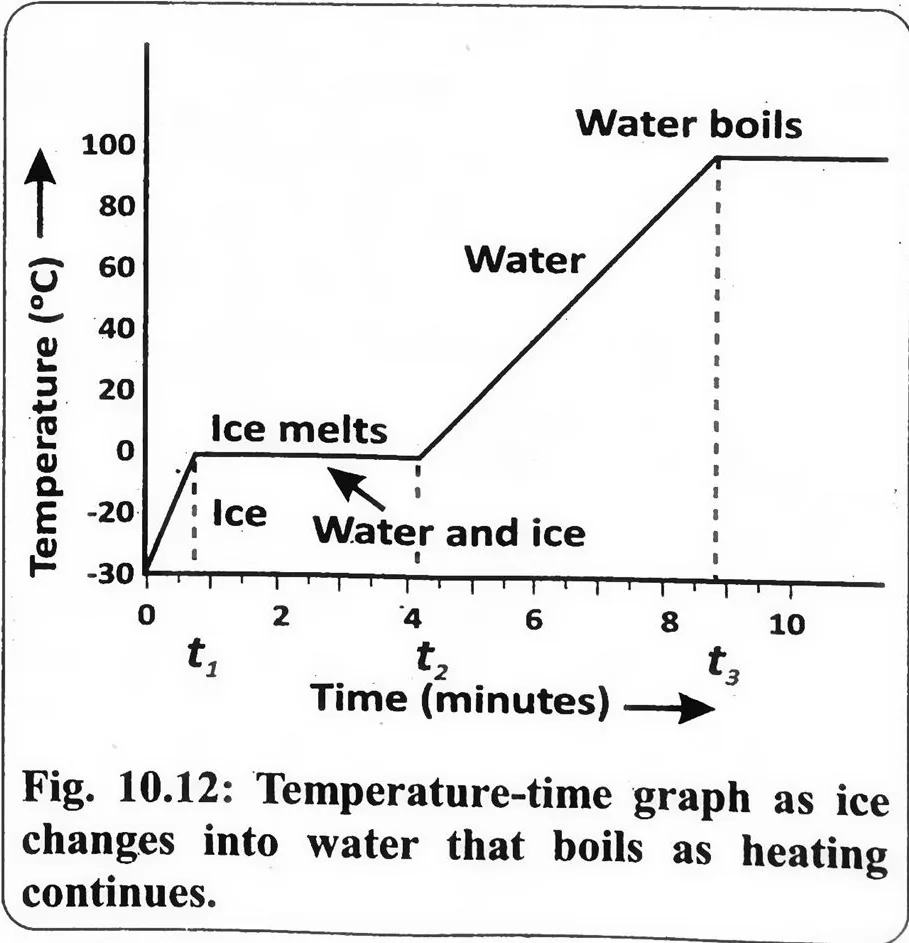
- This involves placing small ice pieces in a beaker over a stand.
- Suspending a thermometer to measure temperature.
- Heating the beaker causes the ice to melt, keeping the mixture at 0 °C until all ice melts.
- Note the time taken for complete melting.
- Further heating causes water temperature to rise from 0 °C to 100 °C.
- Record the time for this increase.
- Plot a temperature-time graph (Fig. 10.12) and calculate the latent heat of fusion of ice using collected data.
Q = m Lf ⇒ Lf = Q/m
Here
Q = c m ΔT
= mc₀(T₂ - T₁)
2. Latent Heat of Vaporization
Definition "Latent heat of vaporization is the heat energy needed to change 1 kg of a liquid into gas at its boiling point without changing the temperature."
a. Explanation
- When a liquid changes into gas, it absorbs heat, but its temperature remains constant until the entire liquid has evaporated.
- This heat is used to break the bonds between liquid molecules, allowing them to escape as gas.
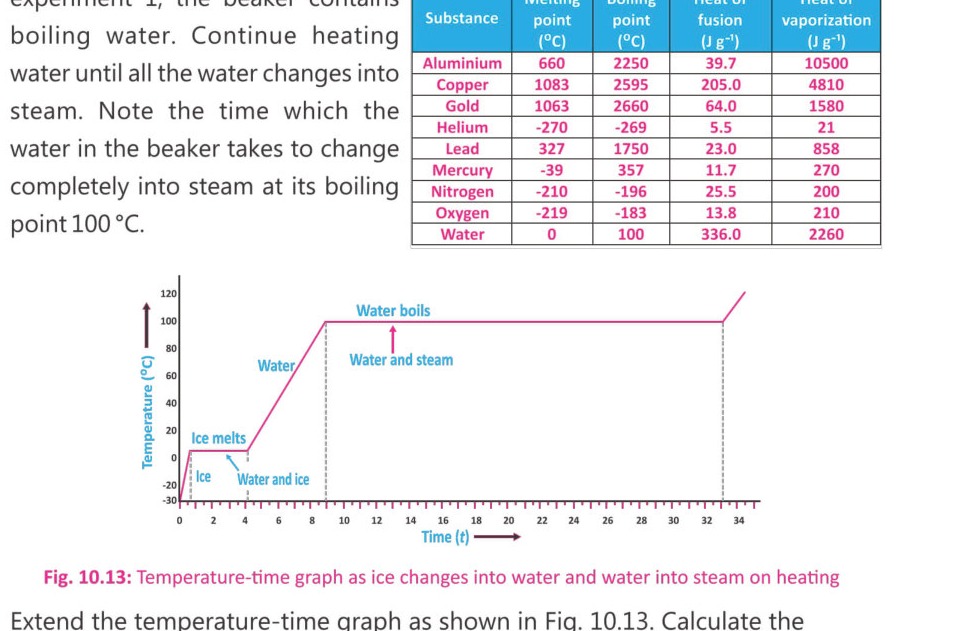
- The latent heat of vaporization of water is 2.26 × 10⁶ J kg⁻¹. This means 2.26 x 10⁶ J of heat energy is needed to convert 1 kg of water into steam at 100 °C.
b. Formula
The latent heat of vaporization is expressed as:
Q = m Lᵥ .....................(10.6)
Where Lᵥ is Latent heat of vaporization, Q is heat energy and m is the mass of the substance.
- Table 10.2 shows the melting point, boiling point, latent heat of fusion, and latent heat of vaporization of some common substances.
c. Experiment 2
- Take boiling water in a beaker.
- Continue heating water until all the water changes into steam note down temperature.
- Note the time which the water in the beaker takes to change completely into steam at its boiling point 100 °C Extend the temperature-time graph as shown in Fig. 10.13. Calculate the latent heat vaporization by collected data using formula.
Lᵥ = Q/m
Here
Q = mc₀ ΔT
ΔT = T₂ - T₁
Superconductivity
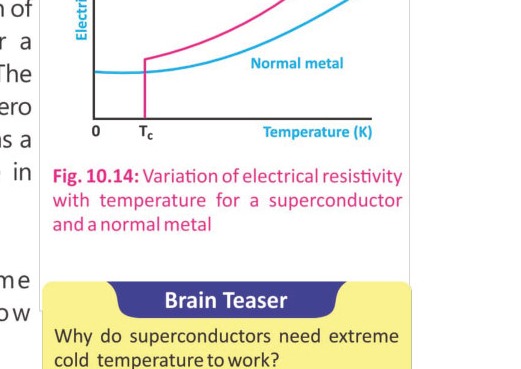
- Superconductivity is a special property of some materials where they have zero electrical resistance when cooled below a certain temperature, called the critical temperature.
- In this state, electricity flows without any energy loss, making superconductors very efficient.
1. Explanation
Since there are no collisions, electric current flows without facing any resistance as superconductors have zero electrical resistance. Figure 10.14 shows the variation of electrical resistivity with temperature for a superconductor and a normal metal. The resistivity of a superconductor drops to zero below the critical temperature (Tc), whereas a normal metal shows a gradual decrease in resistivity.
2. Materials That Show Superconductivity
Some metals and ceramics become superconductors at extremely low temperatures.
a. Mercury – Becomes superconducting below 4.2 K.
b. Lead – Becomes superconducting below 7.2 K.
c. High-temperature superconductors (ceramics) work at higher temperatures, such as 135 K.
3. Uses of Superconductors
Superconductors are used in advanced technologies, including:
a. MRI Machines: To generate strong magnetic fields for medical imaging.
b. Maglev Trains: Use of superconductors to float the train above tracks, reducing friction.
c. Particle Accelerators: Help scientists study fundamental particles. Superconductors are important for future technologies, making electrical systems more efficient and powerful.
Brain Teaser
Q. Why do superconductors need extreme cold temperature to work?
Ans. Superconductors only exhibit property of zero electrical resistance when they are cooled below a specific "critical temperature" (Tc). At these extremely low temperatures, often near absolute zero, the material undergoes a change where electricity can flow without any energy loss. If the temperature rises above this critical point, the material loses its superconducting ability and behaves like a normal metal with resistance.
More figures from this unit