 StudentAid
Reaction Kinetics — Long Questions
10th Class Chemistry · Unit 17: Reaction Kinetics
Key point Reaction Kinetics
Reaction kinetics
It is branch of chemistry that deals with the rates of chemical reactions and the factors that affect rates of reactions.
Explanation Rate of reaction is the speed at which the reaction takes place. Chemical reactions are useful only when they occur at reasonable rate. The rates at which chemical reactions proceeds are studied in reaction kinetics. The factors that govern the rate of reaction are also studied in reaction kinetics. The reactions that occur at the molecular level are also part of reaction kinetics.
Key points Collision Theory of Reaction Rate | The Number of Particles Per Unit Volume | The Frequency of Collisions
Collision theory of reaction rate
Collision theory states that a reaction takes place only when the participating particles (atoms, molecules or ions) collided with one another.
It has been observed that a very small fraction of collisions lead to the formation of products. In the majority of collisions, the reactant particles simply bounce back without any change.
Effective collisions Collisions which lead to reaction are called effective collisions or successive collisions.
Factors affecting the number of effective collisions
The rate of a reaction depends upon the number of effective collisions which, in turn, depends upon the factors like number of particles per unit volume and frequency of collisions etc.
1. The number of particles per unit volume
The larger the number of particles per unit volume, larger is the possibility of effective collisions. In other words, higher the concentration of the reactants, more the number of molecules and hence more will be the number of collisions between them.
2. The frequency of collisions
A greater number of collisions per second will also result in the increase in the number of effective collisions.
Temperature At higher temperature the velocities of the molecules increase resulting in the increase in the frequency of collisions. This increase in the frequency of collisions will also increase the number of successful collisions.
Key points The Kinetic Energy of the Particles | Activation Energy
Factors affecting the number of effective collision: The rate of reaction depends upon the number of effective collisions, which in turn depends upon the factors like kinetic energy of the particles and activation energy etc.
1. The kinetic energy of particles
- The kinetic theory of particles says that all matter is composed of tiny constant moving particles.
- The motion of particles is due to kinetic energy they possess. As the temperature increases, the kinetic energy of the particles also increases. As a result, the particles start moving fast leading to more vigorous motion.
- The fast moving particles will have more chances to collide with each other.
- Effective collisions are increased in this way. Hence rate of reaction is also increased.
2. Activation energy
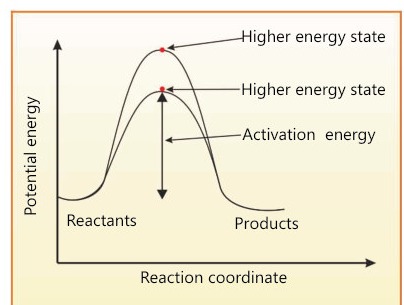
According to collision theory, the colliding particles will lead to effective collisions only when they possess sufficient energy to break the bonds present in the reactant molecules. This minimum energy required to start a chemical reaction is called its activation energy.
Explanation
- Generally, at a particular temperature, most of the molecules of the reactant possess average energy.
- A fraction of total molecules will, however have more than the average energy.
- Particles will react only when average energy of this small fraction of molecules exceeds the energy needed to activate molecules so that they can undergo a chemical reaction.
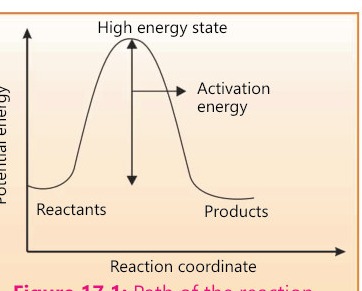
- When the reactant particles come close to each other at the time of collision, they slow down and the kinetic energy they possess, is converted to increase their potential energy. This process can be understood with the help of a graph drawn between the path of reaction and the potential energy of the system as shown in figure 17.1.
- When the reactant particles possessing activation energy collide to form high energy state with the corresponding increase in the potential energy of the system. After this stage the reactants are converted into the stable products and the potential energy of the system falls down.
- The information provided by the energy of activation is very important in understanding the mechanism of the reaction.
Key points Change in Mass during a Chemical Reaction | Formation of a Gas During Chemical Reaction
Change in mass during a chemical reaction
- Law of conservation of mass: The total mass during a chemical reaction always remains the same. This is the requirement of the law of conservation of mass which is always obeyed. However, some reactions may appear to proceed with a change in mass which can usually be explained because a reactant or a product is a gas in such reactions.
- Evolution and absorption of gases: If a reaction is carried out in an open container where gases can escape or enter, the apparent mass change can occur if a gas is either absorbed or evolved.
Example If a gas is evolved, we shall observe a decrease in mass and if a gas is absorbed, the apparent mass will increase.
Reaction with increase in mass: If a ribbon of magnesium is burnt in an open crucible, the mass of the product (MgO) formed will be greater than the reactant (Mg). This increase in mass has occurred due to the reaction of magnesium with oxygen present in air. However, if the two reactants (Mg and O2) are allowed to react in a closed container, the total mass will remain the same before and after the reaction.
Formation of a gas during chemical reaction
Reaction with loss in mass: If a reaction is performed between marble chips and dilute hydrochloric acid in an open container, the mass of products will apparently be less than that of reactants.
This apparent decrease in mass is due to evolution of CO2 gas during the reaction which escapes into the atmosphere.
CaCO3(s) + 2HCl(aq) —→CaCl2(aq) + H2O(l) + CO2(g)
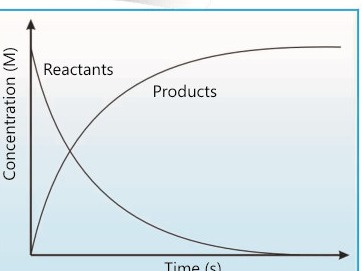
Concentration – time graph When a reaction moves ahead the concentrations of the reactants decrease until all the reactants are used up. At the same time, the concentrations of the products increase and reach the maximum value at the end of the reaction. This is shown in a graph in figure 17.2.
Key point Change in Temperature during a Chemical Reaction
Change in temperature during a chemical reaction
Chemical reactions are quite often accompanied by the changes in the temperature indicating whether they are exothermic or endothermic.
1. Exothermic reactions
In exothermic reactions heat energy is released which is absorbed by the surrounding causing their temperature to increase.
Example When quick lime (CaO) reacts with water, slaked lime Ca(OH)2 is formed and a lot of heat energy is released.
CaO(s) + H2O(l) —→ Ca(OH)2(s)
2. Endothermic reactions
In endothermic reactions heat energy is absorbed causing the surrounding to cool down.
Example When ammonium chloride or ammonium nitrate is dissolved in water, heat energy is absorbed causing the container to cool down.
Effect of increase in temperature: Increasing the temperature of the reaction increases its rate.
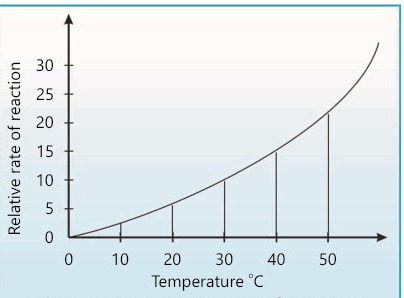
- For many reactions, the rate doubles with every 10°C rise in temperature.
- Cooking food: Cooking food uses high temperature to speed up chemical reactions that break down the components of food making it edible.
Key point List of Factors Affecting the Rates of Reactions
List of factors affecting the rates of reactions
According to the collision theory all those factors which change the number of successful collisions per second affect the rates of chemical reactions.
Some of the important factors are in the following:
(i) Effect of Concentrations of the Reactants
(ii) Reactants present in gas phase
(iii)Effect of Surface Area of Solids
(iv)Effect of Temperature
(v) Effect of Catalyst
(vi)Enzymes as Catalysts
Key point Effect of Concentrations of the Reactants
Effect of concentrations of the reactants
In order for the reaction to occur, the reactants must come in contact with each other. For this reason, the reactions are most often carried out in one phase.
Example In liquid solutions or in gas phase.
Explanation
- When the reactants are present in the same phase, their particles are able to meet on the molecular level and thus are able to collide with each other easily.
- The higher the number of particles of the reactants per unit volume, higher will be the chances of effective collisions and hence higher will be the rate of reaction.
- An increase or decrease in concentrations of the reactants will result in increase or decrease in the rate of reaction respectively.
Examples
(i) Combustion of coal: Combustion of coal in air (21% oxygen) proceeds relatively slowly as compared to the reaction in pure oxygen.
(ii) Limestone and HCℓ: Limestone reacts with different concentrations of hydrochloric acid at different rates.
Volume – time graph
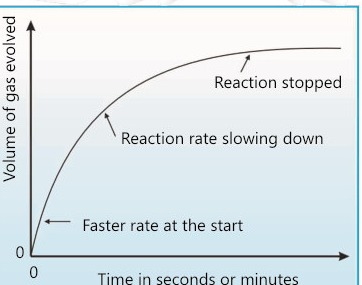
The change in the rate of reaction is then seen when a graph is drawn between the time in seconds or minutes against the volume of gas evolved as shown in figure 17.4.
Graph in the form of a curve
The graph obtained is in the form of a curve. We can measure the rate of reaction during a time interval by drawing a tangent on this curve. The results show that the reaction starts with a very fast rate which then progressively slows down as the concentration of hydrochloric acid decreases. After a while the reaction stops because the whole of hydrochloric acid has been utilized.
Curves A and B (At different concentrations of HCℓ)
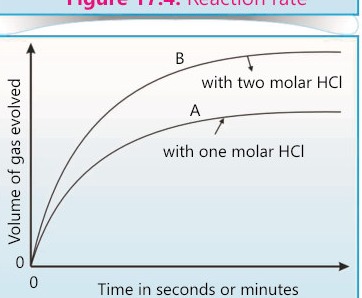
The two curves A and B shown in figure 17.5 represent two separate experiments done with one and two molar concentrations of HCℓ respectively.
Conclusion
- The greater the concentration, the steeper is the curve at the start of the experiment which means faster rate of reaction.
- The more concentrated is the acid, the more are the chances of effective collisions.
Key point Experiment to show the Effect of Increase in Concentration of Reactant on the Rate of Reaction
Experiment to show the effect of increase in concentration of reactant on the rate of reaction
An experiment can be performed to show the increase in the rate of reaction with the increase in the concentration of hydrochloric acid.
Working
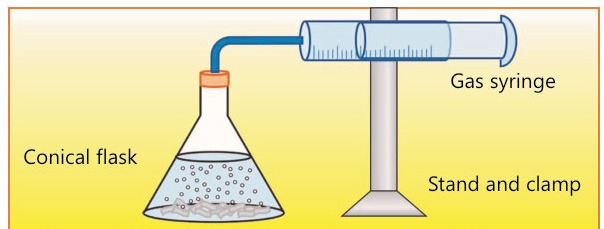
Take a flat-bottomed conical flask fitted with a delivery tube which is connected to a syringe as shown in the figure 17.3.
- The flask contains granules of lime stone taken in excess and a fixed volume of one molar hydrochloric acid.
- When reaction starts, carbon dioxide gas is generated which is collected in the syringe by the following reaction.
CaCO3(s) + 2HCℓ(l) —→ CaCℓ2(aq) + H2O(l) + CO2(g)
- The scale present on the syringe directly measures the volume of carbon dioxide gas evolved.
- It is essential to keep all the variables constant in this experiment.
Example The volume of one molar hydrochloric acid, the temperature at which the experiment is being carried out, the mass and size of lime stone granules, and the rate of stirring.
- The reaction is followed by measuring the volume of carbon dioxide gas evolved.
- The same experiment is then repeated taking the same volume of two molar hydrochloric acid. It results in increases in value of more carbon dioxide produced.
Result
The experiment shows that by increasing the concentration of HCℓ from 1M to 2M the rate of reaction is also doubled. It is experimentally shown by the increase in evolution of carbon dioxide.
Key points Reactants Present in Gas Phase | Effect of Surface Area of Solids
1. Reactants present in gas phase
If reactants in a reaction are present in gas phase, their concentrations can be changed by changing their pressure.
Example The rate of reaction between hydrogen and chlorine can be doubled if the pressure of chlorine gas is doubled provided the other component hydrogen is present in excess.
2. Effect of surface area of solids
Reactions involving solids take place on their surfaces and the rates of their reactions depend to a great extent on the area of the surface contact between them.
- The larger the surface area of the solids, the more is possibility of their particles to come in contact with each other and the higher is the rate of reaction.
- Finely divided solids, because of the greater surface area available, react more rapidly than do large pieces of the same substances.
Examples Aluminium foil reacts slowly with warm sodium hydroxide but in finely divided state it reacts rapidly with even cold aqueous solution of sodium hydroxide evolving hydrogen gas.
2Aℓ(s) + 2NaOH(aq) + 6H2O(l) —→ 2NaAℓ(OH)4(aq) + 3H2(g)
Similarly, a large piece of wood will burn slowly while small pieces burn rapidly.
Key points Effect of Temperature | Increase in Successful Collisions
Effect of temperature
It is an everyday observation that the rates of chemical reactions increase with increase in temperature.
(i) Cooking of food: Food cooks faster at higher temperatures than at lower ones.
(ii) Oxidation of iron: Similarly, the oxidation of iron is very slow at room temperature but proceeds very fast at high temperature. In many cases the rate of reaction is nearly doubled when the temperature is increased by 10 °C. The graph shown in the figure 17.6 explains this rapid increase in the rate of reaction with the rise in temperature.
Increase in successful collisions
According to the collision theory:
- The rate of reaction depends upon the frequency of successful collisions between reactant molecules.
- As the temperature of a reaction is increased, the kinetic energy of the participating reacting particles also increases. This, in turn increases the velocities of their movements. As a result, the collisions which lead to occurrence of reactions also increase, enhancing the rate of reaction.
Key points Catalyst | Effect of Catalyst
Catalyst
A catalyst is a substance which alters the rate of the reaction but it is not consumed during the course of reaction.
Effect of catalyst
The role of catalyst is to alter the way the reaction takes place by substantially lowering its activation energy. When the activation energy is lowered, more and more particles of the reactants will start forming the high energy state and the rate of reaction will increase.
Example Platinum metal serves as a catalyst during the addition of hydrogen in ethene. Both hydrogen and ethene are known to adsorb on the surface of platinum metal and the bonds, present in them, get weakened. Thus, the surface of metal helps the reactant molecule to react together. This is shown in the figure 17.7.
Conclusion In the presence of a catalyst, the activation energy is sufficiently lowered allowing more and more molecules to react together.
Key points Enzymes as Catalysts | Catalytic Action of Enzyme
Enzymes as catalysts
Enzymes are biological catalysts. These are basically proteins which help to speed up specific chemical reactions taking place in our body.
Catalytic action of enzyme
They react with the reactant molecules using the active sites present in them. Once bound with the reactant molecule the particular bonds in the reactant molecule are sufficiently weakened for the reaction to take place. The product formed then dissociates itself from enzyme which is then free to bind another reactant molecule.
Specificity of enzymes The active sites present in enzymes are very specific such that a particular enzyme can catalyze a specific reaction only. Lipase enzyme only decompose lipids and urea is catalyzed by urease only.
Key point Importance of Chemical Kinetics in Food Industry
Importance of chemical kinetics in food industry
The study of reaction rates and the factors which affect these rates play an important role in food industry.
(i) Rate of reactions in minimizing the food spoilage: The rates of chemical reactions which are involved during food ripening and food spoilage are studied for different types of fruits and vegetables. The information thus obtained is used to minimize the losses due to spoilage.
(ii) Determination of optimum conditions: Food scientists can determine the optimum conditions for harvesting, storage and transportation of food products by studying the rates of enzymatic reactions, oxidation or microbial growth.
(iii) Prediction of food ripening and harvesting: Fruits and vegetables ripen owing to the reactions which involve enzymes. These reactions convert starches into sugars, soften tissues and develop characteristics flavour and colours. With the help of rates of these enzymatic reactions, farmers can predict when the product will reach at its peak quality and ready for harvesting.
Example The rate of production of ethene during ripening can be monitored to determine the best time to harvest the fruits.
(iv) Enzymes in food cause of spoilage: Some enzymes which are naturally present in foods can spoil the foods which then undergo changes in texture, flavour and nutritional value. Again understanding the rates of these enzymatic reactions will allow us to plan how to stop this spoilage.
Example If a fruit is known to degrade rapidly during transportation or storage owing to high temperature, refrigeration can be employed to prevent rapid spoilage.