StudentAid
Unit 19: Nitrogen and Sulphur — Long Questions
10th Class Chemistry · Unit 19: Nitrogen and Sulphur
Key point Ammonia
Ammonia
Ammonia gas is one of the most important chemicals produced globally for industrial use because:
(i) Use in fertilizers: Urea and other ammonium salts are extensively used as fertilizers. About 80% of the ammonia produced in the industries world-wide are used to produce these fertilizers.
(ii) Use in plastics and pharmaceuticals: Apart from this, ammonia is also used in the production of plastics and pharmaceuticals.
(iii) As a refrigerant: It is also used as a refrigerant.
Key point Haber Process
Haber process
Ammonia is produced industrially by Haber process discovered by a German Chemist F.J. Haber in 1913.
Process
In this process, a mixture of nitrogen and hydrogen, in the ratio of 1:3 by volume is heated at 400-500°C under 200 atmospheric pressure and in the presence of catalyst Fe/Al₂O₃ to give ammonia.
Chemical reaction
N₂(g) + 3H₂(g) →[400-500°C, Catalyst] 2NH₃(g)
The equilibrium mixture obtained in the above reaction contains 35% ammonia by volume
Liquefaction of ammonia This mixture is cooled by refrigeration coils where ammonia gas changes to liquid ammonia at -33.4°C and is removed from the mixture.
Recycling of hydrogen and nitrogen: The other components of the mixture, hydrogen and nitrogen gases, are then recycled back into the reaction chamber fig. 19.1
Key point Sources of Nitrogen
Sources of nitrogen
One of the raw materials used for the production of ammonia is nitrogen gas and it is obtained by the fractional distillation of air.
Fractional Distillation
(a) Liquid air formation
For the fractional distillation of air to get nitrogen, first of all carbon dioxide present in air is removed.
- The air is subjected to about 200 atmospheric pressure. This compressed air is then cooled and allowed to pass through a spiral jet.
- While escaping through this jet, the air suffers sudden expansion and its temperature is decreased. This process of compression and expansion is repeated again and again till the air is liquified.
(b) Distillation of liquid air
The liquid air is then fractionally distilled. Since the boiling point of nitrogen is less than oxygen, nitrogen evaporates first at -196°C leaving behind the oxygen. The separated nitrogen is reliquified and stored in specially designed cylinders.
Key point Source of Hydrogen
Source of hydrogen
By heating methane in limited oxygen: The second raw material of ammonia manufacturing, hydrogen, is produced by heating methane in the limited amount of oxygen that is not enough to completely oxidize methane to carbon dioxide and water. With less oxygen available, the reaction products contain primarily hydrogen and carbon monoxide and a relatively small amount of carbon dioxide.
Conversion of CO to CO₂: The carbon monoxide obtained is then reacted with water to form carbon dioxide and more hydrogen gas.
Chemical reactions
CH₄(g) + H₂O(g) →CO(g) + 3H₂(g)
CO(g) + H₂O(g) →CO₂(g) + H₂(g)
Key points Sulphuric Acid | Contact Process
Sulphuric acid
Sulphuric acid as king of chemicals
Sulphuric acid is one of the most important chemical compounds known. It is very commonly used in the laboratory and almost every manufacturing process makes use of this acid directly or indirectly at some stage. Therefore, it is called king of chemicals.
Contact process
Sulphuric acid is prepared industrially by the contact process by an English Chemist P. Philipis in 1831
Principle
This process is based on the catalytic oxidation of SO₂ to SO₃ in the presence of atmospheric oxygen. SO₃ absorbed in concentrated H₂SO₄ and oleum (H₂S₂O₇) formed can be converted into sulphuric acid by mixing adequate quantity of water
Process It involves the following steps:
(i) Preparation of sulphur dioxide gas
Sulphur dioxide gas is produced either by burning elemental sulphur in air or roasting a sulphur ore, iron pyrite, in excess of air.
S(s) + O₂(g) →SO₂(g)
4FeS₂(s) + 11O₂(g) →2Fe₂O₃(s) + 8SO₂(g)
Purification of sulphur dioxide
Sulphur dioxide produced above is then passed through purifying chambers and sprayed with steam. This process removes dust impurities as well as arsenic compounds present in the gas.
Removal of arsenic compound This step is important because arsenic compounds poison the catalyst used later on.
Drying of gases The moist gases (SO₂ and O₂) are then dried by passing through a drying tower in which concentrated sulphuric acid is being sprayed. It acts as dehydrating agent.
Source of oxygen Oxygen used in this reaction is obtained by the fractional distillation of air.
(ii) Oxidation of sulphur dioxide
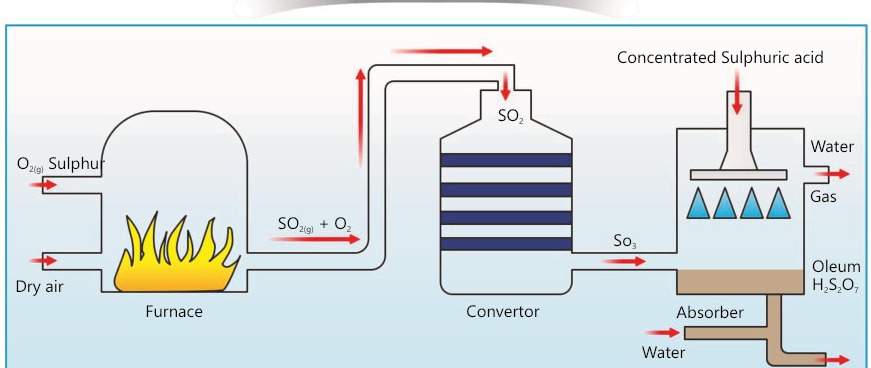
The clean and dry gases (SO₂ and O₂) are then passed over vanadium (V) oxide (vanadium pentaoxide) catalyst at 450°C and 2-3 atmospheric pressure through a contact chamber. Although the reaction is reversible yet under these conditions 98% SO₂ gas is converted to SO₃. Fig. 19.2.
2SO₂(g) + O₂(g) →[V₂O₅, 450°C, 2-3atmosphere] 2SO₃(g)
(iii) Formation of Oleum (Pyro sulphuric acid)
Sulphur trioxide gas formed in the contact chamber is then absorbed into 98% sulphuric acid to give oleum.
SO₃(g) + H₂SO₄(l) →2H₂S₂O₇(l)
oleum
Flow sheet diagram
[Fig 19.2: Contact process]
(iv) Production of sulphuric acid
The oleum is then mixed with an appropriate amount of water to produce sulphuric acid with desired concentration.
H₂S₂O₇(l) + H₂O(l) →H₂SO₄(l)
Benefits of contact process
- The acid produced from this method is extremely pure.
- Any concentration of H₂SO₄ can be obtained by this method.
Key points Oxides | Types of Oxides
Oxides
Binary compounds of elements with oxygen are called oxides. Oxygen shows an oxidation state of -2 in these oxides.
Metallic and non-metallic oxides
- Metal oxides are commonly basic and amphoteric while non-metallic oxides are acidic in nature.
- Both basic and acidic oxides are formed when metals and non-metals are heated respectively in the presence of air or oxygen.
- Metal oxides are typically ionic compounds in which electrons are transferred from metals to oxygen.
- Non-metal oxides are covalent compounds where electrons are shared between non-metals and oxygen atom.
Types of oxides
(i) Basic oxides
(ii) Acidic oxides
(iii) Neutral oxides
(iv) Amphoteric oxides
(i) Basic Oxides: Oxygen reacts with metals to give oxides which are called basic oxides.
Chemical properties
i. When basic oxides dissolved in water produce hydroxides.
ii. They change red litmus blue.
iii. When treated with acids they give salts.
iv. Mostly metallic oxides are ionic in nature.
Oxide of sodium
4Na(s) + O₂(g) →2Na₂O(s)
Na₂O(s) + H₂O(l) →2NaOH(aq)
Oxide of calcium
2Ca(s) + O₂(g) →2CaO(s)
CaO(s) + 2HCℓ(aq) →CaCℓ₂(aq) + H₂O(l)
Oxide of copper
2Cu(s) + O₂(g) →2CuO(s)
CuO(s) + 2HCℓ(aq) →CuCℓ₂(aq) + H₂O(l)
(ii) Acidic Oxides: Oxygen combines with non-metals (S, C, N) to give acidic oxides.
Chemical properties
(i) These oxides react with water to give acids which turn blue litmus red.
S(s) + O₂(g) →SO₂(g)
Sulphur dioxide
SO₂(g) + H₂O(l) →H₂SO₃(aq)
Sulphurous Acid
C(s) + O₂(g) →CO₂(g)
CO₂(g) + H₂O(l) →H₂CO₃(aq)
Carbonic Acid
(ii) Acidic oxides react with bases to give salts.
SO₂(g) + 2NaOH(aq) →Na₂SO₃ + H₂O
Sodium sulphite
CO₂(g) + Ca(OH)₂(aq) →CaCO₃(s) + H₂O(l)
Key points Neutral Oxides | Amphoteric Oxide
(i) Neutral oxides
Neutral oxides are those oxides which on contact with water produce neither an acid nor a base
Properties Their aqueous solutions have no action on blue or red litmus paper
Examples Examples are carbon monoxide (CO), nitric oxide (NO) and nitrous oxide (N₂O).
(ii) Amphoteric oxides
Amphoteric oxides are usually formed when oxygen reacts with less electropositive metals. These oxides behave both as an acid and a base.
2Zn(s) + O₂(g) →2ZnO(s)
4Aℓ(s) + 3O₂(g) →2Aℓ₂O₃(s)
Examples Zinc oxide (ZnO), Aluminium oxide Aℓ₂O₃ and H₂O
(i) Properties as bases: Zinc and aluminium oxides behave as bases in the presence of an acid.
ZnO(s) + 2HCℓ(aq) →ZnCℓ₂(aq) + H₂O(l)
Aℓ₂O₃(s) + 6HCℓ(aq) →2AℓCℓ₃(aq) + 3H₂O(l)
(ii) Properties as acids
Zinc and aluminum oxides behave as acids in the presence of an alkali.
ZnO(s) + 2NaOH(aq) + H₂O(l) →Na₂Zn(OH)₄(aq)
Sodium Zincate
Aℓ₂O₃(s) + 2NaOH(aq) + 3H₂O(l) →2NaAℓ(OH)₄(aq)
Sodium aluminate
(iii) No action on litmus paper
These oxides are insoluble in water and have no action on litmus paper
Key points Metals | General Properties of Metals
Metals
Nearly three fourth elements shown in the periodic table are called metals. Metals show remarkable properties.
General properties of metals
(i) Mostly metals occur in earth crust in the form of their oxides, hydroxides, carbonates and sulphides, etc.
(ii) Metals have a tendency to lose electrons and form cations.
(iii)Usually they form ionic bonds with other elements.
(iv) They are good conductors of heat and electricity.
1. Reactions of metals with cold water
Most of the elements present in the first and second group of the periodic table react vigorously with cold water producing their respective hydroxides and hydrogen gas.
2Na(s) + 2H₂O(ℓ) → 2NaOH(aq) + H₂(g)
2K(s) + 2H₂O(ℓ) → 2KOH(aq) + H₂(g)
Magnesium, however, reacts with cold water slowly giving magnesium hydroxide and hydrogen gas.
Mg(s) + 2H₂O(ℓ) → Mg(OH)₂(s) + H₂(g)
2. Reactions of metals with steam
The more reactive the metal, the more readily it reacts with steam. Reactive metals like lithium, sodium, potassium and calcium react violently with steam and the reaction can be dangerous.
Beryllium and aluminium react with steam at high temperatures (around 700°C) to give their respective oxides and hydrogen.
Be(s) + H₂O(g) → BeO(s) + H₂(g)ₑ
Magnesium, iron and Zn have a moderate reaction with steam producing their respective oxides and hydrogen gas.
Mg(s) + H₂O(g) → MgO(s) + H₂(g)
Key point Difference between First and Second Group Metals Based on their Reactions with Oxygen and Water
First group metals | Second group metals
1. Reaction with oxygen: First group metals react rapidly with oxygen to form oxides sometimes peroxide / superoxides.
4Na(s) + O₂(g) → 2Na₂O(s)
2Na(s) + O₂(g) → Na₂O₂(s)
| 1. Reaction with oxygen: Second group metals react less vigorously with oxygen to form simple oxides.
Ca(s) + O₂(g) → 2CaO(s)
2. Reaction with water: They react vigorously with cold water producing hydroxide and hydrogen gas.
2Na(s) + 2H₂O(ℓ) → 2NaOH(aq) + H₂(g)
2K(s) + 2H₂O(ℓ) → 2KOH(aq) + H₂(g)
| 2. Reaction with water: They react less vigorously, some react slowly with cold water, other with hot water or steam.
Mg(s) + 2H₂O(ℓ) → Mg(OH)₂(s) + H₂(g)
Be(s) + H₂O(g) → BeO(s) + H₂(g)ₑ
Key points Reactions of Metals with Oxygen | Reactions of Metals with Dilute Acids
Reactions of metals with oxygen
Metals react with oxygen to give metal oxides. The ease of reaction and the type of oxide which is formed, depends upon the reactivity of metals and the conditions used.
(i) Sodium burns in air with yellow flame producing both sodium oxide and sodium per oxide.
4Na(s) + O₂(g) → 2Na₂O(s)
2Na(s) + O₂(g) → Na₂O₂(s)
(ii) Magnesium, calcium, strontium, and barium burn in oxygen with colour of the flame characteristic to each metal giving their respective oxides.
Ca(s) + O₂(g) → 2CaO(s)
Characteristic colours of flame
Metal | Colours of flame
Mg | Intense white flame
Ca | White flame with a tinge of red
Sr | Crimson flame
Ba | A pale green flame
Reactions of metals with dilute acids
(i) Group 1 metals: The more reactive the metal the more vigorous is its reaction with dilute acids. Sodium and potassium are very dangerous and react violently with dilute acids, giving their respective salts and hydrogen gas.
2Na(s) + 2HCℓ(aq) → 2NaCℓ(aq) + H₂(g)
(ii) Group 2 metals: All group 2 elements react with dilute acids giving their salts, and hydrogen gas. The reaction generally becomes more vigorous as we move down the group.
Mg(s) + 2HCℓ(aq) → MgCℓ₂(aq) + H₂(g)
Key point Reactivity Series of Metals
Reactivity series of metals
Based on their reactions with water and acids, the metals can be arranged in decreasing order of their reactivities. Such an arrangement is called the reactivity series of metals. It is shown in table 19.1
Calcium and above metals in activity series
According to this reactivity series, calcium and metals above it react with cold water to give metal hydroxides and hydrogen gas.
2K + 2H₂O → 2KOH + H₂
2Na + 2H₂O → 2NaOH + H₂
Metals below calcium in reactivity series
The metals below calcium do not react with cold water, instead they react with steam to give metal oxides and hydrogen gas.
Reaction with dilute acids Only metals above hydrogen will be able to liberate H⁺ upon reacting with dilute acids. Unreactive metals below hydrogen do not react with dilute acids.
The more reactive the metal, the more vigorous its reaction will be with dilute acids. Similarly, reactive metals, like potassium and sodium, react with oxygen easily whereas the less reactive metals like silver, copper and iron react with oxygen much more slowly.
Reducing agents The metals at the top of the series are powerful reducing agents since they are easily oxidized.
However, the reducing ability of metals decreases going down the series.
Zn(s) + CuSO₄(aq) → ZnSO₄(aq) + Cu(s)
Key points Role of Oxides of Nitrogen in Spreading Air Pollution
Sources of Oxides of Nitrogen | Effects of Acid Rain
Role of oxides of nitrogen in spreading air pollution
Primary pollutants The primary pollutants in the atmosphere include oxides of nitrogen, sulphur, carbon, and various hydrocarbons etc.
Secondary pollutants The primary pollutants are converted into secondary pollutants through various reactions going on in the atmosphere. The main secondary pollutants are ozone, per oxyacetyl nitrate (PAN), sulphuric acid etc. All these compounds are toxic and their concentration in the atmosphere must be controlled.
Oxides of nitrogen
Oxides of nitrogen which are harmful when present in the atmosphere include NO and NO₂, collectively represented by NOₓ.
Sources of oxides of nitrogen
They are generated in the atmosphere through both natural and man-made sources.
(a) Natural sources: Natural sources for the production of NOₓ include electrical discharges
N₂(g) + O₂(g) →[Electrirc] 2NO(g)
2NO(g) + O₂(g) → 2NO₂(g)
during lightning which can cause atmospheric nitrogen and oxygen to react forming nitric oxide. This nitric oxide is rapidly converted into nitrogen dioxide by oxygen present in air.
(b) Man-made sources
(i) Combustion of fuels
Combustion of fossil fuels in vehicles, various industrial processes and electricity power plants are the main man-made sources which generate NOₓ in the atmosphere.
(ii) Agricultural activities
Apart from these, agricultural activities and fertilizers also contribute to NOₓ emission.
(iii) Heavy traffic
Heavy traffic during morning and evening hours together with industrial processes emit a huge amount of oxides of nitrogen (NOₓ) and most volatile organic compounds (VOCs) in the atmosphere.
(iv) Formation of PAN
Ultraviolet radiation present in sunlight interacts with the oxides of nitrogen and VOCs through a complex series of chemical reactions to produce secondary pollutants like ozone, aldehydes and peroxyacetyl nitrate (PAN) is also part of smog.
(v) Acid rain
Oxides of nitrogen forming acid rain: Oxides of nitrogen are also responsible for the formation of another type of pollutant called acid rain. Especially NO₂ reacts with water and other chemicals presents in air, to produce vapours of nitric acid and nitrous acid.
2NO₂(g) + H₂O(ℓ) → HNO₃(g) + HNO₂(g)
These acidic vapours then mix with water vapours present in air and fall to earth as acid rain.
Oxides of nitrogen as catalyst in acid rain: Oxides of nitrogen (NOₓ) can also act as catalyst to convert, another primary pollutant, sulphur dioxide present in air, to sulphuric acid which is another major component of acid rain.
2SO₂(g) + O₂(g) →[oxides of nitrogen] 2SO₃(g)
SO₃(g) + H₂O(g) → H₂SO₄(g)
Effects of acid rain
Acid rain has a pH less than 5.6. Acid rain is damaging for the ecosystem, it can corrode materials and can lead to respiratory problems.
More figures from this unit